
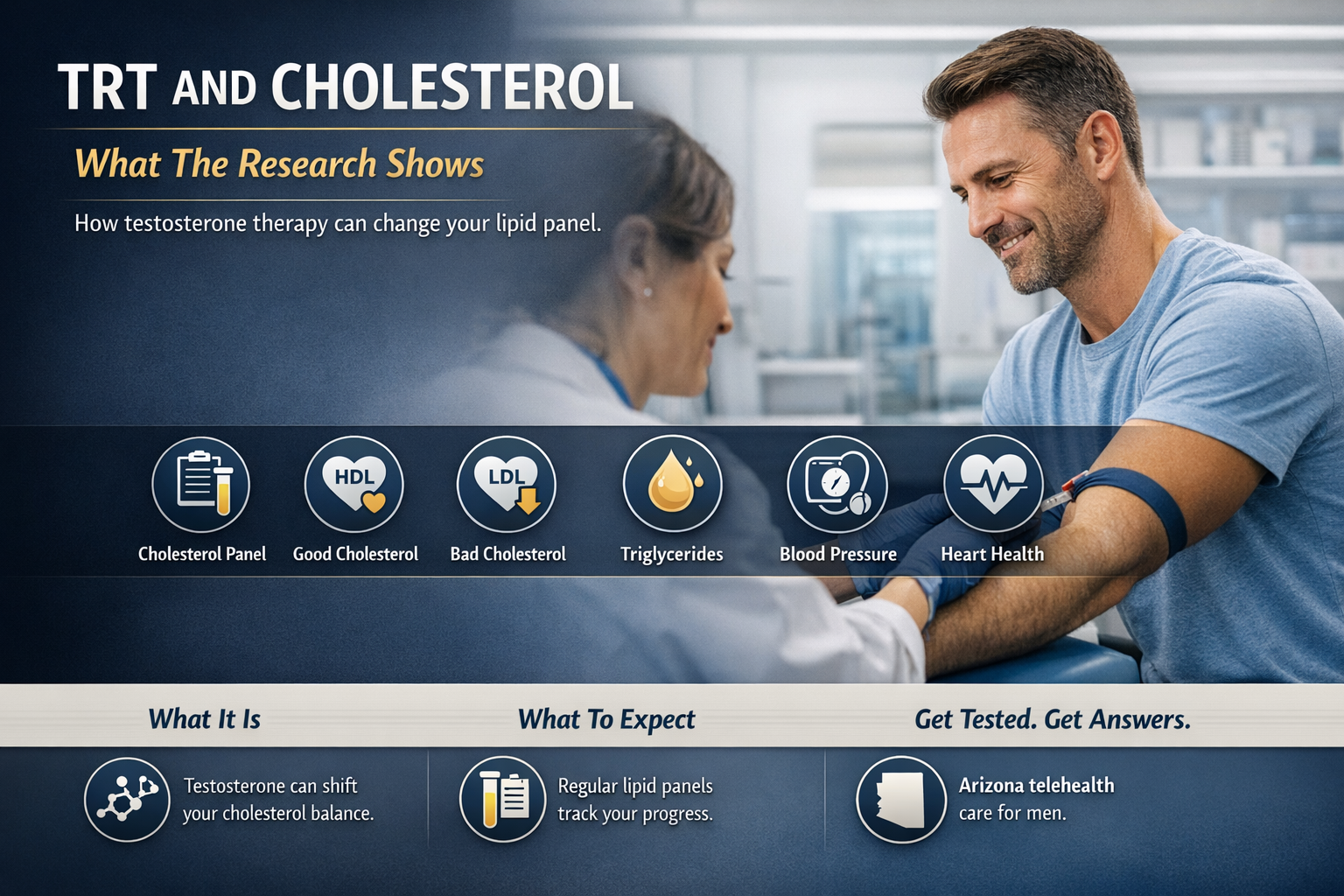
Does TRT Affect Your Cholesterol? What Arizona Men Should Know
If you are researching testosterone replacement therapy in Phoenix, Scottsdale or anywhere else in Arizona, the cholesterol question comes up fast — usually right after the heart-health question. It is a fair concern. Cholesterol is one of the few health markers most men actually know their own numbers for, and nobody wants to fix their energy and libido at the cost of their arteries.
Here is the honest picture: TRT and cholesterol have a real but modest relationship, and the direction of the effect depends heavily on your dose, your delivery method, your starting body composition and what else changes in your life once you feel better. This guide walks through what the research actually shows, which lipid markers move, why HDL gets the most attention, and how a well-run Arizona TRT program monitors all of it.
A quick refresher: what your lipid panel is measuring
When your provider orders a lipid panel, they are looking at four core numbers:
- Total cholesterol — the overall amount of cholesterol circulating in your blood.
- LDL cholesterol — low-density lipoprotein, the "bad" fraction that contributes to arterial plaque.
- HDL cholesterol — high-density lipoprotein, the "good" fraction that helps clear cholesterol from circulation.
- Triglycerides — circulating fat, closely tied to diet, alcohol, body fat and insulin resistance.
These four markers are almost always part of the bloodwork you need before starting TRT, alongside total and free testosterone, estradiol, PSA and a complete blood count. That baseline matters enormously here — without it, there is no way to tell whether a number six months into therapy is a change or just where you have always been.
What the research says about TRT and cholesterol
The evidence is more reassuring than the internet chatter suggests, but it is not uniformly positive.
Across studies in men with genuinely low testosterone, testosterone replacement has been associated with reductions in total cholesterol and LDL cholesterol, with HDL either holding steady or rising modestly. In that same body of work, physiologic dosing — the kind used in legitimate replacement therapy — showed the most favorable pattern, along with improvements in inflammatory markers and blood vessel function.
Other data point the opposite direction on HDL specifically. Some studies have documented meaningful decreases in HDL cholesterol during testosterone therapy, particularly at higher doses and with oral or injectable androgens. This is the single most consistent lipid finding attached to TRT, and it is the one worth understanding.
The overall read from mainstream cardiology is that testosterone's effect on lipids is modest and does not translate cleanly into cardiovascular risk. Large trial data has not shown that men on properly supervised testosterone therapy suffer more major cardiac events than men on placebo. If you want the fuller version of that story, we covered it in depth in our guide to TRT and heart health.
Why HDL drops — and how much it matters
Testosterone increases the activity of an enzyme called hepatic lipase, which speeds up the breakdown of HDL particles. More hepatic lipase activity means lower circulating HDL. That is the mechanism, and it is dose-dependent: the higher the androgen load, the bigger the drop.
This is exactly why anabolic steroid abuse and TRT are not the same conversation. Men running supraphysiologic doses — several times a replacement dose, often stacked with oral compounds — can see HDL fall dramatically. Men on a monitored replacement protocol that keeps total testosterone in the normal adult male range typically see a much smaller shift, and many see none at all.
There is also a nuance worth flagging: HDL is not a simple "more is better" number. What matters is HDL function — how effectively those particles remove cholesterol from tissue — and a modest drop in HDL concentration alongside falling LDL, falling triglycerides and falling visceral fat is a very different clinical picture than an isolated HDL crash with everything else worsening.
Want your cholesterol watched, not guessed at?
Doctor-supervised • Arizona-based • Telehealth available
Get Started — Free Assessment →The indirect effect nobody talks about: body composition
Isolating "what testosterone does to cholesterol" in a lab setting misses most of what happens in real life. Men with untreated low testosterone frequently carry more visceral fat, exercise less, sleep worse and eat worse — and every one of those factors independently worsens a lipid panel.
When testosterone is restored, a lot of that reverses. Visceral fat tends to fall, lean mass tends to rise, training becomes tolerable again, and triglycerides — the marker most sensitive to fat mass and insulin resistance — often drop noticeably. This is the same mechanism we described in our article on low testosterone and stubborn belly fat, and for many men it does more for their lipid panel than any direct hormonal effect.
The corollary is uncomfortable but true: if you start TRT and your habits do not change, your cholesterol probably will not improve much either. Testosterone makes the work possible. It does not do the work.
How delivery method changes the picture
Not all testosterone affects lipids equally:
- Injectable testosterone cypionate or enanthate — the most common approach in Arizona TRT programs. Lipid effects are generally mild at replacement doses, though large weekly boluses that spike well above range can hit HDL harder than smaller, more frequent dosing.
- Transdermal gels and creams — tend to produce the flattest lipid response, since blood levels stay steadier.
- Oral androgens — older 17-alpha-alkylated oral steroids were notorious for tanking HDL and stressing the liver. Modern oral testosterone formulations are a different class of drug, but oral delivery still warrants closer lipid monitoring.
- Pellets — convenient, but levels are harder to fine-tune, which makes overshooting easier.
If your lipid panel is already borderline, dosing frequency becomes a lever your provider can pull. Splitting a weekly dose into two smaller injections keeps peaks lower, which is one reason we discuss how often you take TRT injections with every patient rather than defaulting everyone to the same schedule.
What monitoring should look like on TRT in Arizona
Cholesterol is not the only bloodwork that matters on testosterone therapy, and a clinic that only checks your testosterone level is not monitoring you — it is refilling you.
A reasonable schedule looks like this:
- Baseline, before your first dose: full lipid panel, total and free testosterone, estradiol, CBC with hematocrit, PSA if age-appropriate, metabolic panel.
- Six to twelve weeks in: testosterone and estradiol to confirm dosing; hematocrit, which is the marker most likely to move early. We explain why in our guide to TRT and hematocrit monitoring.
- Six months: repeat lipid panel. This is where you find out whether your numbers actually moved.
- Annually thereafter: lipids, hematocrit, PSA, testosterone, plus blood pressure at every touchpoint.
Blood pressure belongs on that list too, since it interacts with the same cardiovascular risk calculation — a topic we cover separately in whether TRT raises blood pressure.
Practically speaking in Arizona: draws are easy to arrange at Sonora Quest and LabCorp locations throughout Phoenix, Mesa, Scottsdale, Chandler, Gilbert, Tempe and Tucson. Fast for nine to twelve hours if your provider wants an accurate triglyceride reading, and try to keep your draw timing and habits consistent between panels so you are comparing like with like.
What to do if your cholesterol worsens on TRT
If a follow-up panel comes back worse, that is information, not a verdict. Options your provider may consider:
- Lowering the dose or splitting it into more frequent, smaller injections to flatten peaks.
- Switching delivery method — for example, moving from injections to a transdermal.
- Reviewing alcohol intake, which drives triglycerides hard and is often the real culprit.
- Adding structured resistance and aerobic training, which raises HDL and lowers triglycerides more reliably than any hormone adjustment.
- Coordinating with your primary care physician or cardiologist about lipid-lowering therapy if your overall cardiovascular risk warrants it.
What should not happen is quietly continuing an unmonitored protocol and hoping for the best. Guideline-based care from the Endocrine Society's clinical practice guideline on testosterone therapy is built around a structured diagnosis and monitoring plan for exactly this reason.
Frequently asked questions
Does TRT raise your bad cholesterol?
Generally no. Most research in men with low testosterone shows LDL cholesterol holding steady or falling modestly on replacement-dose testosterone therapy. The marker more likely to move is HDL, which can decrease somewhat. Large increases in LDL are more associated with supraphysiologic anabolic steroid use than with monitored TRT.
How often should I check my cholesterol on testosterone therapy?
A baseline lipid panel before your first dose, a repeat around six months, and annually after that is a reasonable standard for most men. If your baseline panel is already abnormal or you have other cardiovascular risk factors, your provider may check more frequently and coordinate with your primary care physician.
Can I still take TRT if I have high cholesterol?
In many cases yes, but it is a conversation to have with a licensed provider who reviews your full cardiovascular risk profile, not a decision to make from a blog post. High cholesterol is not an automatic disqualifier the way untreated prostate cancer or an elevated hematocrit can be, but it does mean your monitoring plan should be tighter and your lipid management should be actively addressed alongside therapy.
Start TRT the right way in Arizona
Doctor-supervised • Arizona-based • Telehealth available
Get Started — Free Assessment →The bottom line
TRT can nudge your cholesterol, most often by shaving a few points off HDL. For the large majority of men on a properly dosed, properly monitored protocol, that shift is small, offset by improvements in body composition and triglycerides, and does not appear to translate into higher cardiac risk. The men who get into trouble are the ones running unsupervised high doses without ever pulling a lipid panel.
The fix is not avoiding treatment. It is choosing a provider who tests before starting, tests again after starting, and adjusts when the numbers say to.
Sources
- Cardiovascular Effects of Testosterone Replacement Therapy in Hypogonadal Men: A Systematic Review of Lipid Profiles, Inflammatory Markers, and Vascular Function — National Library of Medicine (PMC)
- Testosterone Replacement Therapy and the Risk of Adverse Cardiovascular Outcomes and Mortality — National Library of Medicine (PMC)
- Testosterone and the Heart — Harvard Health Publishing
- Testosterone Therapy for Hypogonadism Clinical Practice Guideline — Endocrine Society
