
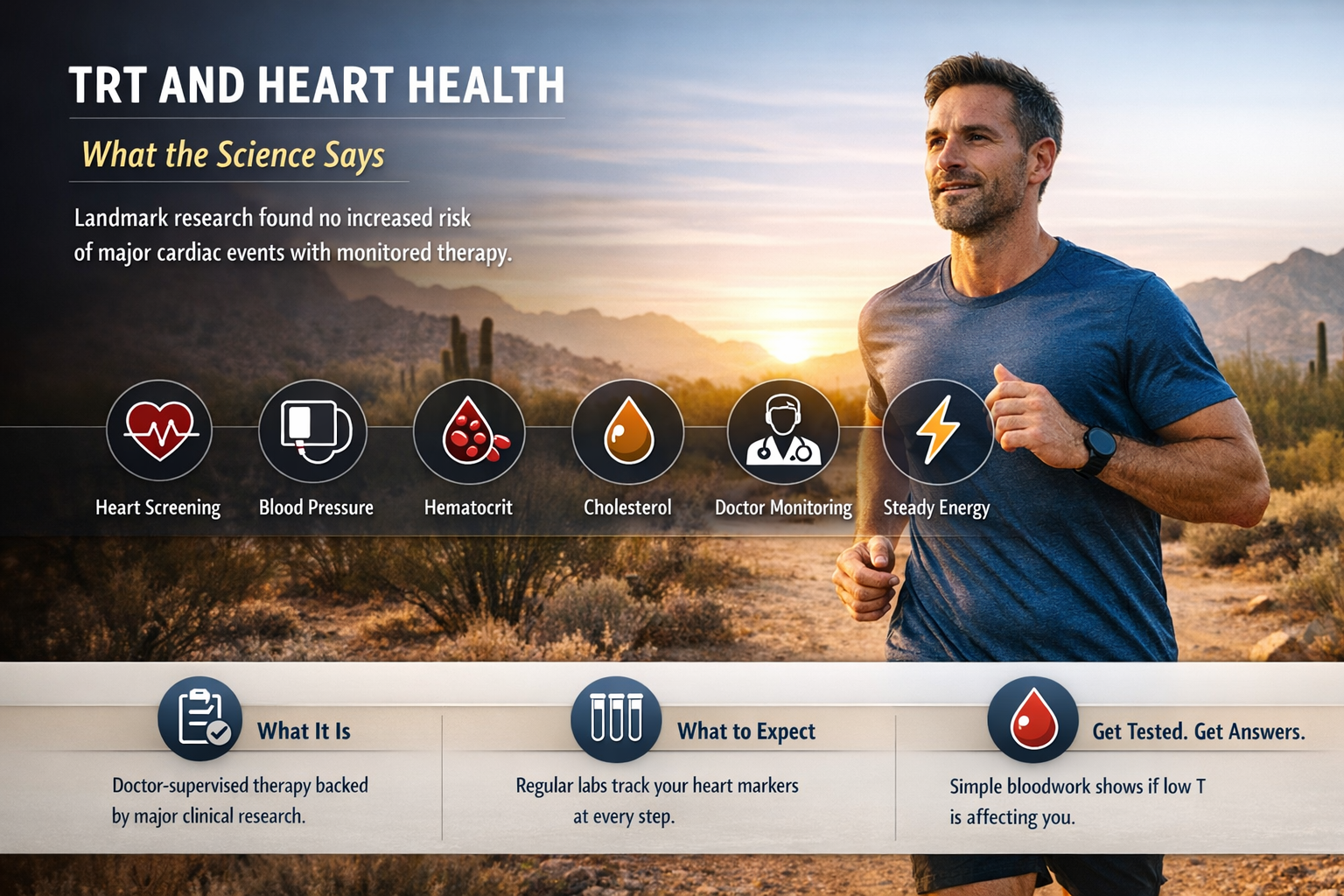
TRT and Heart Health: Is Testosterone Safe for Your Heart?
TRT and heart health is the question men ask us more than almost any other — and for good reason. For years, headlines suggested testosterone replacement therapy might raise the risk of heart attacks and strokes. Then the largest cardiovascular safety trial ever run on testosterone told a very different story. If you're a man in Phoenix, Scottsdale, or anywhere in Arizona weighing TRT, here's what the current evidence actually says about your heart — the reassuring parts, the real risks, and how proper monitoring keeps you safe.
Why men worry about TRT and heart health
The concern isn't irrational. In the early 2010s, a handful of observational studies suggested a possible link between testosterone therapy and cardiac events, and in 2015 the FDA added a cardiovascular caution to testosterone labeling. Those studies had serious limitations — many included men who were never properly diagnosed with low testosterone, or who received no monitoring at all — but the damage to public perception was done.
The problem was that nobody had run a large, randomized, placebo-controlled trial designed specifically to answer the question. That changed in 2023.
What the TRAVERSE trial actually found
The TRAVERSE trial is the most important piece of evidence on this topic, full stop. It enrolled 5,246 men aged 45 to 80 who had hypogonadism symptoms and either pre-existing cardiovascular disease or a high risk of it — in other words, exactly the men you'd worry about most. Half received testosterone gel, half received placebo, and researchers tracked them for years.
The result: testosterone therapy was non-inferior to placebo for major adverse cardiac events — heart attack, stroke, and cardiovascular death occurred at essentially the same rate in both groups. Following those results, a European expert panel position statement concluded that testosterone therapy is cardiovascularly safe when prescribed to appropriately selected patients and monitored regularly, with benefits outweighing risks when therapy is used responsibly.
For Arizona men who've been putting off treatment out of heart-attack fear, this is the headline: in the best study we have, properly diagnosed and supervised TRT did not raise the risk of major cardiac events — even in men who already had heart disease.
Worried About Your Heart? Start With Real Data.
Doctor-supervised • Arizona-based • Telehealth available
Get Started — Free Assessment →The real cardiovascular risks TRT does carry
TRAVERSE was reassuring on the big events, but it wasn't a blank check. In the same trial, researchers observed somewhat higher rates of atrial fibrillation, pulmonary embolism, and acute kidney injury in the testosterone group. These are less common than heart attack or stroke, but they're real, and they're the reason "safe" and "unsupervised" are not the same thing.
The cardiovascular-adjacent risks worth knowing:
- Elevated hematocrit. Testosterone stimulates red blood cell production. If hematocrit climbs too high, blood thickens and clot risk rises. This is the most common lab change on TRT — and the easiest to catch and manage with routine bloodwork.
- Atrial fibrillation. An irregular heart rhythm seen slightly more often in the TRAVERSE testosterone group. Men with a history of AFib should discuss it explicitly before starting.
- Blood pressure and fluid retention. Some men see modest blood pressure changes, particularly early in therapy — another reason ongoing check-ins matter.
- Blood clots (VTE/PE). Rare, but risk appears modestly elevated, especially in men with clotting disorders or very high hematocrit.
Every one of these is detectable and manageable with proper follow-up. If you want the complete picture beyond the heart, we've covered the full range of TRT risks and side effects and how they're monitored in a dedicated guide.
The other side of the ledger: low testosterone hurts your heart too
Here's what the "is TRT dangerous?" framing misses: untreated low testosterone is itself associated with worse cardiovascular and metabolic health. As Harvard Health notes in its overview of testosterone and the heart, men with clearly low testosterone face health consequences from deficiency, and for men with true testosterone deficiency there's no apparent increased risk of heart attack or stroke from replacement therapy.
Low T is closely tied to increased visceral fat, insulin resistance, and metabolic syndrome — all major drivers of heart disease. It's a two-way street: low testosterone promotes belly fat, and belly fat further suppresses testosterone. We've broken down that cycle in our guide to low testosterone and weight gain. The point isn't that TRT is a heart treatment — it isn't, and no honest clinic will claim that. The point is that "do nothing" is not automatically the heart-safe choice.
How doctor-supervised TRT protects your heart
The difference between the men who do well on TRT and the horror stories is almost always monitoring. At a legitimate clinic, your heart-relevant markers are checked before you start and rechecked on a schedule:
- Baseline labs before your first dose. Total and free testosterone, hematocrit, lipids, PSA, and metabolic markers. Here's the full rundown of the bloodwork you need before starting TRT.
- Follow-up labs in the first months. Hematocrit and estradiol are rechecked so dosing can be adjusted before problems develop.
- Ongoing monitoring. Labs every 6–12 months once you're stable, plus blood pressure and symptom check-ins.
- Dose adjustments, not guesswork. If hematocrit trends high, options include lowering the dose, splitting injections into smaller more frequent doses, or donating blood.
This is exactly the protocol gap that made those early observational studies look scary — many of those men were never monitored at all.
TRT and heart health in Arizona: what to do next
If you're in the Phoenix metro — Scottsdale, Mesa, Tempe, Chandler, Gilbert — or anywhere in Arizona, getting a real answer is straightforward. Telehealth TRT is fully legal for Arizona residents, and lab draws take one short visit to a local Quest or Labcorp location, often with early-morning slots that beat the summer heat. The process starts with a proper diagnosis: symptoms plus confirmed low morning testosterone on bloodwork. If you're not sure whether your numbers qualify, start with our guide on how low testosterone is diagnosed.
One caution: not all providers treat heart safety with equal seriousness. Clinics that skip baseline labs, never recheck hematocrit, or prescribe without a diagnosis are the ones that give TRT a bad name. We've published a checklist of what to look for in a Phoenix TRT clinic — lab monitoring should be non-negotiable on your list.
Get Your Levels — and Your Heart Markers — Checked
Doctor-supervised • Arizona-based • Telehealth available
Get Started — Free Assessment →Frequently asked questions
Does TRT increase the risk of heart attack or stroke?
Based on the best available evidence, no. The TRAVERSE trial — over 5,000 men at elevated cardiovascular risk — found testosterone therapy was no worse than placebo for heart attack, stroke, and cardiovascular death. TRT did show slightly higher rates of atrial fibrillation and blood clots, which is why medical monitoring is essential.
Can I take TRT if I have heart problems?
Many men with cardiovascular disease or risk factors were included in the TRAVERSE trial and did not experience more major cardiac events on testosterone. That said, anyone with a history of heart disease, AFib, or clotting problems needs an individualized evaluation, honest risk discussion, and closer monitoring — this is a decision to make with a licensed medical provider, not on your own.
What heart-related labs are monitored on TRT?
The key ones are hematocrit (red blood cell concentration, which affects clot risk), blood pressure, lipids, and estradiol, alongside testosterone levels themselves. A quality Arizona TRT program checks these before you start, again in the first few months, and every 6–12 months after that.
Sources
- TRAVERSE Study Supports Cardiovascular Safety of Testosterone Therapy When Used as Indicated — Cleveland Clinic
- Cardiovascular Safety of Testosterone Therapy — Insights from the TRAVERSE Trial and Beyond: A Position Statement — NCBI/PMC
- Testosterone Therapy May Be Safe for Men at Risk for Heart Attack and Stroke — Harvard Health
- Testosterone and the Heart — Harvard Health
