
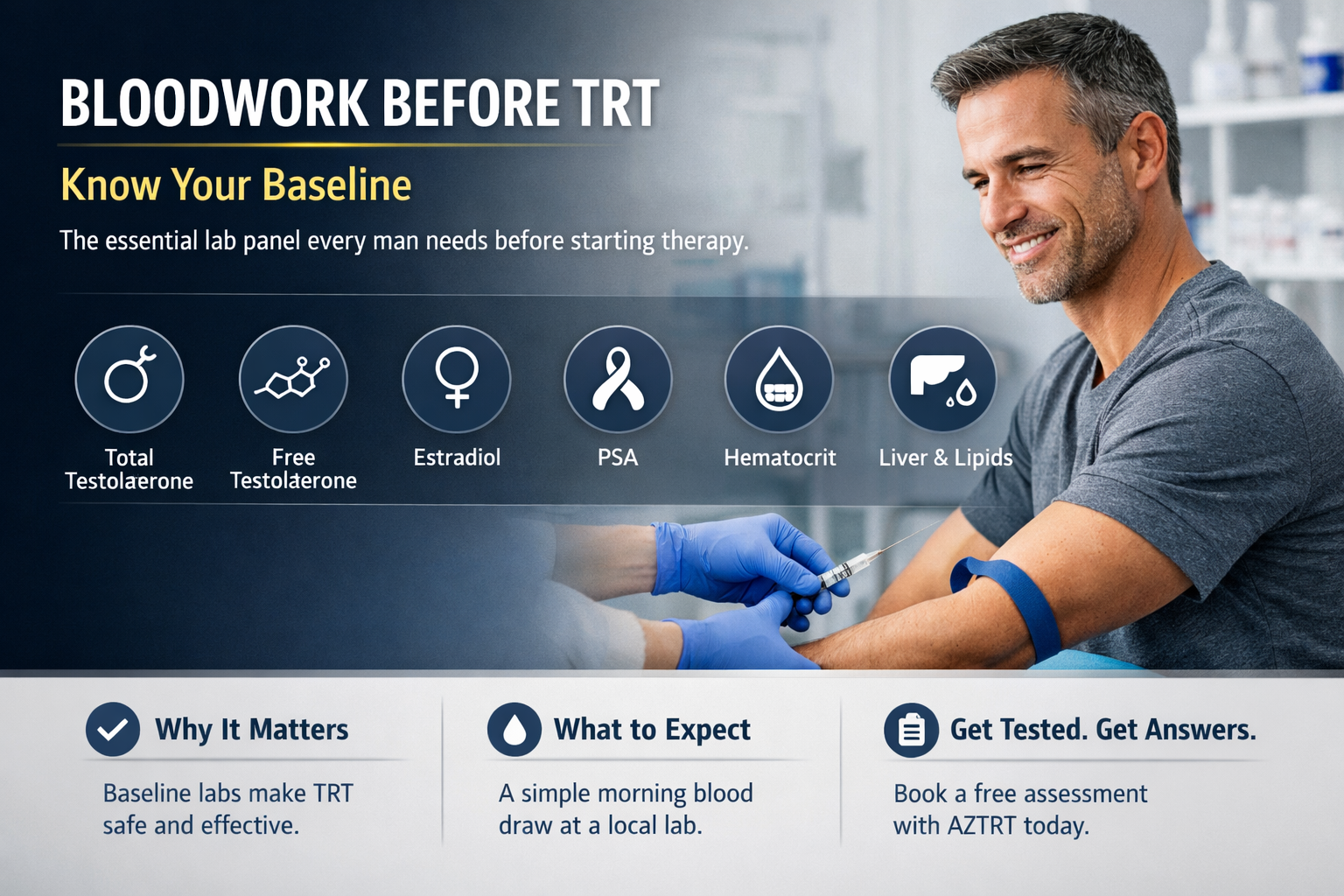
What Bloodwork Do You Need Before Starting TRT? A Lab Guide
Knowing what bloodwork you need before starting TRT is the single most important step in doing testosterone replacement therapy safely. A proper pre-TRT lab panel does two jobs at once: it confirms that your testosterone is actually low (not just your energy), and it establishes the baseline numbers your doctor will use to monitor your health for as long as you're on therapy. At AZTRT, a Phoenix-based telehealth TRT clinic, every new patient completes this panel before any prescription is written — and this guide walks through exactly what's on it and why.
Why baseline bloodwork matters so much
Testosterone replacement therapy changes your body's hormone signaling, red blood cell production, and estrogen levels. Without baseline labs, there's no way to know whether a change six months into therapy is a side effect of treatment or something that was already there. Baseline bloodwork protects you in three ways:
- It confirms the diagnosis. Fatigue, low libido, and brain fog have many causes. Guidelines from the Endocrine Society and American Urological Association call for at least two separate morning testosterone measurements before diagnosing low T — one low reading isn't enough.
- It rules out conditions that need attention first. Elevated PSA, very high hematocrit, or untreated pituitary issues should be evaluated before testosterone therapy begins.
- It creates your monitoring baseline. Your provider will re-check labs during your first year on TRT. Those follow-ups only mean something when compared against where you started.
The core pre-TRT lab panel
1. Total testosterone (tested twice, in the morning)
This is the headline number. Testosterone peaks in the early morning and can swing meaningfully day to day, which is why reputable clinics require two separate draws, ideally between 7 and 10 a.m., before confirming a diagnosis. Most labs and guidelines treat readings consistently below roughly 300 ng/dL — alongside symptoms — as consistent with low testosterone.
2. Free testosterone (and SHBG)
Most testosterone in your blood is bound to proteins and unavailable to your tissues. Free testosterone measures the small unbound fraction that actually does the work. Men with normal total testosterone but high SHBG (sex hormone-binding globulin) can still have genuinely low free T — which is why testing only the total number can miss the real problem.
3. LH and FSH
Luteinizing hormone and follicle-stimulating hormone are the pituitary signals that tell your testes to make testosterone and sperm. These two values tell your doctor why your testosterone is low: low T with high LH points to a testicular issue (primary hypogonadism), while low T with low or normal LH points to a signaling issue from the brain (secondary hypogonadism). That distinction shapes treatment — including whether alternatives like enclomiphene make sense.
4. Estradiol (E2)
Some of your testosterone naturally converts to estradiol, and TRT can increase that conversion. A baseline estradiol reading — ideally by the more accurate "sensitive" assay for men — lets your provider manage symptoms like water retention or moodiness later, instead of guessing.
5. Complete blood count (CBC) with hematocrit
Testosterone stimulates red blood cell production. That's often a benefit for men with borderline-low counts, but if hematocrit climbs too high, blood becomes thicker and cardiovascular risk can rise. Hematocrit is the number most likely to require a dose adjustment on TRT, so knowing your starting point is essential.
6. PSA (prostate-specific antigen)
For men 40 and older — and younger men with a family history of prostate cancer — a baseline PSA is standard before starting testosterone. Current evidence does not show that TRT causes prostate cancer, but an existing prostate issue should be evaluated first, and PSA will be monitored during therapy.
7. Comprehensive metabolic panel (CMP)
Liver enzymes, kidney function, glucose, and electrolytes round out the picture of your overall health and confirm your body can process treatment normally. Many providers add a lipid panel and HbA1c here, since low testosterone frequently travels with insulin resistance and abnormal cholesterol.
Often added: thyroid, prolactin, and vitamin D
A TSH test rules out thyroid problems that mimic low-T symptoms almost perfectly. Prolactin is checked when LH is low, to screen for a benign pituitary cause. Vitamin D is commonly low even in sunny Phoenix — indoor lifestyles and sunscreen see to that — and it plays a supporting role in hormone health.
Ready to Find Out Where Your Levels Stand?
Doctor-supervised • Arizona-based • Telehealth available
Get Started — Free Assessment →How to prepare for your blood draw
A few simple steps keep your results accurate and save you a repeat trip to the lab:
- Book a morning appointment. Aim for 7–10 a.m., when testosterone is at its daily peak. An afternoon draw can read 20–30% lower and produce a false "low."
- Ask whether to fast. Testosterone itself doesn't require fasting, but if your panel includes glucose or a lipid profile, an 8–12 hour fast (water is fine) keeps those numbers clean. In Arizona summer heat, hydrate well — it also makes the draw easier.
- Skip heavy training the day before. An intense leg day or long ride in the heat can temporarily shift hormone and CBC values.
- Hold biotin supplements for 48 hours. High-dose biotin can interfere with some hormone assays.
- Tell your provider about medications and supplements — especially anything marketed as a "testosterone booster," which can muddy your baseline.
Getting pre-TRT bloodwork done in Arizona
For men in the Phoenix metro, this is easier than most expect. With a telehealth TRT clinic like AZTRT, the process looks like this: you book an online assessment, a lab order is sent to a draw location near you — Sonora Quest and Labcorp have dozens of patient service centers across Phoenix, Scottsdale, Mesa, Tempe, Chandler, Gilbert, and Tucson — and you stop in for a single morning draw, usually in under 30 minutes. Results come back within a few days and are reviewed with a licensed provider over a telehealth visit, so there's no sitting in a waiting room. If your levels are low and you're a candidate, treatment can begin shortly after; if they're not, you've still learned something valuable about your health.
What happens after your results come back
Your provider will look at the whole picture, not just one number: total and free testosterone from two morning draws, your symptoms, LH/FSH pattern, and safety markers like PSA and hematocrit. From there, the conversation is about options — TRT, alternatives such as enclomiphene for men prioritizing fertility, or addressing an underlying cause first. Whatever the path, that baseline panel becomes the yardstick for every follow-up lab check, typically repeated around 3 months, 6 months, and 12 months into treatment, then annually.
Get Your Complete Lab Panel Reviewed by an Arizona Doctor
Doctor-supervised • Arizona-based • Telehealth available
Get Started — Free Assessment →Frequently asked questions
Do you need to fast before TRT bloodwork?
Not for the testosterone test itself. However, most pre-TRT panels include glucose and cholesterol, which are most accurate after an 8–12 hour fast. Schedule an early-morning draw, drink plenty of water, and eat right after — you'll cover both requirements in one visit.
How much does testosterone bloodwork cost in Arizona?
Cash-pay pricing for a comprehensive hormone panel at Arizona labs typically runs from around $100 to $300 depending on how many markers are included. Many telehealth TRT clinics, including AZTRT, bundle lab work into the initial assessment so there are no surprise costs.
How often do you need bloodwork once you start TRT?
Most providers re-check labs about 3 months after starting or changing a dose, again at 6 and 12 months, and then annually once you're stable. Follow-ups focus on testosterone, hematocrit, estradiol, and PSA to keep therapy both effective and safe.
