
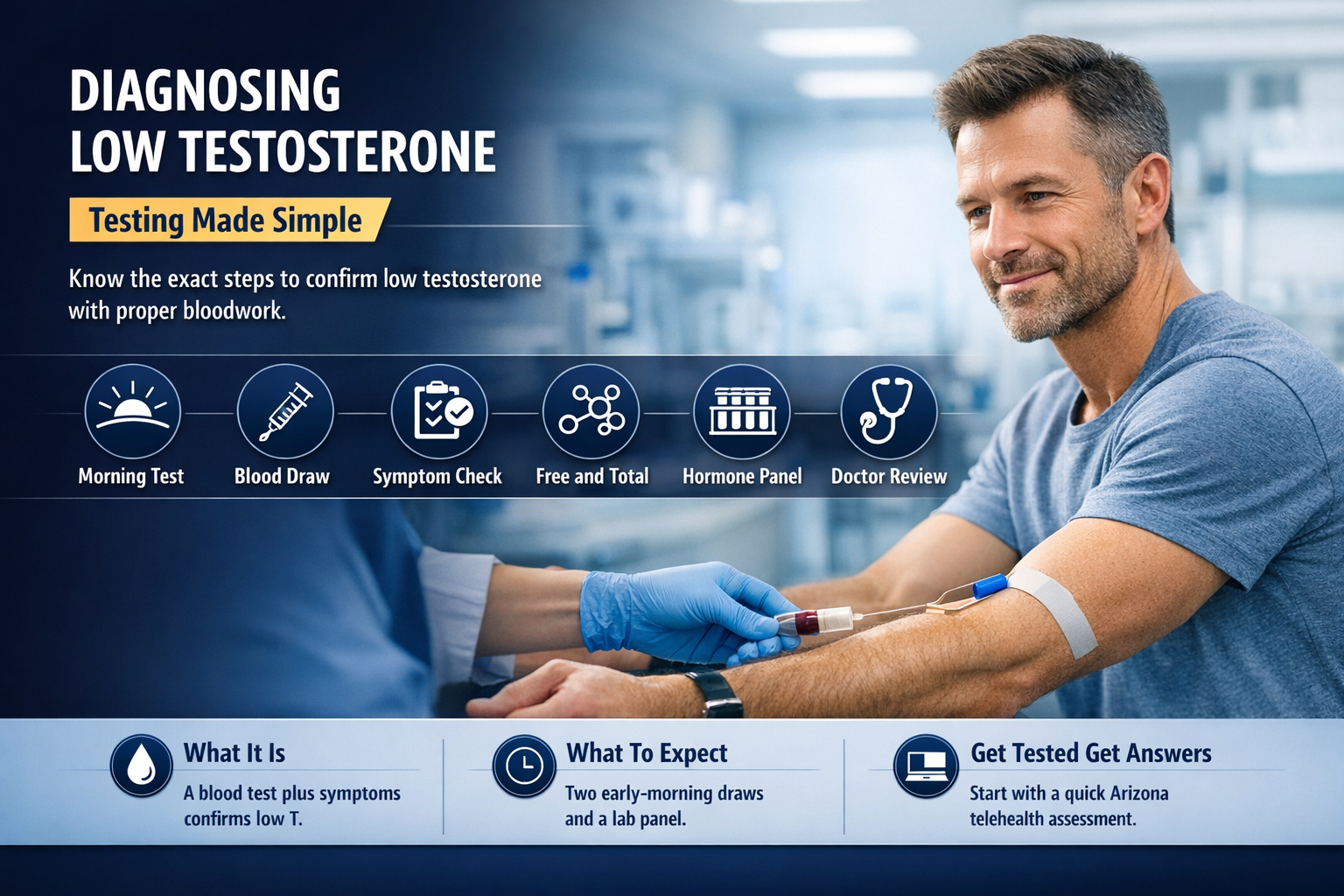
How Is Low Testosterone Diagnosed? Tests & What to Expect
If you have been feeling drained, foggy, or off for months, you may be wondering whether your testosterone is to blame — and how a doctor would actually know. The good news is that diagnosing low testosterone (also called low T or hypogonadism) is straightforward when it is done correctly. It comes down to two things: a proper blood test done at the right time of day, and symptoms that line up with the numbers. In this guide, our Arizona TRT team walks you through exactly how low testosterone is diagnosed, what bloodwork you need, and why timing matters so much.
The two-part rule: symptoms plus lab numbers
A common misconception is that you can diagnose low testosterone from symptoms alone, or from a single blood draw at any time of day. Neither is true. Major medical guidelines, including those from the American Urological Association (AUA), define testosterone deficiency as the combination of consistent symptoms and signs plus a confirmed low blood testosterone level. Both pieces have to be present.
This matters because the symptoms of low T — fatigue, low sex drive, weight gain, poor sleep, irritability, and difficulty building muscle — overlap with many other conditions, from thyroid problems to depression to sleep apnea. Testing prevents you from treating the wrong thing. Equally, a slightly low number with zero symptoms usually does not warrant treatment on its own. That is why a good clinic evaluates the whole picture, not just one lab value.
Step 1: The symptom review
Diagnosis usually starts with a conversation. Your provider will ask about the classic markers of low testosterone, which tend to cluster into a few groups:
- Sexual: reduced libido, weaker erections, fewer morning erections.
- Physical: fatigue, loss of muscle, increased body fat (especially belly fat), reduced strength or stamina.
- Cognitive and mood: brain fog, low motivation, irritability, low mood, and poor concentration.
- Sleep: trouble sleeping or unrefreshing sleep.
No single symptom confirms low T, but a pattern of several — especially low libido combined with fatigue — is a strong signal that bloodwork is worth doing.
Step 2: The morning blood test (and why timing is everything)
The cornerstone of diagnosis is a simple blood test measuring your total testosterone. The catch is when it is drawn. Testosterone follows a daily rhythm: it peaks in the early morning and steadily declines through the afternoon. A level that looks low at 4 PM might be perfectly normal at 8 AM. For that reason, guidelines call for the blood to be drawn between 8 AM and 10 AM, ideally after a normal night of sleep.
Because a single result can be thrown off by illness, poor sleep, stress, or lab variation, the diagnosis also requires two separate low readings on different days. Both draws should be done at the same lab using the same method so the numbers are truly comparable. One morning test showing low T earns you a second confirming test — not an immediate prescription.
Wondering if low T is behind how you feel?
Doctor-supervised • Arizona-based • Telehealth available
Get Started — Free Assessment →What testosterone level counts as "low"?
Under AUA guidance, a total testosterone below roughly 300 ng/dL, confirmed on two morning tests, is the threshold used to diagnose testosterone deficiency in adult men. That 300 ng/dL cutoff was chosen to balance the potential benefits of treatment against its risks.
It is not a hard line for everyone, though. Younger men in their 20s and 30s naturally run higher, so some experts use age-specific cutoffs closer to 350–400 ng/dL for that group. And two men with identical numbers can feel very different. This is exactly why your symptoms are weighed alongside the number rather than a lab value being read in isolation.
Free vs. total testosterone
Total testosterone measures all the testosterone in your blood, but much of it is bound to proteins — mainly sex hormone–binding globulin (SHBG) — and is not biologically active. Free testosterone is the small, unbound fraction your body can actually use. When total testosterone is borderline, or when SHBG is unusually high or low, a good provider will also check free testosterone (and sometimes calculate it from SHBG and albumin) to get the truer picture of your hormone status.
Step 3: The confirming bloodwork panel
Because low testosterone can have several underlying causes, diagnosis rarely stops at one number. Once a low reading is confirmed, your provider orders additional labs to understand why your testosterone is low and to make sure treatment would be safe. A thorough panel typically includes:
- Total and free testosterone plus SHBG — to quantify usable hormone.
- LH and FSH — pituitary hormones that reveal whether the problem is in the testicles or the brain's signaling.
- Estradiol (E2) — the main estrogen in men, important for balance and monitoring.
- Prolactin — an elevated level can point to a treatable pituitary cause.
- PSA — a prostate baseline before any therapy begins.
- CBC / hematocrit — a red-blood-cell baseline, since TRT can raise it.
- Thyroid panel, metabolic panel, and lipids — to catch other conditions that mimic low T.
This fuller workup is what separates responsible care from a quick-and-dirty "test-and-prescribe" approach. It confirms the diagnosis, uncovers the root cause, and establishes the baselines used to monitor you safely over time.
How to get diagnosed in Arizona
Getting tested is easier than most Phoenix-area men expect. At AZTRT, the process is built around convenience for men across Phoenix, Scottsdale, Mesa, Tempe, Chandler, Gilbert, and beyond. It generally looks like this:
- Start with a quick assessment of your symptoms and health history, done by telehealth from anywhere in Arizona.
- Get your morning labs drawn at a convenient local lab near you — timed correctly between 8 and 10 AM.
- Review your results with a licensed provider, who interprets the numbers in the context of your symptoms and confirms with a second draw if needed.
- Build a plan together — which may be TRT, another treatment, or addressing an underlying issue — with ongoing monitoring built in.
Because so much can be handled through telehealth, Arizona men can complete most of the diagnostic journey without repeated trips to a clinic, while still getting properly timed labs and physician oversight.
Get real answers with properly timed labs
Doctor-supervised • Arizona-based • Telehealth available
Get Started — Free Assessment →Frequently asked questions
How many blood tests do I need to diagnose low testosterone?
At least two. Guidelines call for two separate low total-testosterone readings, both drawn in the early morning (8–10 AM) on different days, before a diagnosis of low testosterone is confirmed. A single low result is used to prompt the second, confirming test rather than to start treatment.
What testosterone level is considered low?
Most guidelines use a total testosterone below about 300 ng/dL, confirmed on two morning tests, as the threshold for testosterone deficiency in adult men. Younger men may warrant a slightly higher cutoff, and your symptoms are always weighed alongside the number.
Do I have to fast or prepare for a testosterone blood test?
The most important preparation is timing: have your blood drawn between 8 and 10 AM after a normal night's sleep. Some panels checked at the same time (like glucose or lipids) may call for fasting, so your provider will tell you if fasting is needed for your specific labs.
