
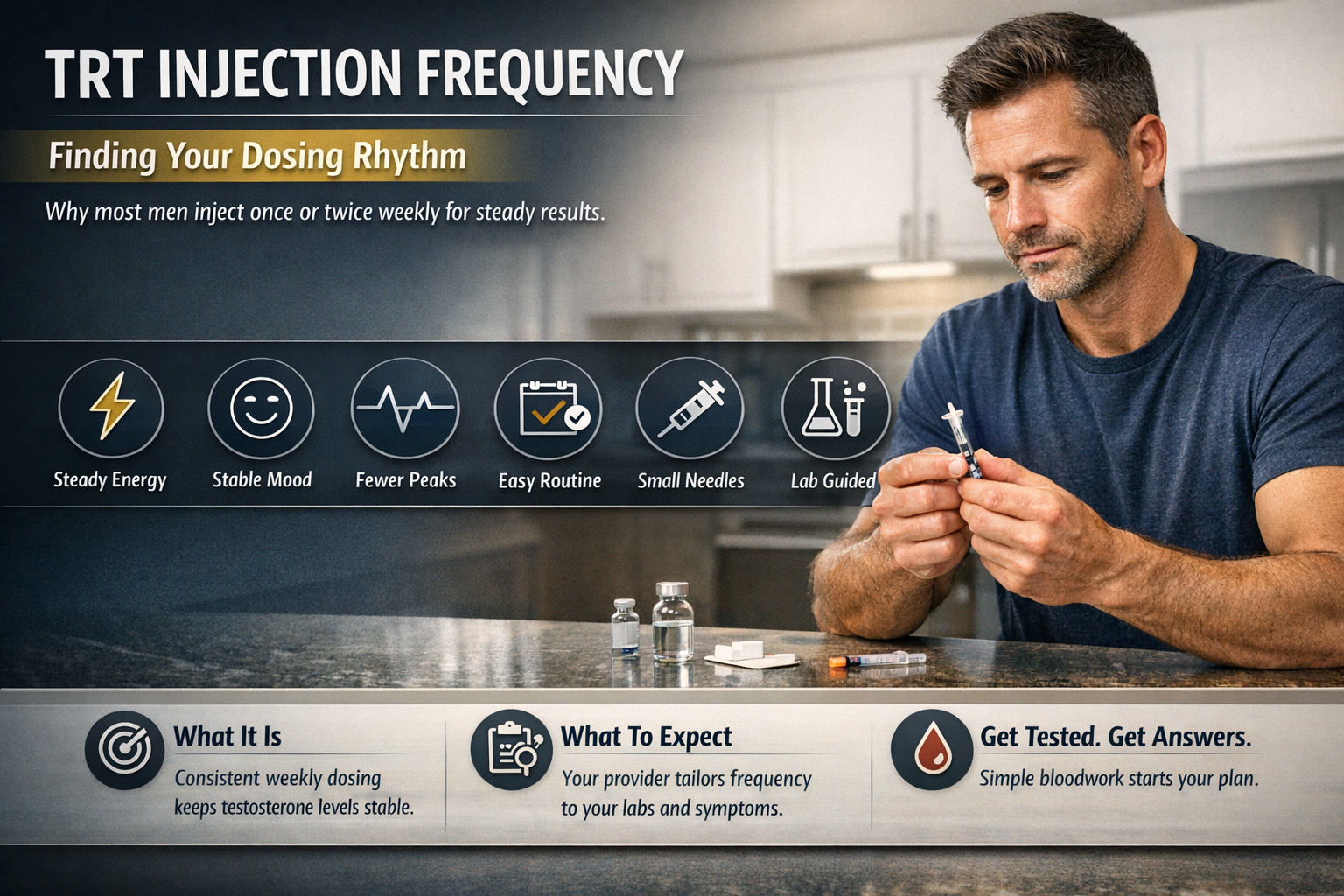
How Often Do You Take TRT Injections? Dosing Schedule Guide
If you're starting therapy, one of the first practical questions is: how often do you take TRT injections? It's a fair question — the answer shapes your weekly routine, how stable you feel, and even how well side effects are controlled. The short version: most Arizona men on testosterone replacement therapy inject once or twice per week, and the era of the every-two-weeks "rollercoaster" schedule is largely behind us. Here's why frequency matters, what the common schedules look like, and how a TRT provider in Phoenix dials in the right rhythm for you.
The short answer: once or twice a week for most men
Injectable testosterone in the U.S. is almost always an esterified form — usually testosterone cypionate, sometimes enanthate — suspended in oil so it releases slowly after injection. According to the clinical literature on androgen replacement, weekly dosing is generally recommended because it minimizes the supraphysiologic (higher-than-normal) peaks that occur when larger doses are given less often.
In practice, modern TRT protocols usually land in one of three places:
- Once weekly: the most common schedule — simple, effective, and easy to remember (e.g., every Sunday morning).
- Twice weekly: the same total weekly dose split in half (e.g., Monday and Thursday) for the smoothest possible levels.
- Every 10–14 days: an older schedule still used in some primary-care settings; intramuscular testosterone is traditionally given every one to two weeks, but many men feel noticeable ups and downs on the longer interval.
Why injection frequency matters: the peak-and-trough problem
After an intramuscular injection of a testosterone ester, your blood level rises to a peak within the first few days, then declines until the next dose. Pharmacokinetic research shows that injections spaced too far apart produce supraphysiologic levels shortly after dosing that can fall to low or sub-therapeutic levels before the next injection — a large peak-to-trough swing.
That swing isn't just a lab curiosity. Men on infrequent injections often describe feeling energetic and sharp for the first week, then flat, irritable, or low the second week. Big peaks can also aggravate estrogen conversion and red blood cell production. Two related topics worth understanding here are how estrogen (E2) is managed on TRT — since higher testosterone peaks give the aromatase enzyme more raw material to convert — and why hematocrit monitoring matters on TRT, because steadier levels are generally friendlier to your blood counts than repeated spikes.
Splitting the dose into smaller, more frequent injections flattens the curve: lower peaks, higher troughs, steadier mood and energy. That's the main reason many Arizona TRT clinics, including AZTRT, favor weekly or twice-weekly protocols.
Ready for a TRT plan built around your labs — not a one-size schedule?
Doctor-supervised • Arizona-based • Telehealth available
Get Started — Free Assessment →Common TRT injection schedules compared
Once weekly
The workhorse schedule. One injection per week keeps levels within a reasonable band for most men, fits easily into a routine, and requires only 52 injections a year. If you're new to needles, the process is simpler than most men expect — our step-by-step guide to self-injecting testosterone at home walks through supplies, technique, and safety.
Twice weekly
Splitting the same weekly dose into two smaller injections (for example, half on Monday, half on Thursday) produces the steadiest levels of any standard protocol. Men who are sensitive to hormonal fluctuation — mood dips, energy swings, estrogen-related symptoms — often do best here. The tradeoff is simply more injections, though with small-gauge insulin-style needles most men find each one takes under a minute.
Every two weeks
Some primary-care offices still prescribe 200 mg every 14 days. The total monthly dose can be identical to a weekly protocol, but the experience is different: a big early peak, then a long slide. If you're on this schedule and feel like a different person in week two, the schedule — not the medication — may be the problem.
Subcutaneous vs. intramuscular
Frequency also interacts with injection route. Subcutaneous injections (into belly fat with a tiny needle) are typically done weekly or twice weekly and are a popular, well-tolerated option for at-home dosing. Injections are only one delivery method, of course — see how TRT injections compare with gels, pellets, and creams, which have their own dosing rhythms ranging from daily application to every few months.
How your provider dials in your schedule
There's no single "correct" frequency — there's the frequency that keeps your levels in the therapeutic range and your symptoms resolved. The American Urological Association's testosterone deficiency guideline emphasizes confirming a diagnosis with proper testing, targeting a therapeutic testosterone level, and monitoring men on therapy with follow-up labs.
In a well-run program, that looks like:
- Baseline labs confirming low testosterone and screening safety markers before you start.
- A starting protocol — commonly weekly testosterone cypionate — chosen with your preferences in mind.
- Follow-up bloodwork after roughly 6–8 weeks, ideally drawn at trough (just before your next injection), to see where your levels actually land.
- Adjustments to dose or frequency based on labs plus how you feel — not labs alone.
For men in Phoenix, Scottsdale, Mesa, and across Arizona, this whole cycle can run through telehealth: labs are drawn locally at Sonora Quest or Labcorp locations around the Valley, visits happen by video, and medication ships to your door. Here's a closer look at how online TRT works in Arizona if the at-home model appeals to you.
Practical tips for staying consistent
- Anchor your injection to a routine: same day(s), same time — Sunday coffee, Monday/Thursday after your shower.
- Set a phone reminder: consistency matters more than the exact day you choose.
- Rotate injection sites: alternating sides reduces soreness and scar tissue.
- Never "double up" peaks: if you miss a dose, follow your provider's catch-up instructions rather than injecting extra.
- Keep your lab appointments: your schedule is only as good as the data used to set it.
Find the injection schedule that actually fits your life
Doctor-supervised • Arizona-based • Telehealth available
Get Started — Free Assessment →Frequently asked questions
How often do you take TRT injections?
Most men inject testosterone once or twice per week. Weekly dosing of testosterone cypionate or enanthate keeps blood levels reasonably steady, while twice-weekly dosing (the same total dose split in half) produces the smoothest levels. Some providers still use every-two-week schedules, but larger swings in energy and mood are more common on that interval.
Is it better to inject testosterone once or twice a week?
Both work well. Twice-weekly injections produce lower peaks and higher troughs, which some men notice as steadier mood, energy, and fewer estrogen-related side effects. Once-weekly is simpler and still keeps most men in range. The right choice depends on your labs, symptoms, and preference — and it can be changed if the first schedule doesn't feel right.
Can you take TRT injections every two weeks?
Yes — testosterone cypionate has traditionally been dosed every one to two weeks. However, longer intervals produce a high peak in the first several days and a noticeable decline before the next dose, which many men feel as an energy and mood rollercoaster. Most modern protocols favor weekly or twice-weekly dosing for steadier results.
Sources
- Androgen Replacement (StatPearls) — NCBI Bookshelf / NIH
- Pharmacokinetics of Testosterone Therapies in Relation to Diurnal Variation of Serum Testosterone Levels — PMC / NIH
- Evaluation and Management of Testosterone Deficiency: AUA Guideline — American Urological Association
- Testosterone Injections: Uses & Side Effects — Cleveland Clinic
