
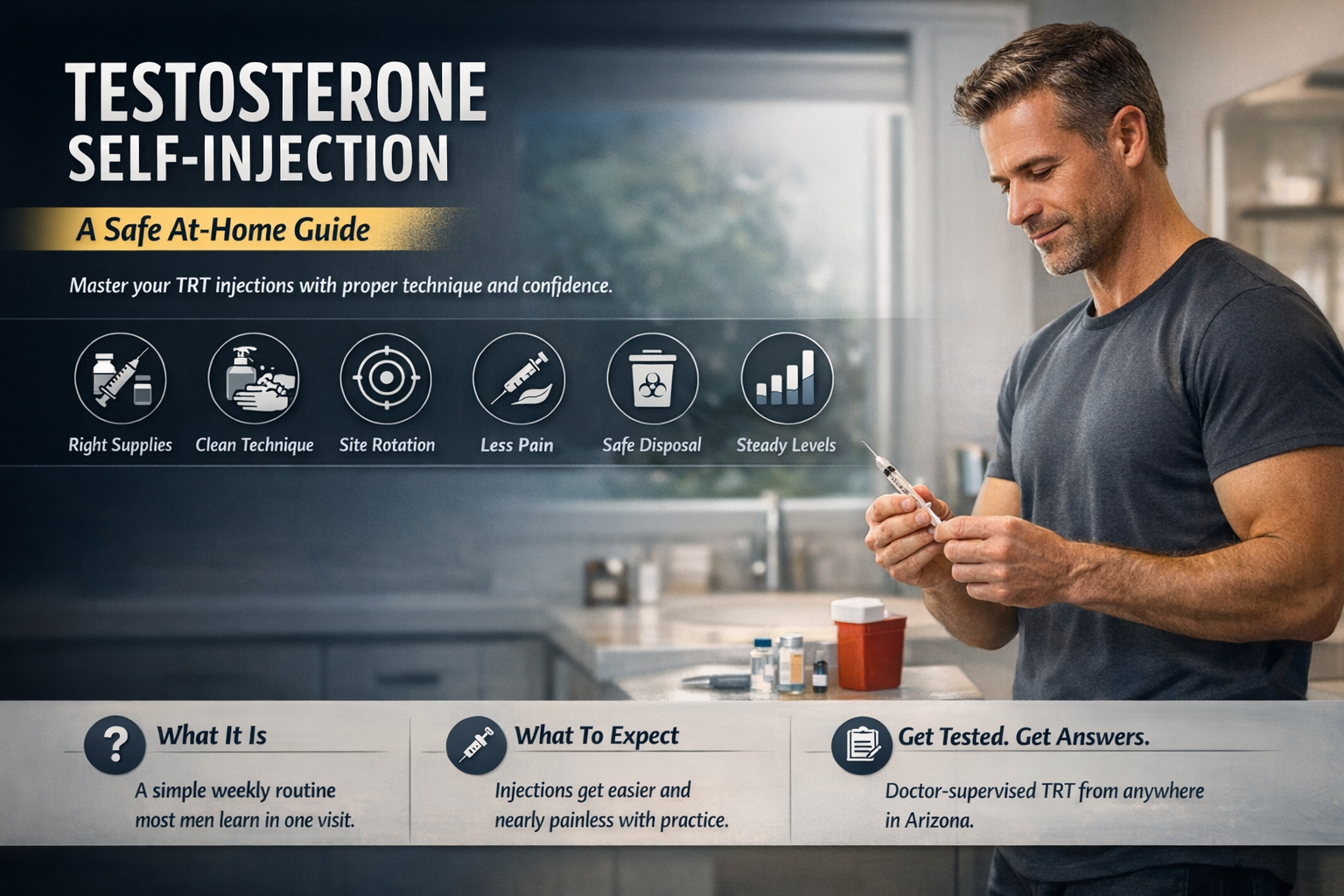
How to Self-Inject Testosterone at Home: Step-by-Step Guide
Learning how to self-inject testosterone at home is one of the biggest hurdles for men starting TRT — and one of the fastest to get over. The first injection feels intimidating. By week three or four, most AZTRT patients in Phoenix, Scottsdale, and across Arizona describe it as a two-minute routine that's easier than shaving. This guide walks through the supplies, the technique for both intramuscular and subcutaneous injections, how to rotate sites, and the mistakes to avoid — so your weekly dose becomes just another part of your schedule.
One thing up front: this article supplements — never replaces — the training your medical provider gives you. Testosterone is a prescription medication, and your first injection should always be walked through with your clinician, in person or over telehealth video.
Why most TRT patients self-inject
Injectable testosterone (usually testosterone cypionate) remains the most common and cost-effective form of TRT. Compared with daily gels or implanted pellets, injections deliver reliable dosing, are easy to adjust, and cost far less per month — we compare every option in our guide to TRT injections vs. gels, pellets, and creams. Driving to a clinic every week for a 30-second shot doesn't make sense for busy men, which is why modern programs — including online TRT with telehealth visits here in Arizona — teach you to self-administer at home after proper training.
The supplies you'll need
Your pharmacy or TRT clinic typically ships everything together. A standard home-injection kit includes:
- Your prescribed testosterone vial — most commonly testosterone cypionate 200 mg/mL.
- Syringes — usually 1 mL (insulin-style for SubQ, luer-lock for IM).
- Drawing needles — a larger 18–21 gauge needle used only to pull the oil from the vial.
- Injection needles — a fresh, smaller needle for the actual shot: commonly 25–27 gauge, 1"–1.5" for IM, or 25–30 gauge, 1/2"–5/8" for SubQ.
- Alcohol swabs — for the vial stopper and your skin.
- A sharps container — an FDA-cleared container or heavy plastic bottle with a screw lid for used needles.
Always use a new, sterile needle and syringe for every injection, and never reuse or share needles.
Intramuscular vs. subcutaneous: which is right for you?
There are two accepted routes for injectable testosterone, and both intramuscular and subcutaneous routes are recognized options your prescriber may choose between.
Intramuscular (IM)
The traditional method: testosterone is injected deep into a large muscle — most often the outer-middle thigh (vastus lateralis) for self-injection, since it's easy to see and reach. IM injections have decades of history and are the standard many clinics start with.
Subcutaneous (SubQ)
The newer approach injects testosterone into the fat layer of the abdomen with a very short, thin needle. Peer-reviewed research has found that subcutaneous testosterone injections are effective, well tolerated, and often less painful and easier to self-administer than IM, with steady blood levels between doses. Because the needle is tiny and the technique is simple, many men — especially those uneasy about a longer needle — prefer SubQ. Per Cleveland Clinic's guidance on subcutaneous testosterone, your care team will show you exactly how and where to give it, and you should follow their directions precisely.
Neither route is "better" for everyone. Your provider will recommend one based on your dose, body composition, and comfort — and it's fine to switch later.
Want a doctor to walk you through your first injection?
Doctor-supervised • Arizona-based • Telehealth available
Get Started — Free Assessment →Step-by-step: how to self-inject testosterone
The exact steps below describe general best practice — follow your own clinician's instructions if they differ.
1. Prepare
- Wash your hands thoroughly with soap and water.
- Let the vial reach room temperature (cold oil injects harder and stings more — roll the vial between your palms for a minute).
- Wipe the vial's rubber stopper with an alcohol swab.
2. Draw the dose
- Attach the larger drawing needle to your syringe.
- Pull air into the syringe equal to your dose, inject the air into the vial (this makes drawing easier), then turn the vial upside down and slowly draw your prescribed amount.
- Switch to a fresh injection needle. Hold the syringe needle-up and tap out air bubbles, pushing the plunger until a tiny bead of oil appears at the tip.
3. Inject
- Clean the injection site with a new alcohol swab and let it dry.
- IM (thigh): sit down, relax the leg, and insert the needle into the outer-middle thigh at 90 degrees with one quick, dart-like motion. Clinical references note that a quick insertion followed by a slow, steady injection minimizes pain and helps the muscle retain the medication. Inject slowly — roughly 10 seconds per mL — pause a few seconds, then withdraw smoothly.
- SubQ (abdomen): pinch a fold of belly fat at least two inches from your navel, insert the short needle at 45–90 degrees, and inject slowly.
- Apply light pressure with gauze. A drop of blood or oil at the site is normal; significant pain, swelling, or spreading redness in the following days is not — call your provider.
4. Dispose
Place the used needle and syringe directly into your sharps container — never the trash, and never recap by pushing toward your fingers. When the container is about three-quarters full, seal it and follow Arizona disposal guidance: most Phoenix-area pharmacies, fire stations, and household-hazardous-waste events accept sealed sharps containers.
Rotate your injection sites
Injecting the same spot repeatedly can cause scar tissue, soreness, and inconsistent absorption. Mayo Clinic's patient guidance is simple: use a different body area for each shot and keep track of where you injected. In practice, that means alternating left and right thighs each week for IM, or moving around the abdomen (left, right, upper, lower — always two inches from the navel) for SubQ. A note in your phone works fine.
Common mistakes to avoid
- Skipping the needle change: the drawing needle dulls when it punctures the stopper. Injecting with it hurts more — always switch to a fresh needle.
- Injecting cold oil too fast: warm the vial and take your time; most post-injection soreness comes from speed, not the needle.
- Guessing at your dose: your dose is set from your labs. More is not better — that's how side effects happen. Review the bloodwork you need before starting TRT to see what your protocol is built on.
- Skipping follow-up labs: injectable testosterone can raise red blood cell counts over time, which is why hematocrit monitoring on TRT is part of any legitimate program.
- Buying testosterone without a prescription: black-market vials carry real contamination and dosing risks. TRT is safe when it's prescribed, dosed, and monitored by a licensed provider.
Self-injecting with an Arizona telehealth clinic
At AZTRT, self-injection training is built into onboarding: after your labs at a local Arizona draw site (Phoenix, Scottsdale, Mesa, Tempe, Tucson and beyond) and your telehealth consult, your provider walks you through your first injection on video, your medication ships to your door, and follow-up labs keep your dose dialed in. If you're brand new to therapy, start with our step-by-step guide to getting started with TRT.
Frequently asked questions
Does injecting testosterone at home hurt?
Far less than most men expect. With a room-temperature vial, a fresh sharp needle, and a slow push, most describe a brief pinch. SubQ injections with a short, thin needle are often nearly painless, and even IM thigh injections become routine within a few weeks.
Where is the best place to inject testosterone?
For self-administered IM injections, the outer-middle thigh is the most practical site because it's easy to see and reach. For subcutaneous injections, the fat of the abdomen at least two inches from the navel is standard. Rotate sites every injection, and use the site your prescriber trained you on.
What do I do with used needles in Arizona?
Place them immediately in a sharps container or a heavy-duty plastic bottle with a screw cap. When it's about three-quarters full, seal it and take it to a participating pharmacy, fire station, or household-hazardous-waste drop-off in your city. Never put loose needles in household trash or recycling.
Ready to start doctor-supervised TRT from home?
Doctor-supervised • Arizona-based • Telehealth available
Get Started — Free Assessment →Sources
