
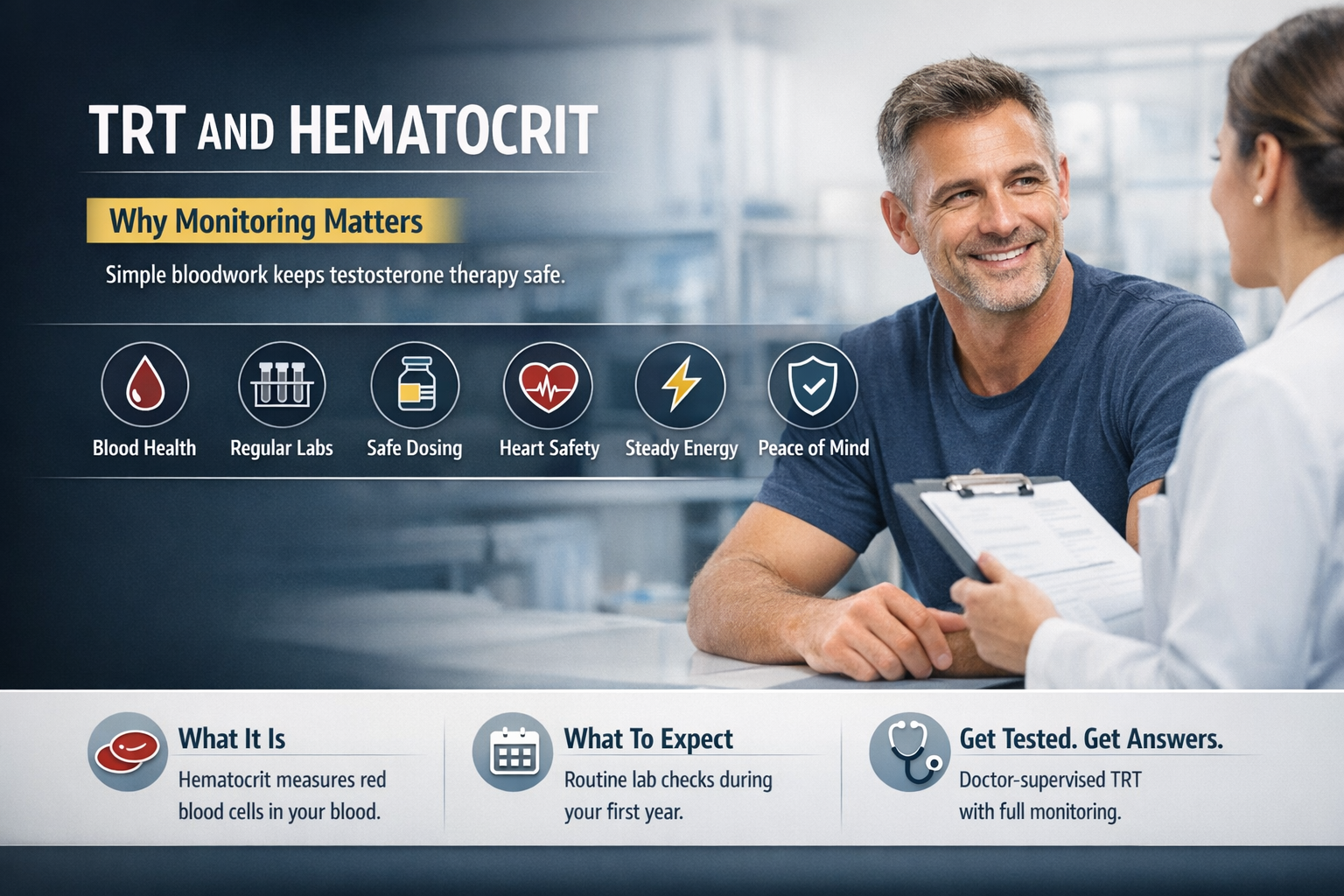
TRT and Hematocrit: Why Blood Monitoring Matters
If you are researching testosterone replacement therapy in Arizona, you have probably seen the word hematocrit on a lab requisition and wondered why it matters. Hematocrit is simply the proportion of your blood volume made up of red blood cells, and it is one of the most important numbers your provider tracks on TRT. Testosterone naturally signals your bone marrow to produce more red blood cells, so a higher hematocrit is an expected, well-documented effect of therapy — not a surprise, and not a reason to avoid treatment. What matters is that it is measured and managed. This guide explains what hematocrit is, why TRT raises it, what levels are considered safe, and how a monitored program at a Phoenix-area clinic keeps you protected.
What is hematocrit, and why does TRT raise it?
Hematocrit (often abbreviated Hct) is reported on a standard complete blood count (CBC) as a percentage. A typical range for adult men is roughly 40–52%. Red blood cells carry oxygen throughout your body, so having enough of them is good — but having too many thickens the blood, which can strain circulation.
Testosterone increases red blood cell production through a few mechanisms, including stimulating erythropoietin (the hormone that tells your marrow to make red cells) and improving iron availability. When red cell production outpaces what your body needs, the result is a condition called erythrocytosis (sometimes loosely called polycythemia). Research consistently identifies erythrocytosis as the most common side effect of testosterone therapy. It is one of the core reasons TRT is a monitored medical treatment rather than something to buy online and self-manage — a point we cover in depth in our overview of TRT risks and side effects and how to manage them.
Why an elevated hematocrit matters
In moderation, a modest rise in hematocrit is harmless. The concern is when it climbs high enough to meaningfully increase blood viscosity — essentially, thicker blood that flows less easily. In theory, very high hematocrit can raise the risk of clot-related events. This is closely tied to broader cardiovascular considerations, which is why hematocrit monitoring goes hand in hand with the topics we discuss in TRT and heart health.
The reassuring context: for most men on a properly dosed, monitored program, hematocrit rises only slightly and stays within a safe range. Problems tend to arise with excessive doses, infrequent lab checks, or delivery methods that cause big peaks in testosterone levels. Monitoring is what turns a potential risk into a non-event.
Want TRT done safely, with full monitoring?
Doctor-supervised • Arizona-based • Telehealth available
Get Started — Free Assessment →What hematocrit levels are considered safe on TRT?
Professional guidelines give providers clear thresholds to work with. According to the American Urological Association (AUA) testosterone deficiency guideline, clinicians should check hemoglobin and hematocrit before starting therapy, and if the hematocrit exceeds 50% during treatment, the cause should be investigated. A hematocrit of 54% or higher generally warrants intervention — reducing the dose or temporarily stopping testosterone.
Here is how providers typically respond as levels rise:
- Under ~50%: Usually within the acceptable range; continue therapy and routine monitoring.
- 50–54%: A yellow flag — your provider may look for contributing factors (dose, delivery method, dehydration, sleep apnea, smoking) and consider adjustments.
- 54% and above: A red flag — guidelines call for lowering the dose, pausing treatment, or therapeutic blood donation until the level normalizes.
Because these are individualized decisions, your provider weighs your full clinical picture, not just a single number.
How elevated hematocrit is managed
The good news is that erythrocytosis on TRT is very manageable. Common strategies include:
- Adjusting the dose. Often the simplest fix — a lower dose reduces the stimulus for red cell production while still treating your symptoms.
- Changing the delivery method. Large peaks in testosterone drive bigger hematocrit rises. Switching from infrequent, high-peak injections to more frequent smaller injections or a transdermal option can help. We compare the trade-offs in our guide to TRT injections vs. gels vs. pellets.
- Therapeutic phlebotomy (blood donation). Donating blood directly lowers hematocrit and is a recognized management option. Some research even questions how aggressively phlebotomy should be used for testosterone-induced erythrocytosis, underscoring that decisions should be individualized with your clinician.
- Staying hydrated and addressing other factors. Dehydration can artificially raise hematocrit, and conditions like untreated sleep apnea or smoking add to the effect.
How monitoring works at an Arizona TRT clinic
A well-run program builds hematocrit tracking into your care from day one. Before you start, baseline bloodwork establishes your normal — part of the panel we outline in our guide to the bloodwork you need before starting TRT. From there, follow-up labs at roughly 3, 6, and 12 months (then annually) catch any upward trend early, long before it becomes a concern.
For men across the Phoenix metro — Scottsdale, Mesa, Tempe, Chandler, Gilbert, and beyond — this does not require repeated in-person visits. With telehealth TRT in Arizona, you can complete lab draws at a local lab near you and review results with your provider remotely. The convenience never comes at the expense of safety, because the monitoring schedule stays the same. That combination — local labs plus doctor oversight — is exactly what separates a legitimate clinic from a pill-mill operation.
Ready for TRT with real medical monitoring?
Doctor-supervised • Arizona-based • Telehealth available
Get Started — Free Assessment →Frequently asked questions
Does TRT always raise your hematocrit?
Most men see at least a small rise in hematocrit on TRT, since testosterone stimulates red blood cell production. For the majority it stays within a safe range. The size of the increase depends on your dose, your delivery method, and personal factors like hydration, smoking, and sleep apnea. Routine bloodwork is how your provider keeps the change in check.
What hematocrit is too high on testosterone therapy?
Guidelines generally flag a hematocrit above 50% for investigation and recommend intervention — such as a dose reduction, a pause in treatment, or a blood donation — at 54% or higher. Your provider interprets the number alongside your overall health rather than reacting to a single lab value in isolation.
How often should hematocrit be checked on TRT?
A common schedule is baseline testing before you start, then checks at about 3, 6, and 12 months, and annually after that. If your levels trend upward, your provider may test more frequently until things stabilize. In Arizona, you can complete these draws at a local lab and review results via telehealth.
Sources
- Evaluation and Management of Testosterone Deficiency: AUA Guideline — American Urological Association
- Management of Erythrocytosis in Men Receiving Testosterone Therapy: Clinical Consultation Guide — PubMed (National Library of Medicine)
- Testosterone Therapy-Induced Erythrocytosis: Can Phlebotomy Be Justified? — Endocrine Connections (PMC)
