
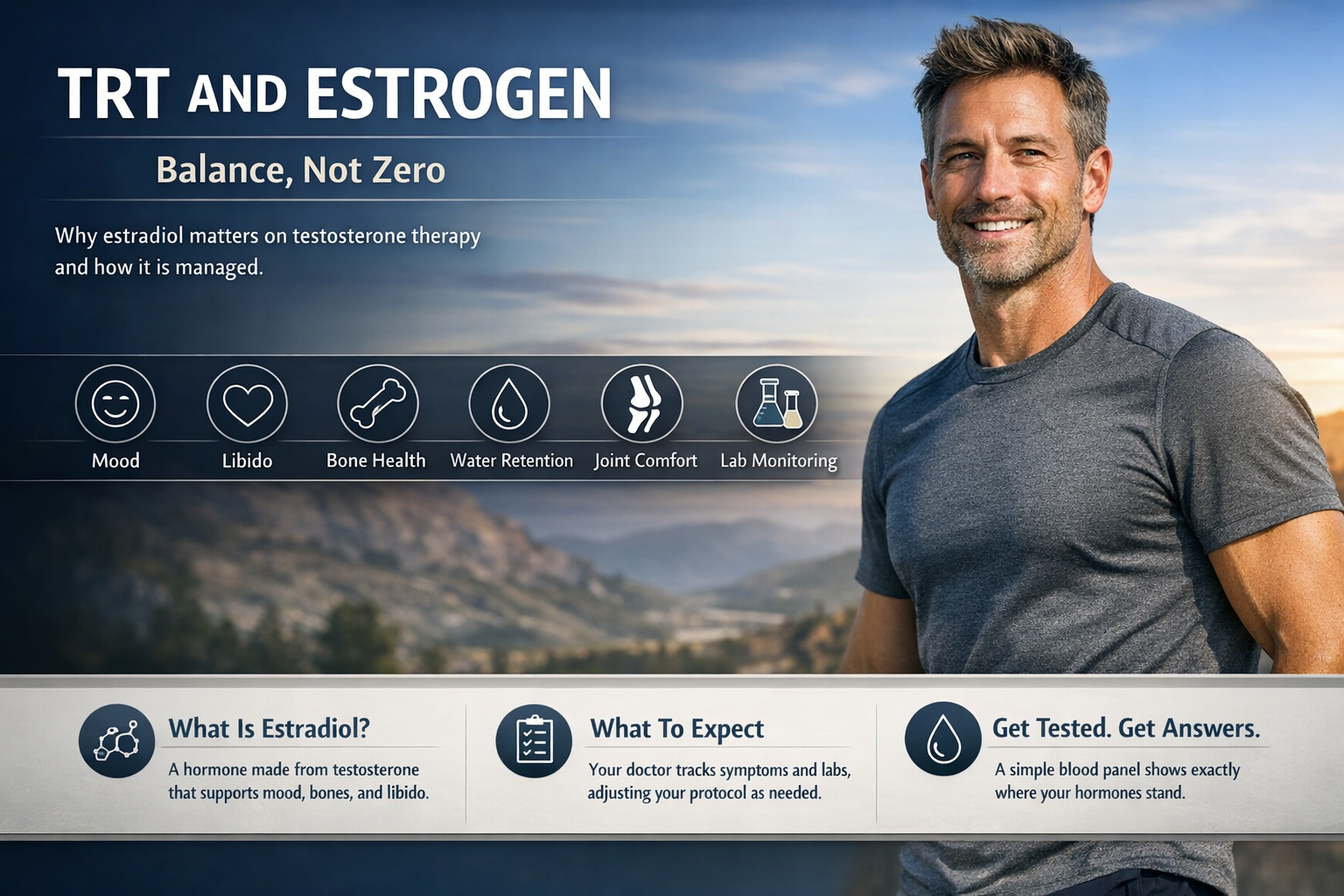
TRT and Estrogen (E2) Management: What Men Need to Know
If you've spent any time in TRT forums, you've probably seen estrogen treated like the enemy. The truth is more interesting: TRT and estrogen management go hand in hand because estradiol (E2) is one of the most important hormones in the male body. Men starting testosterone replacement therapy in Arizona often ask us whether they'll need an "estrogen blocker" on day one. For most men, the answer is no — and understanding why will make you a smarter patient wherever you get treated.
This guide covers why testosterone converts to estrogen, what E2 actually does for you, the symptoms of levels that are too high or too low, and how a good TRT clinic manages it all with labs rather than guesswork.
Why testosterone converts to estrogen in men
Your body contains an enzyme called aromatase, found mainly in fat tissue, that converts a portion of circulating testosterone into estradiol. This isn't a malfunction — it's by design. Every man makes estrogen this way, and when you raise testosterone with TRT, estradiol typically rises alongside it.
A few factors influence how much conversion happens:
- Body fat percentage. Aromatase lives largely in adipose tissue, so men carrying more body fat tend to convert more testosterone to estradiol.
- Dose size and injection frequency. Large, infrequent injections create big testosterone peaks that drive more aromatization. Smaller, more frequent doses keep levels — and conversion — steadier.
- Genetics. Some men are simply "high aromatizers" at any body composition.
This is one reason a baseline estradiol level is part of the bloodwork you need before starting TRT — your provider wants to know your starting point before your protocol begins.
What estradiol actually does for men
Estradiol is not a "female hormone" that men should suppress to zero. In men, estradiol plays essential roles in libido, erectile function, and sperm production, and endocrinology reviews now describe estradiol as a genuine male hormone with important effects on bone density, body fat regulation, and brain function.
Adequate E2 in men supports:
- Bone health — much of testosterone's protective effect on bone actually works through estradiol.
- Libido and erections — both very low and very high E2 are associated with sexual symptoms.
- Mood and cognition — estradiol is active in the brain and contributes to emotional stability.
- Cardiovascular and metabolic health — E2 influences cholesterol handling and fat distribution.
In other words, crushing estradiol with medication "just in case" can undermine several of the benefits you started TRT to get.
Symptoms of high estradiol on TRT
That said, estradiol can climb higher than ideal, especially early in treatment or with higher doses. Possible signs include:
- Water retention, puffiness, or a bloated feeling
- Moodiness or heightened emotional sensitivity
- Nipple sensitivity or tenderness
- Gynecomastia — the growth of breast gland tissue, which the Endocrine Society attributes to an imbalance between estrogen and testosterone
- Reduced libido despite good testosterone levels
None of these symptoms is proof by itself that E2 is high — several overlap with other causes, which is why symptom reports should always be paired with labs. High estradiol is one of the more manageable items on the list of TRT risks and side effects, precisely because it responds so predictably to protocol adjustments.
Wondering where your estradiol stands? Find out with a full hormone panel.
Doctor-supervised • Arizona-based • Telehealth available
Get Started — Free Assessment →Symptoms of estradiol that's too low ("crashed E2")
The opposite problem is just as real — and usually self-inflicted. Men who take aromatase inhibitors too aggressively, often without labs, can crash their estradiol and feel worse than before TRT:
- Achy, creaky joints and tendon discomfort
- Flat mood, irritability, or low-grade anxiety
- Vanishing libido and weaker erections — remember, E2 contributes to sexual function, so tanking it can mimic the very problems covered in our guide to erectile dysfunction versus low testosterone
- Fatigue and poor sleep quality
- Over the long term, accelerated bone loss
Crashed estradiol typically takes weeks to recover, which is why experienced clinicians treat aromatase inhibitors with respect rather than handing them out reflexively.
How a good TRT clinic manages estradiol
Modern estrogen management follows a clear hierarchy, and medication is near the bottom of it:
- Dose and frequency first. If E2 runs high, the first move is usually splitting the weekly testosterone dose into smaller, more frequent injections or modestly lowering the total dose. Smaller peaks mean less aromatization.
- Body composition second. Because fat tissue houses aromatase, losing body fat durably lowers estrogen conversion — a benefit that compounds as TRT itself helps improve body composition.
- Treat symptoms plus labs, not numbers alone. A man with an E2 slightly above the reference range and zero symptoms often needs no intervention at all.
- Aromatase inhibitors only when clearly indicated. Research on men receiving testosterone therapy shows that aromatase inhibitors are typically reserved for men with clearly elevated estradiol plus symptoms, at conservative doses with follow-up labs — not used as a default add-on.
Expect some fine-tuning in your first months of treatment: estradiol is one of the levers your provider watches while your protocol is dialed in, alongside your symptoms and energy. Our overview of how long TRT takes to work walks through that adjustment timeline in detail.
Monitoring estradiol on TRT in Arizona
Estradiol is checked with a simple blood draw — ideally the sensitive (LC/MS) estradiol assay, which is more accurate for men than the standard immunoassay used for women. At AZTRT, estradiol monitoring is built into routine follow-up labs alongside total testosterone and hematocrit — if you're curious why that last one matters, see our explainer on why hematocrit monitoring matters on TRT.
For men in Phoenix, Scottsdale, Mesa, Tempe, Chandler, Gilbert, and Tucson, the process is telehealth-friendly: your lab order is sent electronically, you stop by a local draw site (Labcorp and Quest locations are spread across the Valley and Tucson), and results are reviewed with your provider online. No clinic waiting rooms required — a real advantage when it's 110° outside.
The bottom line
Estrogen isn't your enemy on TRT — imbalance is. Estradiol supports your bones, brain, libido, and heart, and most men on well-designed protocols keep it in range without any additional medication. The keys are sensible dosing, regular labs with the sensitive E2 assay, and a provider who treats you — not just a number on a page.
Get a doctor-supervised TRT protocol that keeps your hormones in balance.
Doctor-supervised • Arizona-based • Telehealth available
Get Started — Free Assessment →Frequently asked questions
What should estradiol levels be on TRT?
There's no single perfect number. Many men feel best with estradiol roughly in the 20–40 pg/mL range on a sensitive assay, but the right level varies by individual. Providers interpret E2 in context — alongside your testosterone level, symptoms, and how you feel — rather than chasing a specific target number.
Do I need an aromatase inhibitor on TRT?
Most men don't. Aromatase inhibitors like anastrozole are generally reserved for men with clearly elevated estradiol plus real symptoms, after dose and frequency adjustments have been considered. Taking one "preventively" risks crashing your estradiol, which causes joint pain, low libido, mood problems, and bone loss.
Does high estrogen on TRT cause gynecomastia?
It can contribute. Gynecomastia develops from an imbalance between estrogen and testosterone activity in breast tissue. On a monitored TRT protocol it's uncommon, and early nipple sensitivity is a signal to check labs and adjust — long before any lasting tissue change develops.
Sources
- The Role of Estradiol in Male Reproductive Function — PMC / National Institutes of Health
- Mechanisms in Endocrinology: Estradiol as a Male Hormone — PubMed / European Journal of Endocrinology
- Gynecomastia — Endocrine Society
- The Utilization and Impact of Aromatase Inhibitor Therapy in Men With Elevated Estradiol Levels on Testosterone Therapy — PubMed
