
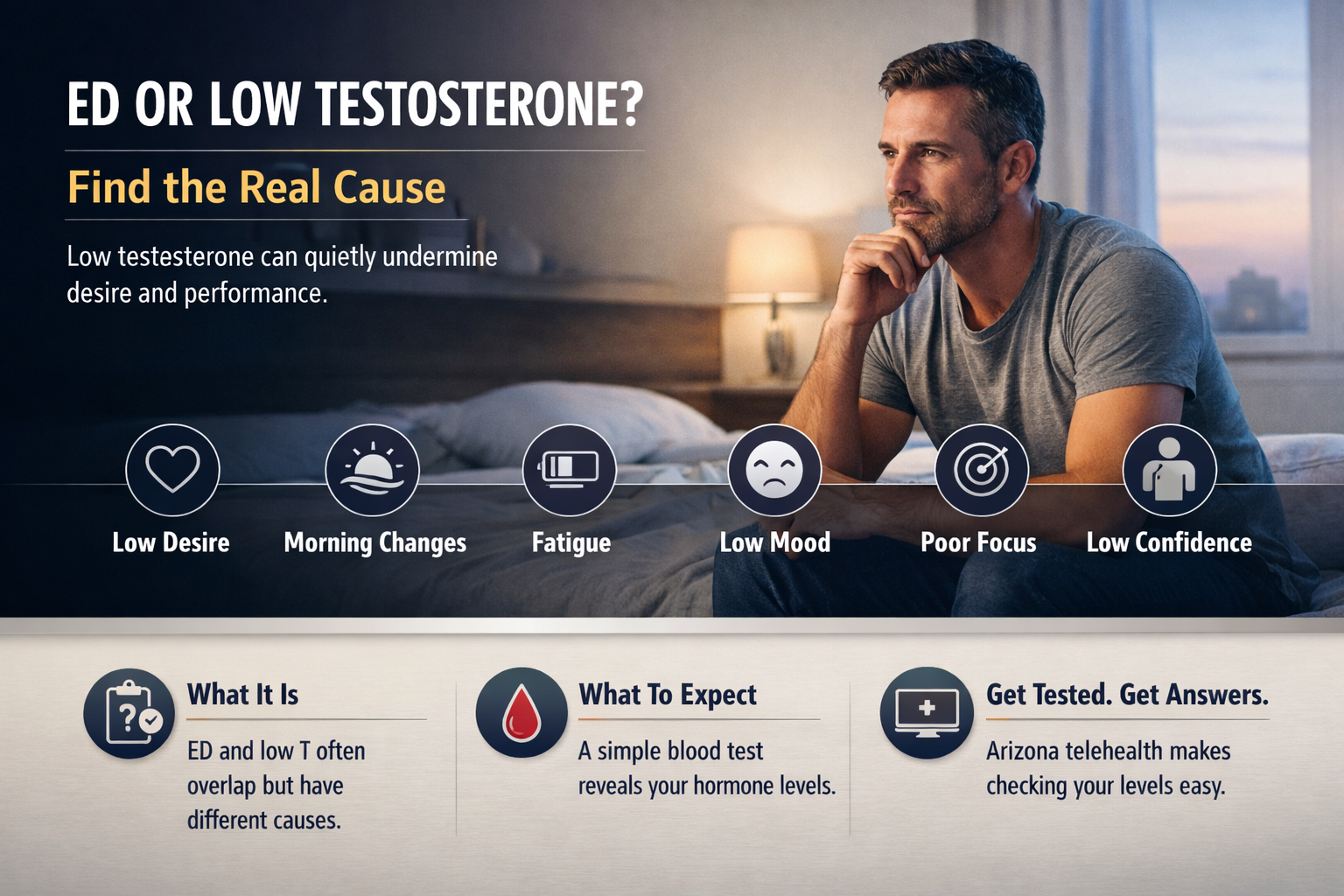
Erectile Dysfunction vs. Low Testosterone: Which Is It?
If you're dealing with erectile dysfunction, one of the first questions worth asking is whether low testosterone is the real cause — or whether something else is going on. Erectile dysfunction (ED) and low testosterone (low T) overlap in many men, but they are distinct conditions with different causes and different treatments. Treating the wrong one wastes months. This guide explains how to tell the difference, when testosterone replacement therapy (TRT) actually helps, and how men in Phoenix and across Arizona can get a clear answer with one blood draw.
ED and low testosterone aren't the same thing
Erectile dysfunction means difficulty getting or keeping an erection firm enough for sex. Low testosterone means your body isn't producing enough of the primary male hormone — typically confirmed when a morning total testosterone reading comes back below roughly 300 ng/dL alongside symptoms.
Here's the part most men don't hear: erections depend more on blood vessels and nerves than on hormones. Testosterone plays a supporting role — it drives desire and helps maintain the biological machinery of erections — but a man with completely normal testosterone can still have ED, and some men with low T have no erection problems at all. Studies of men presenting with ED find that only a minority have low testosterone as the primary driver. That's exactly why testing matters: you want to know which problem you're actually treating.
How testosterone affects erections and sex drive
Testosterone influences sexual function through several pathways:
- Libido (desire). This is testosterone's strongest sexual effect. When levels drop, interest in sex often fades first — before any mechanical problem appears.
- Nighttime and morning erections. Spontaneous nocturnal erections are partly testosterone-dependent. Many men with low T notice these becoming less frequent or disappearing.
- Nitric oxide signaling. Testosterone supports the enzyme activity that produces nitric oxide, the molecule that relaxes blood vessels in the penis and allows blood to flow in.
- Brain arousal circuits. Testosterone acts on the central nervous system regions that initiate arousal — with low T, the "spark" itself can weaken.
So low testosterone can absolutely contribute to erectile problems. But it usually does so indirectly, by dialing down desire and arousal, rather than by blocking the physical mechanism outright.
Signs your problem is more likely low testosterone
Low T is rarely just a bedroom issue. If your erection problems come packaged with body-wide symptoms, hormones deserve a close look:
- Your desire for sex has dropped — the interest isn't there, not just the performance
- Morning erections are rare or gone
- Persistent fatigue that sleep doesn't fix
- Low mood, irritability, or flat motivation
- Losing muscle or gaining belly fat despite consistent training
- Brain fog or trouble concentrating at work
This pattern — gradual onset, low desire, plus energy and mood changes — points toward a hormonal cause and is a strong reason to get your levels checked.
Signs it's more likely something other than low T
Other clues point away from hormones:
- Sudden onset. Hormone-related decline is gradual. ED that appears almost overnight is more often psychological or medication-related.
- Situational ED. If erections work fine during masturbation or in the morning but fail during sex, performance anxiety or relationship stress is a likely driver.
- Normal desire, failing mechanics. Wanting sex but being physically unable to maintain an erection suggests a vascular or nerve issue rather than low T.
- Cardiovascular risk factors. Diabetes, high blood pressure, high cholesterol, and smoking damage the small arteries that fill the penis. ED can be an early warning sign of vascular disease — worth taking seriously for reasons far beyond the bedroom.
- Medications. Some antidepressants (especially SSRIs), blood pressure drugs, and prostate medications commonly cause ED as a side effect.
Find Out If Low T Is Behind Your Symptoms
Arizona-licensed providers • Arizona-based • Telehealth available
Get Started — Free Assessment →Can TRT fix erectile dysfunction?
It depends on whether low testosterone is actually the cause — which is why guessing is a bad strategy.
When TRT tends to help
In men with confirmed low testosterone, restoring levels to the normal range often improves libido first, typically within the first several weeks of therapy. Erection quality frequently improves alongside it, especially when the main complaints were low desire and weak spontaneous erections. Research suggests TRT produces the most noticeable sexual benefits in men who start with clearly low levels — bringing an already-normal level higher generally doesn't improve erections.
When TRT alone isn't enough
If ED is primarily vascular — narrowed arteries from diabetes, hypertension, or years of smoking — TRT won't repair blood vessels. In these cases, providers often combine approaches: PDE5 inhibitors (sildenafil, tadalafil) to improve blood flow, plus TRT if levels are low. Interestingly, some evidence suggests PDE5 inhibitors work better when testosterone is in the normal range, which is one reason clinicians check hormones in men whose ED medication has stopped working well.
Lifestyle still moves the needle
Weight loss, resistance training, better sleep, limiting alcohol, and quitting smoking each independently support both testosterone production and erectile function. The men who see the best results usually combine medical treatment with these changes rather than choosing one or the other.
How Arizona men can find out for sure
The only way to know whether low testosterone is contributing to your ED is bloodwork — symptoms alone can't distinguish the causes. A proper evaluation includes:
- A morning blood draw (roughly 7–10 a.m.), when testosterone peaks. Afternoon values run misleadingly low.
- Total and free testosterone, since some men have normal totals but low free (usable) hormone.
- A repeat test to confirm a low result before any diagnosis, plus related labs your provider may add based on your history.
For men in Phoenix, Scottsdale, Mesa, Tempe, Gilbert, Tucson, and everywhere in between, this no longer requires sitting in a waiting room. AZTRT operates entirely by telehealth for Arizona residents: your consultation happens online, your lab order is sent to a draw site near you, and a licensed provider reviews your results and symptoms together. If low testosterone is confirmed, treatment and ongoing monitoring are managed remotely with medication shipped to your door — and if your levels come back normal, you've ruled out a major suspect and can focus on the real cause with your doctor.
Frequently asked questions
Can low testosterone cause erectile dysfunction?
Yes, low testosterone can contribute to erectile dysfunction — mainly by reducing sexual desire, weakening spontaneous erections, and dampening the nitric oxide signaling that drives blood flow. However, most ED has other primary causes, such as vascular disease, medications, or stress, so a blood test is needed to know whether low T is involved.
Will TRT help with ED?
TRT tends to improve erections and libido in men with confirmed low testosterone, with desire often improving within the first several weeks. If testosterone levels are normal, TRT is unlikely to fix ED, and vascular or psychological causes should be evaluated instead. Some men benefit from combining TRT with PDE5 inhibitors like sildenafil or tadalafil.
What testosterone level causes ED?
There is no single cutoff, but sexual symptoms — including reduced erections and low libido — become much more common as morning total testosterone falls below roughly 300 ng/dL. Some men notice symptoms at higher levels, which is why providers evaluate free testosterone and symptoms together rather than relying on one number.
Get Tested. Get Answers. Get Back to Yourself.
Arizona-licensed providers • Arizona-based • Telehealth available
Get Started — Free Assessment →