
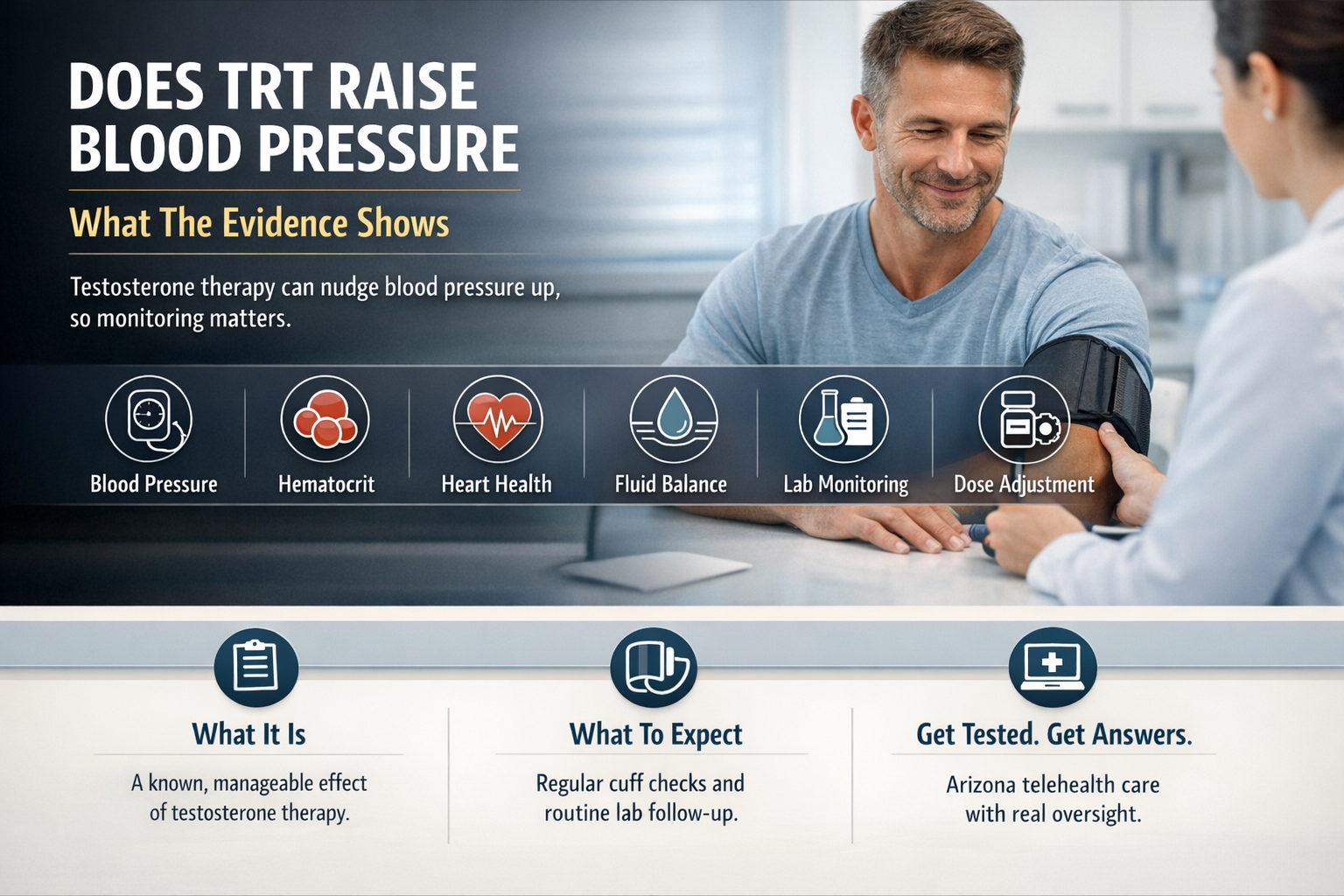
Does TRT Raise Blood Pressure? What Arizona Men Should Know
If you have been researching testosterone therapy in Phoenix, Scottsdale, or anywhere else in Arizona, sooner or later you run into the question: does TRT raise blood pressure? It is a fair concern. Blood pressure is the single most common chronic condition in American men, and nobody wants to fix their energy and libido at the cost of their cardiovascular health. The honest answer is that testosterone therapy can nudge blood pressure upward in some men — usually by a small amount — and that this effect is predictable, measurable, and manageable when someone is actually watching your numbers.
Below is what the evidence actually shows, why it happens, who is most at risk, and how a properly run Arizona TRT program keeps blood pressure from becoming a problem.
What the FDA says about TRT and blood pressure
This is not a fringe worry — it is now printed on the label. In early 2025, after reviewing the results of required post-market ambulatory blood pressure monitoring studies, the FDA issued class-wide labeling changes adding a blood pressure warning to all testosterone products. Those same labeling changes also removed the older boxed warning about increased cardiovascular risk, based on the large TRAVERSE trial.
That combination is worth sitting with, because it is easy to misread in either direction:
- The good news: in men with genuinely diagnosed low testosterone, TRT did not increase major adverse cardiac events like heart attack and stroke compared with placebo — which is why the old boxed warning came off.
- The caveat: ambulatory monitoring did consistently detect a small rise in blood pressure across the whole drug class — which is why the new warning went on.
In other words, the risk profile shifted from "vague and alarming" to "specific and trackable." A specific, trackable risk is exactly the kind a monitoring program can handle. We go deeper into the broader cardiac picture in our guide to TRT and heart health.
How much does testosterone actually raise blood pressure?
The magnitude matters. In the 24-hour ambulatory blood pressure studies the FDA required, the average increases were in the low single digits — roughly two to four points of systolic pressure and one to two points of diastolic pressure, depending on the product and study duration.
For a man sitting comfortably in the normal range, an increase that small is clinically unremarkable. For a man who is already borderline hypertensive or poorly controlled on medication, the same small shift can be the difference between "acceptable" and "needs attention." That is the practical takeaway: the average effect is small, but the average is not you.
It is also worth noting that the picture in the research literature is genuinely mixed. A review of testosterone therapy's effects on blood pressure in hypogonadal men found that some studies actually reported reductions in systolic and diastolic pressure, likely because correcting low testosterone can improve body composition, insulin sensitivity, and sleep — all of which push blood pressure down. Formulation appears to matter too, with certain oral preparations showing more of a pressor effect than others.
Why testosterone can push blood pressure up
There is no single mechanism. Several plausible ones stack together:
1. More red blood cells, thicker blood
This is the big one. Testosterone stimulates the bone marrow to produce red blood cells. Push it far enough and you get erythrocytosis — a hematocrit high enough to make blood measurably more viscous. Thicker blood means the heart works harder to move it, which can register as higher pressure. Research on erythrocytosis following testosterone therapy identifies it as the most common dose-limiting side effect of TRT, driven by rises in erythropoietin and drops in hepcidin. This is precisely why tracking hematocrit with routine bloodwork is non-negotiable on therapy.
2. Fluid and sodium retention
Testosterone can cause mild sodium and water retention, especially in the first weeks of treatment. More circulating volume means more pressure against the arterial wall. This usually settles, and it is often what men are describing when they mention slight puffiness early on.
3. Estradiol conversion
Some testosterone converts to estradiol. Poorly managed estradiol can contribute to fluid retention and other symptoms, which is one of several reasons E2 is monitored alongside testosterone rather than ignored.
4. Dose and delivery method
Supraphysiologic dosing — the kind seen with unsupervised or black-market testosterone use, not legitimate replacement therapy — amplifies every one of the effects above. Formulations with big peak-and-trough swings tend to produce more hematocrit drift than steadier ones.
Want TRT with real monitoring behind it?
Doctor-supervised • Arizona-based • Telehealth available
Get Started — Free Assessment →Who is most at risk?
Not every man on TRT needs to worry equally. The men who warrant closer watching are those who:
- Already have hypertension, especially if it is not well controlled
- Start therapy with a hematocrit in the upper end of the normal range
- Have untreated obstructive sleep apnea — a major independent driver of both high blood pressure and elevated hematocrit
- Carry significant excess weight, since the relationship between low testosterone and body fat runs in both directions and excess weight independently raises blood pressure
- Have a personal or family history of blood clots, heart failure, or kidney disease
- Drink heavily, smoke, or use stimulants
Sleep apnea deserves special mention because it is so common and so often undiagnosed in men presenting with low-T symptoms. If you snore heavily or wake unrefreshed, read our piece on TRT and sleep apnea before starting therapy.
Living in Arizona adds one more variable: heat
This is a genuinely local consideration. Phoenix, Mesa, Tempe, and the rest of the Valley spend months above 100°F, and dehydration meaningfully affects both blood pressure regulation and hematocrit readings. A man who shows up dehydrated for a summer blood draw can produce a hematocrit result that looks alarming but partly reflects concentrated plasma rather than true red cell mass.
Practical Arizona habits that help:
- Hydrate well the day before and the morning of any lab draw
- Schedule summer labs early in the morning, before the heat load builds
- Increase fluid intake during outdoor work or training, not just during it
- Mention any recent heat exposure or illness to your provider when reviewing unexpected results
How a well-run TRT program manages blood pressure
A serious clinic does not simply hand you a vial and wish you luck. Blood pressure management on TRT looks like this:
- Baseline before anything starts. Blood pressure reading plus a full lab panel including hematocrit, hemoglobin, PSA, estradiol, and lipids. Without a baseline, later numbers are uninterpretable.
- Conservative starting dose. Replacement, not enhancement. The goal is a healthy physiologic range, not the highest number the lab can print.
- Recheck at roughly 8–12 weeks. Repeat labs and blood pressure, then adjust.
- Ongoing monitoring, typically every 6–12 months once you are stable.
- Home cuff readings between visits. A $40 upper-arm monitor gives far better data than a single reading in a clinic, and it catches drift early.
- Act on the numbers. If hematocrit climbs or pressure rises, the response is a dose reduction, a formulation change, a hydration and lifestyle review, therapeutic phlebotomy where appropriate, or coordination with your primary care physician on antihypertensive management — not "wait and see."
This is also why the safety conversation should be had before your first injection, not after. Our overview of the risks and side effects of testosterone replacement therapy covers the full list, and if you have not yet confirmed a diagnosis, start with how to get your testosterone tested in Arizona.
Should high blood pressure stop you from starting TRT?
Usually, no — but it changes the sequence. Well-controlled hypertension is not a barrier to testosterone therapy for most men. Uncontrolled hypertension is a reason to get your pressure managed first, then reassess. The same logic applies to untreated sleep apnea and to a starting hematocrit that is already elevated.
Mayo Clinic's overview of the potential benefits and risks of testosterone therapy makes a related point that is easy to miss: the favorable safety data applies to men who genuinely have low testosterone and a clinical indication for treatment. It is not a green light for men with normal levels seeking a performance edge. If your levels are normal, the risk-benefit math is entirely different — which is why diagnosis comes first, always.
Get answers about your levels — and your numbers
Doctor-supervised • Arizona-based • Telehealth available
Get Started — Free Assessment →The bottom line
TRT can raise blood pressure modestly, the FDA now requires that warning on every testosterone label, and the effect is driven mostly by red blood cell production and fluid retention. It is small on average, variable between individuals, and entirely trackable with a blood pressure cuff and routine labs. The men who run into trouble are almost always the ones running testosterone without oversight — no baseline, no follow-up bloodwork, no dose adjustments, no one watching hematocrit climb quarter after quarter.
Testosterone therapy is a long-term medical treatment. Treated like one, blood pressure is a manageable variable rather than a hidden risk.
Frequently asked questions
Can I take TRT if I already have high blood pressure?
In most cases yes, provided your blood pressure is reasonably well controlled. Your provider will want a baseline reading and labs before starting, then closer monitoring in the first few months. If your hypertension is uncontrolled, the usual approach is to get it managed first — often in coordination with your primary care physician — and then reassess starting testosterone therapy.
How often should I check my blood pressure on testosterone therapy?
A reasonable approach is a home upper-arm cuff reading a couple of times a week for the first three months, then weekly or biweekly once you are stable, plus formal readings at each follow-up visit. Take readings at the same time of day, seated and rested for five minutes, and bring the log to your appointments. This catches gradual drift that a single office reading would miss.
Does blood pressure go back down if I stop TRT?
Generally yes. The blood-pressure-related effects of testosterone therapy — elevated hematocrit and fluid retention — are dose-dependent and tend to reverse over weeks to a few months after stopping or reducing the dose. That said, stopping TRT abruptly brings its own consequences, including the return of low-testosterone symptoms, so any change should be made with your provider rather than on your own.
Sources
- FDA Issues Class-Wide Labeling Changes for Testosterone Products — U.S. Food and Drug Administration
- Testosterone Replacement Therapy: Effects on Blood Pressure in Hypogonadal Men — PubMed Central (NIH)
- Erythrocytosis Following Testosterone Therapy — PubMed Central (NIH)
- Testosterone Therapy: Potential Benefits and Risks as You Age — Mayo Clinic
