
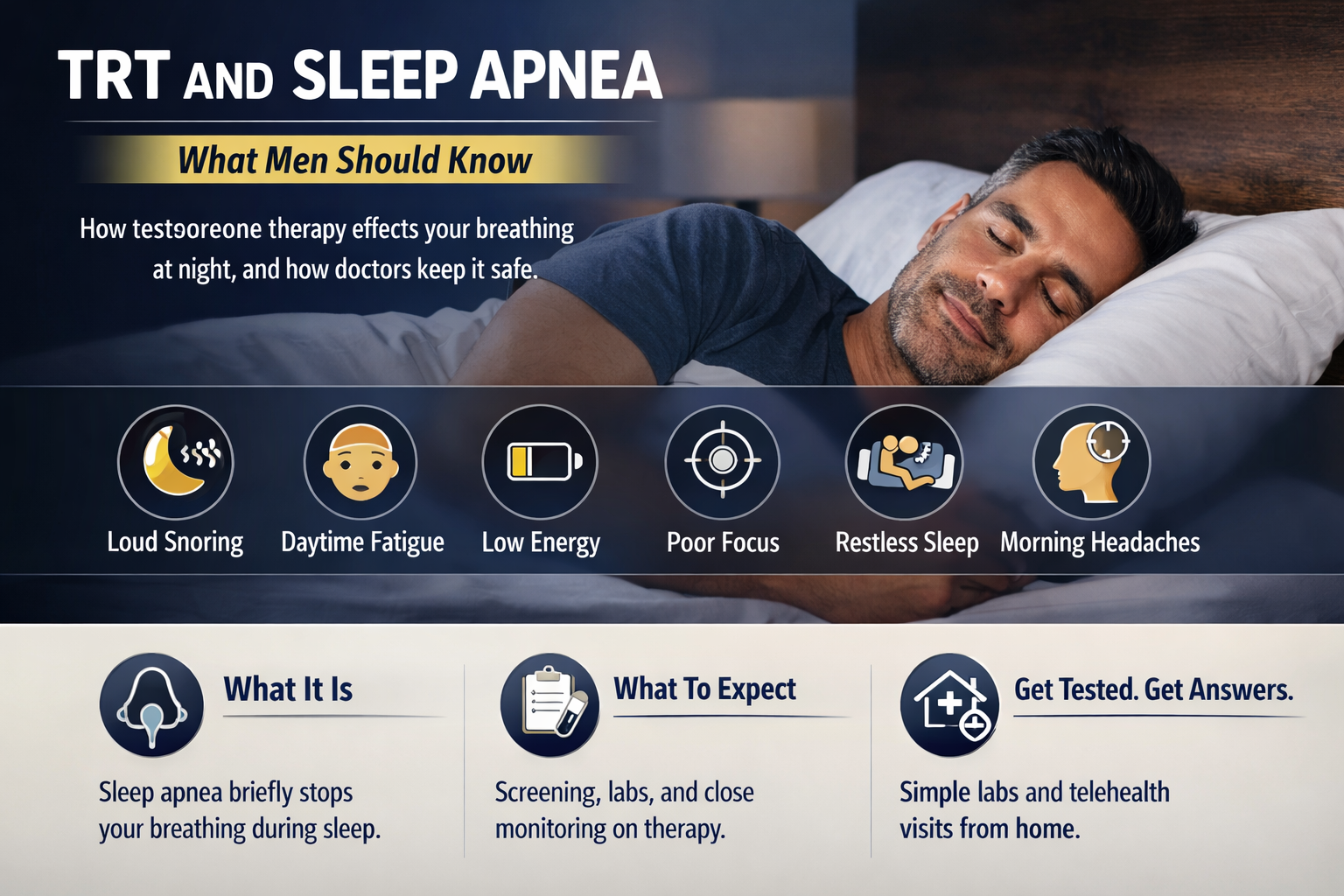
TRT and Sleep Apnea: Is Testosterone Therapy Safe If You Snore?
If you snore loudly, wake up gasping, or feel exhausted no matter how long you sleep, the question of TRT and sleep apnea matters more than you might think. Obstructive sleep apnea and low testosterone show up together constantly in Arizona men — and each one makes the other worse. Testosterone replacement therapy (TRT) can be safe and effective for men with sleep apnea, but only when it's screened for, managed, and monitored the right way. Here's what men in Phoenix, Scottsdale, Mesa, and across Arizona should know before starting therapy.
What is obstructive sleep apnea?
Obstructive sleep apnea is a condition where the soft tissue in your throat repeatedly collapses during sleep, briefly blocking your airway. Each blockage — an "apnea" — can last ten seconds or longer, and it can happen dozens of times per hour without you ever fully waking up. Your brain registers the drop in oxygen, jolts you just enough to reopen the airway, and the cycle repeats all night. According to the Cleveland Clinic's overview of obstructive sleep apnea, hallmark signs include loud snoring, witnessed pauses in breathing, gasping or choking at night, morning headaches, and heavy daytime fatigue.
Sound familiar? Many of those symptoms — fatigue, brain fog, irritability, low drive — overlap almost perfectly with the symptoms of low testosterone. That overlap is exactly why the two conditions get tangled together, and why a good TRT clinic screens for sleep apnea rather than assuming every tired man just needs testosterone.
How are sleep apnea and low testosterone connected?
The relationship runs in both directions.
- Sleep apnea can lower testosterone. Your body produces most of its testosterone during deep sleep. OSA shatters sleep architecture, cutting down the deep and REM stages where that production happens. Research on the relationship between obstructive sleep apnea, hypogonadism, and TRT shows that men with OSA — particularly men carrying extra weight — have meaningfully lower testosterone levels than men who sleep normally.
- Low testosterone can worsen sleep quality. Low T is independently associated with fragmented, unrefreshing sleep, which compounds the problem. We cover that side of the loop in detail in our guide to low testosterone and poor sleep.
- Obesity feeds both. Excess weight is the biggest shared risk factor — it narrows the airway and suppresses testosterone at the same time, creating a cycle that's hard to break without treating both ends.
In practice, that means a man in his 40s with untreated sleep apnea often walks into a Phoenix TRT clinic with a testosterone level well below where it should be — and treating one condition while ignoring the other leaves results on the table.
Can TRT make sleep apnea worse?
It can, in some men — and this is the part every honest TRT clinic should explain up front. Testosterone influences the neuromuscular control of your upper airway and your body's response to low oxygen during sleep. Because of that, Endocrine Society clinical practice guidelines recommend against starting testosterone therapy in men with severe, untreated obstructive sleep apnea.
A few important nuances from the research:
- The worsening effect appears most often with short-term, higher-dose testosterone. Studies suggest the effect tends to fade over time, and long-term physiologic dosing has not shown the same consistent harm.
- Men with treated sleep apnea — for example, using a CPAP machine nightly — are generally considered appropriate candidates for TRT with monitoring.
- TRT raises red blood cell production, and untreated OSA does the same thing through repeated nighttime oxygen drops. Stacked together, the two can push hematocrit high enough to thicken the blood — one more reason hematocrit monitoring on TRT is non-negotiable.
None of this makes TRT off-limits for men who snore. It makes screening and dosing strategy essential.
Tired all day no matter how you sleep? Find out if low T is part of it.
Doctor-supervised • Arizona-based • Telehealth available
Get Started — Free Assessment →Can you take TRT if you have sleep apnea?
For most men, yes — with the right sequence. Here's how a responsible Arizona TRT protocol handles it:
- Screen before you start. A short questionnaire covering snoring, witnessed apneas, neck size, blood pressure, and daytime sleepiness flags men at high risk. Men with strong red flags are referred for a sleep study — often an at-home test that takes one night.
- Treat severe OSA first. If a sleep study shows severe untreated apnea, getting it controlled (usually with CPAP) comes before testosterone. This isn't a delay tactic — controlled OSA makes TRT both safer and more effective.
- Start with baseline labs. Testosterone, hematocrit, PSA, and estradiol all get measured before the first dose. Our breakdown of the bloodwork you need before starting TRT walks through exactly what's drawn and why — all available at local Arizona labs, no doctor's office wait required.
- Dose conservatively and recheck. Physiologic dosing, follow-up labs at regular intervals, and symptom check-ins catch problems early. Worsening snoring, new gasping episodes, or a partner noticing breathing pauses are all reasons to reassess — the same vigilance we apply to every item on the list of TRT risks and side effects.
Does treating sleep apnea raise testosterone on its own?
Sometimes — but usually not enough. It's a fair question: if OSA suppresses testosterone, shouldn't fixing the OSA fix the testosterone? The evidence is mixed. A meta-analysis of CPAP's effect on testosterone levels found that CPAP therapy alone did not significantly raise testosterone in men with OSA. Weight loss appears to do more for both conditions than CPAP does for testosterone.
The practical takeaway for Arizona men: treat sleep apnea because it protects your heart, brain, and energy — and if your testosterone is still clinically low once your sleep is controlled, that's when TRT earns its place in the plan.
How AZTRT handles TRT and sleep apnea in Arizona
AZTRT is a physician-supervised, telehealth-first TRT clinic built for Arizona men. For patients with sleep apnea or symptoms that suggest it, that means OSA screening during your initial evaluation, lab orders at draw sites near you in Phoenix, Scottsdale, Mesa, Tempe, Chandler, Gilbert, or Tucson, conservative evidence-based dosing, and scheduled hematocrit and hormone monitoring for as long as you're on therapy. If your history points to untreated severe apnea, we'll say so — and help you get it addressed before putting testosterone into the mix. That's what safe hormone optimization looks like.
Snoring, low energy, low drive? Get real answers from an Arizona TRT doctor.
Doctor-supervised • Arizona-based • Telehealth available
Get Started — Free Assessment →Frequently asked questions
Can I start TRT if I have untreated sleep apnea?
If your sleep apnea is severe and untreated, most guidelines — including the Endocrine Society's — recommend getting it treated before starting testosterone therapy, because TRT can temporarily worsen breathing during sleep. Men with mild or well-treated OSA can usually start TRT safely under medical supervision with regular monitoring.
Does TRT cause sleep apnea?
TRT doesn't cause sleep apnea in men with healthy airways, but it can unmask or aggravate existing OSA, most often early in treatment or at higher doses. Research suggests the effect tends to lessen over time at physiologic doses. Screening before treatment and follow-up monitoring keep the risk low.
Will treating my sleep apnea increase my testosterone?
Not reliably. Studies show CPAP alone usually doesn't raise testosterone significantly, though it dramatically improves sleep quality and daytime energy. Weight loss helps both conditions more. If testosterone remains clinically low after your OSA is controlled, doctor-supervised TRT is the direct way to restore it.
Sources
- The complex relation between obstructive sleep apnoea syndrome, hypogonadism and testosterone replacement therapy — PMC / National Institutes of Health
- Testosterone Therapy for Hypogonadism Clinical Practice Guideline — Endocrine Society
- Effects of CPAP on Testosterone Levels in Patients With Obstructive Sleep Apnea: A Meta-Analysis — PMC / National Institutes of Health
- Obstructive Sleep Apnea (OSA): Symptoms & Treatment — Cleveland Clinic
