
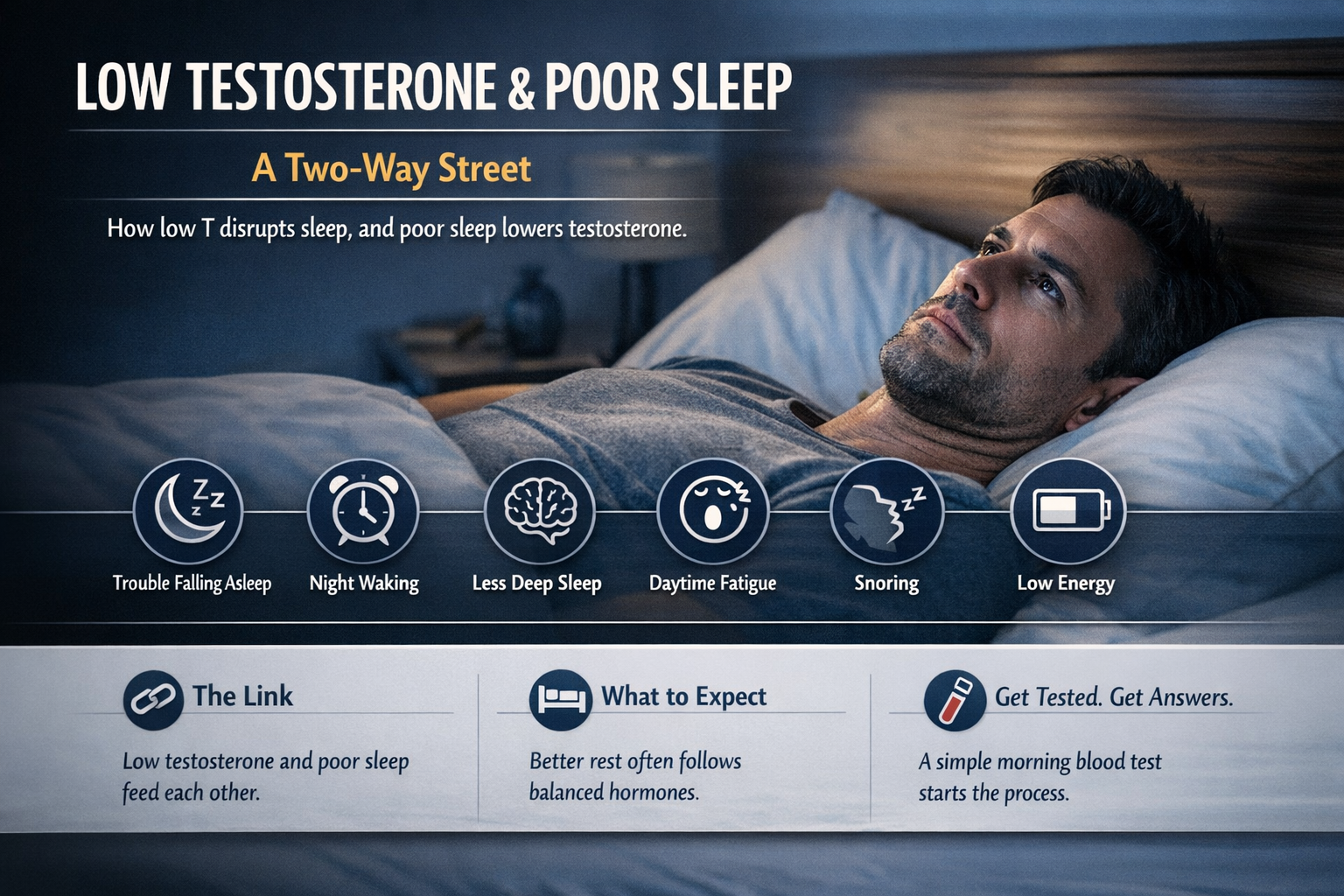
Low Testosterone and Poor Sleep: What's the Link?
If you're lying awake at 2 a.m. wondering why you're exhausted all day but can't sleep at night, low testosterone and poor sleep could be locked in a cycle that keeps making each other worse. Testosterone and sleep are tightly connected in men: your body releases most of its daily testosterone while you sleep, and low testosterone in turn is associated with lighter, more fragmented rest. For men across Phoenix, Scottsdale, Mesa, and the rest of Arizona, understanding this connection matters — because treating just the sleep, or just the hormones, often isn't enough.
How testosterone and sleep are connected
Testosterone production follows a daily (circadian) rhythm. Levels climb during the night — especially during deep sleep and the first REM cycles — and peak in the early morning. That's why labs measure testosterone between roughly 7 and 10 a.m., when levels are highest and most consistent.
This rhythm means sleep isn't just rest for your brain; it's the production window for your primary male hormone. Men who consistently sleep well give their bodies the conditions needed to produce normal testosterone. Men who consistently sleep 5–6 hours or wake repeatedly through the night cut that production window short, night after night.
How low testosterone disrupts sleep
The relationship runs the other direction, too. Men with low testosterone commonly report:
- Trouble falling asleep — low T is associated with insomnia-like symptoms and a restless, wired-but-tired feeling at night.
- Frequent night waking — sleep becomes lighter and more fragmented, with less time in restorative deep sleep.
- Night sweats — hormonal shifts can trigger sweating episodes that break up sleep.
- Non-restorative sleep — waking after a full night in bed still feeling drained.
Low testosterone also tends to travel with higher evening cortisol (your stress hormone), increased body fat, and low mood — all of which independently make sleep worse. The result is a frustrating pattern: you're exhausted by 9 p.m., asleep by 10, awake at 2, and dragging by noon.
How poor sleep lowers testosterone
Sleep restriction has a measurable effect on hormone levels. In controlled research, healthy young men limited to about five hours of sleep per night for just one week saw their daytime testosterone drop noticeably — a decline comparable to a decade or more of normal aging. Other studies link chronic short sleep and shift work with lower average testosterone.
The mechanism is straightforward: less total sleep and less deep sleep mean less time in the hormonal production window. Add in the elevated cortisol that comes with sleep deprivation — cortisol and testosterone tend to move in opposite directions — and a few months of bad sleep can leave a real dent in your levels.
This is why a man in his 30s or 40s juggling work stress, young kids, and six hours of broken sleep can present with testosterone levels you'd expect in a much older man.
Sleeping Poorly? Check Your Testosterone.
Doctor-supervised • Arizona-based • Telehealth available
Get Started — Free Assessment →The sleep apnea connection
No honest discussion of testosterone and sleep is complete without obstructive sleep apnea (OSA). Men with untreated sleep apnea frequently have lower testosterone, because apnea destroys exactly the deep, continuous sleep that hormone production requires. Loud snoring, gasping awake, morning headaches, and severe daytime sleepiness are classic warning signs.
Two important points for men considering TRT:
- Treating apnea can help your hormones. Restoring quality sleep with CPAP or other therapy improves the conditions for natural testosterone production — and dramatically improves how you feel.
- TRT and untreated severe apnea need caution. Testosterone therapy may worsen untreated sleep apnea in some men, which is one reason a legitimate TRT clinic screens for apnea symptoms before prescribing and monitors you afterward.
If your partner says you snore like a freight train and stop breathing at night, get evaluated for apnea — ideally alongside your hormone workup, not instead of it.
Breaking the cycle: what actually works
Step 1: Fix the sleep basics
Before and alongside any hormone treatment, the fundamentals matter — and in Arizona, the summer heat makes some of them harder:
- Keep the bedroom cool. Deep sleep depends on a drop in core body temperature, which is a genuine challenge during a Phoenix summer — set the thermostat lower at night if you can.
- Hold a consistent sleep and wake time, seven days a week.
- Cut alcohol close to bedtime — it fragments the second half of the night, exactly when much of your hormone production happens.
- Get morning sunlight (easy in Arizona) to anchor your circadian rhythm.
Step 2: Test, don't guess
If you've cleaned up your sleep habits and still feel wrecked — or if poor sleep comes bundled with low libido, brain fog, stubborn belly fat, or low motivation — it's time for lab work. A proper evaluation includes a morning total and free testosterone draw, ideally repeated to confirm, plus related markers your provider uses to understand the full picture.
For Arizona men, this is simpler than it sounds: AZTRT operates by telehealth across the state, with a quick morning blood draw at a lab near you in the Phoenix metro, Tucson, or wherever you live in Arizona. No waiting rooms, no awkward conversations.
Step 3: Treat what the labs show
If your levels come back low and your symptoms fit, doctor-supervised treatment can help restore normal testosterone — and many men report that deeper, more refreshing sleep is one of the quality-of-life improvements they notice as energy, mood, and body composition improve over the first few months. Results vary from man to man, which is why ongoing monitoring and dose adjustment matter.
Ready to Fix the Root Cause?
Doctor-supervised • Arizona-based • Telehealth available
Get Started — Free Assessment →Frequently asked questions
Can low testosterone cause insomnia?
Low testosterone doesn't cause classic insomnia in every man, but it is associated with lighter, more fragmented sleep, night sweats, and waking unrefreshed. Because low T also affects mood and stress hormones, many men with low testosterone describe insomnia-like symptoms — trouble falling asleep and staying asleep — that improve as their overall hormonal picture is addressed.
Does sleeping more increase testosterone?
For men who are sleep-deprived, yes — extending sleep toward 7–9 quality hours restores the overnight production window where most testosterone is made, and research shows sleep restriction measurably lowers levels. Sleep alone won't fix clinically low testosterone from other causes, but it's a required foundation for healthy levels.
Should I get my testosterone tested if I sleep badly?
If poor sleep comes with other low-T symptoms — fatigue, low libido, brain fog, irritability, or stubborn weight gain — testing is worth it. A morning blood draw measuring total and free testosterone gives a clear answer. Arizona men can complete the entire process through AZTRT's telehealth service with a local lab visit in the Phoenix metro or statewide.
