
TTrials: Testosterone and Anemia in Older Men
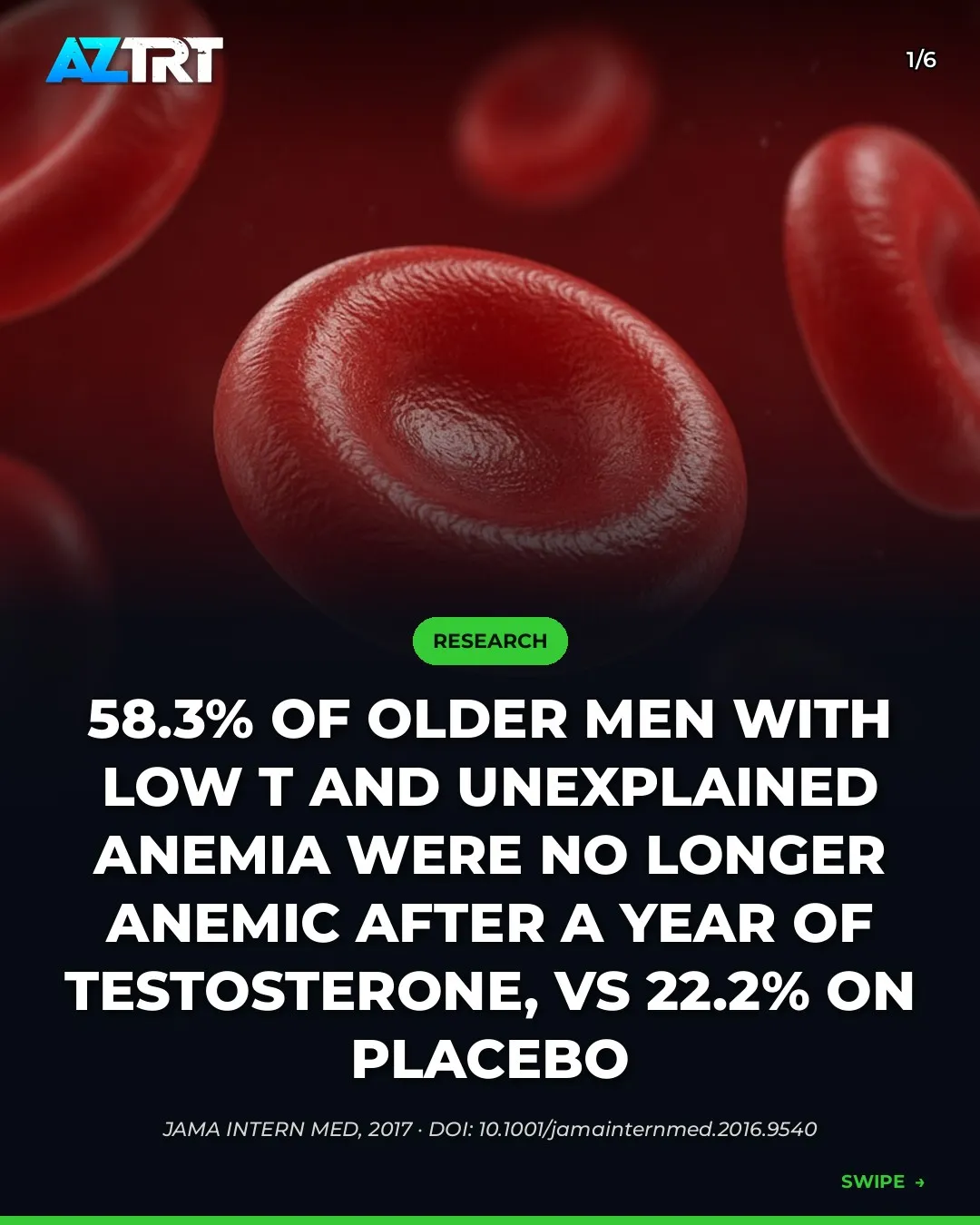
In older men with low T and unexplained anemia, more than half were no longer anemic after a year of testosterone vs about 1 in 5 on placebo.
This article walks through the JAMA Intern Med (2017) paper in plain English: what was studied, what changed, what the limits are, and what it does not prove. Full citation and DOI link are at the end, with a PubMed record.
What the study found
The Anemia Trial was part of the NIH-funded Testosterone Trials, a double-blinded, placebo-controlled study of 788 men aged 65 or older with testosterone below 275 ng/dL. Of these, 126 were anemic and 62 had no known cause. Men used testosterone gel or placebo gel for 12 months.
Among men with unexplained anemia, 54% on testosterone raised their hemoglobin by at least 1 g/dL, compared with 15% on placebo, and 58.3% were no longer anemic at 12 months vs 22.2%. The subgroup was small, and six men who were not anemic at baseline rose above 17.5 g/dL, which is why blood counts are monitored during treatment.
Key finding (from the study record): Unexplained anemia: Hb up >=1.0 g/dL in 54% vs 15% placebo; 58.3% no longer anemic vs 22.2% (P=.002). Known-cause anemia: 52% vs 19%.
How the study was done
- Design: Double-blind placebo-controlled trial (T Trials Anemia Trial)
- Who was studied: 788 men >=65 with low T; 126 anemic (62 unexplained)
- Journal / year: JAMA Intern Med (2017)
- First author: Roy CN et al.
From the abstract: IMPORTANCE: In one-third of older men with anemia, no recognized cause can be found. OBJECTIVE: To determine if testosterone treatment of men 65 years or older with unequivocally low testosterone levels and unexplained anemia would increase their hemoglobin concentration. DESIGN, SETTING, AND PARTICIPANTS: A double-blinded, placebo-controlled trial with treatment allocation by minimization using 788 men 65 years or older who have average testosterone levels of less than 275 ng/dL.
What it means — and what it does not
Useful takeaway: In older men with low T and unexplained anemia, more than half were no longer anemic after a year of testosterone vs about 1 in 5 on placebo.
Limits and caveats: Small subgroup (62 men). 6 non-anemic men exceeded Hb 17.5 g/dL - over-correction risk. Overall health benefit not established.
This evidence can inform a conversation with a licensed provider. It is not a guarantee of similar results for you, and it is not a recommendation to start, stop, or change any medication on your own.
Related research we cite
- Efficacy of Testosterone Replacement Therapy in Correcting Anemia in Men With Hypogonadism: A Randomized Clinical Trial — JAMA Netw Open (2023); also on PubMed. Takeaway: In men with low T and anemia, testosterone corrected the anemia more often than placebo, and hemoglobin gains tracked with energy.
How this connects to care
Because testosterone can raise red-cell production, hemoglobin and hematocrit are checked at baseline and during TRT. See hematocrit monitoring on TRT and donating blood on TRT. TRT is $149 a month in 90-day terms ($447 per term, or $357.60 if you pay the 90 days up front). Initial labs are included; follow-up labs are billed separately. See pricing for the full list.
Relevant pages on this site:
FAQ
What did this study actually find?
In older men with low T and unexplained anemia, more than half were no longer anemic after a year of testosterone vs about 1 in 5 on placebo. The design was: Double-blind placebo-controlled trial (T Trials Anemia Trial). Population: 788 men >=65 with low T; 126 anemic (62 unexplained).
How does this compare with the 2023 anemia trial?
The 2023 trial cited above was a larger randomized study in men with low T and anemia. Both found hemoglobin rose more often on testosterone than on placebo, and both are a reminder of why blood counts are checked during treatment.
What are the main limits of this evidence?
Small subgroup (62 men). 6 non-anemic men exceeded Hb 17.5 g/dL - over-correction risk. Overall health benefit not established.
Why monitor blood counts on TRT?
Testosterone can raise red-cell production. That may help anemia in some men, but hematocrit that rises too far is a known risk and is monitored.
Keep reading
- Low Testosterone and Diabetes: What Arizona Men Should Know
- TRT and Hematocrit: Why Blood Monitoring Matters
- Benefits of Testosterone Replacement Therapy for Men
- Best Foods for Testosterone: Nutrition for Hormone Health
Reference
Roy CN et al. Association of Testosterone Levels With Anemia in Older Men: A Controlled Clinical Trial. JAMA Intern Med. 2017. https://doi.org/10.1001/jamainternmed.2016.9540 · PubMed 28241237.
Next step
Book a free consult with an Arizona-licensed provider. Bring your questions — including anything this study raised for you.
TRT is $149 a month in 90-day terms, with initial labs included. See pricing for prepay and follow-up lab details.
Talk to a licensed provider. Results vary. Not medical advice.
Talk to a licensed provider. Results vary. Not medical advice.
