
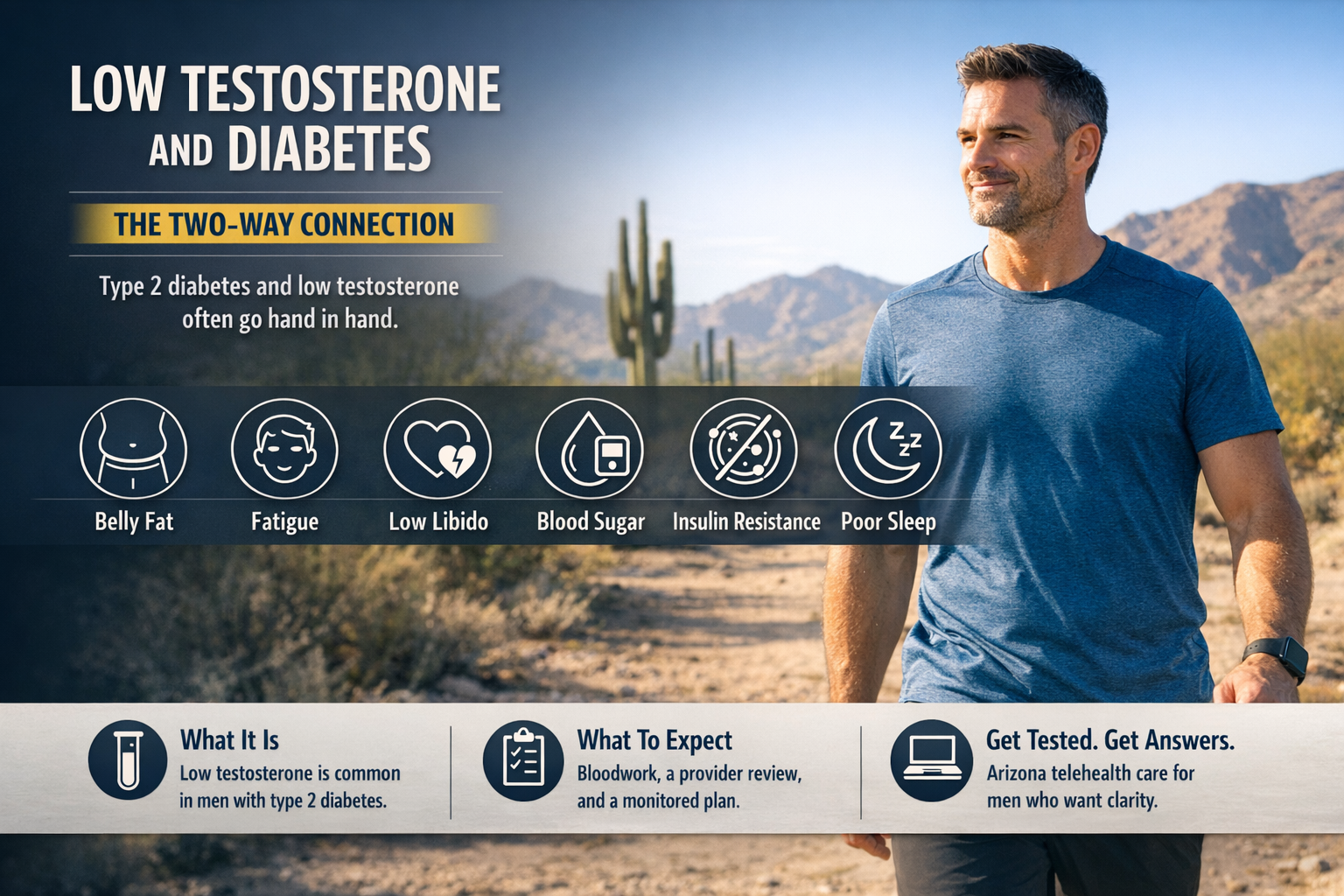
Low Testosterone and Diabetes: What Arizona Men Should Know
If you have type 2 diabetes or prediabetes and you also feel exhausted, foggy, and unmotivated — with a waistline that keeps creeping up no matter what you do — there's a reasonable chance low testosterone is part of the picture. This is one of the most common overlaps we see at our Arizona TRT clinic, and it's also one of the most frequently missed. Many men in Phoenix, Mesa, and Scottsdale get their A1c checked every three months for years and never once have their testosterone measured.
Here's what the evidence actually says about the connection between low T and diabetes, what testosterone therapy can and can't do for metabolic health, and how Arizona men can find out where they stand.
How common is low testosterone in men with diabetes?
Much more common than most men realize. Research consistently finds that a large share of men with type 2 diabetes have testosterone levels in the low range — estimates in the literature vary widely depending on how "low" is defined, but even conservative figures put it well above what you'd expect in the general population. The Cleveland Clinic notes that low testosterone is more common in men who have type 2 diabetes and men carrying excess weight.
The overlap isn't a coincidence, and it isn't simply "both happen as you get older." There are real biological mechanisms tying the two together.
Why the two conditions feed each other
Visceral fat converts testosterone into estrogen
Fat tissue — particularly the deep abdominal fat associated with insulin resistance — contains an enzyme called aromatase, which converts testosterone into estradiol. More visceral fat means more aromatase activity, which means less circulating testosterone and more estrogen. Researchers describe this in detail when explaining how dysfunctional fat tissue drives obesity-related male hypogonadism, including effects on the brain signals (LH and FSH) that tell the testes to produce testosterone in the first place.
Low testosterone makes fat gain easier
Testosterone helps maintain lean muscle mass, and muscle is where most of your glucose gets disposed of after a meal. Less muscle means less capacity to clear blood sugar. Meanwhile, lower testosterone is associated with increased fat storage — which is exactly why so many men describe the frustrating pattern of low testosterone and stubborn belly fat that doesn't respond to the same habits that used to work in their thirties.
Insulin resistance itself lowers SHBG
Insulin resistance reduces sex hormone-binding globulin (SHBG), the protein that carries testosterone through the bloodstream. Lower SHBG lowers your measured total testosterone, which is one reason total testosterone alone can be a misleading number in metabolically unhealthy men. A proper workup looks at free testosterone too.
Put those three together and you get a loop: weight gain lowers testosterone, lower testosterone makes weight gain and muscle loss easier, and that worsens insulin resistance, which lowers testosterone further.
Find out if low T is part of your metabolic picture
Doctor-supervised • Arizona-based • Telehealth available
Get Started — Free Assessment →Does testosterone therapy improve blood sugar?
This is where you need an honest answer rather than a marketing one.
The most important trial on this question is T4DM, a two-year, randomized, double-blind, placebo-controlled study of just over 1,000 men aged 50–74 with a large waist circumference, low-to-borderline testosterone, and either impaired glucose tolerance or newly diagnosed type 2 diabetes. Every participant was enrolled in a lifestyle program. Half also received injectable testosterone. The result: testosterone treatment on top of a lifestyle program reduced the proportion of men with type 2 diabetes at two years, with a roughly 40% relative reduction compared with lifestyle changes alone. The investigators also flagged rises in hematocrit as a potential treatment-limiting side effect and noted that long-term durability and cardiovascular safety need further study.
Beyond that single trial, pooled analyses point the same general direction. A meta-analysis of testosterone therapy in men with type 2 diabetes or metabolic syndrome found improvements in measures including insulin resistance and body composition, though not every endpoint reached significance and study quality varied.
Three honest caveats:
- TRT is not a diabetes drug. It is not a substitute for metformin, a GLP-1, dietary change, or resistance training. In T4DM, testosterone was added on top of a lifestyle program — not instead of one.
- The benefit is concentrated in men who are actually hypogonadal. Men with normal testosterone should not expect metabolic improvement from adding more.
- Results are not universal. Some well-designed studies have found no meaningful effect on insulin resistance. Individual response varies a great deal.
What a proper workup looks like
If you're a man in Arizona with diabetes or prediabetes and symptoms of low T, don't diagnose yourself from a symptom list. The workup is straightforward:
- Morning blood draw, ideally repeated. Testosterone peaks in the morning and fluctuates day to day, so a single afternoon reading isn't enough. This is the core of how low testosterone is diagnosed properly.
- Total and free testosterone, plus SHBG. Especially important in men with insulin resistance, where SHBG distortion is common.
- LH, FSH, estradiol, prolactin. These help distinguish a testicular problem from a pituitary or hypothalamic one.
- Metabolic panel, A1c, lipids, CBC, PSA. A baseline CBC matters because of the hematocrit issue — here's why hematocrit monitoring matters on TRT.
Arizona men can typically get all of this drawn at a local Quest or Labcorp location — there are dozens across the Phoenix metro, Tucson, and the East Valley — and then review results with a provider over telehealth. If you want the step-by-step, we've written a full guide on how to get your testosterone tested in Arizona.
Weight loss, TRT, and doing both at once
For many men with diabetes and low T, meaningful weight loss will raise testosterone on its own — sometimes enough that TRT is unnecessary. That's a genuinely good outcome, and a responsible clinic will tell you so.
Other men need both. Combining medical weight loss with hormone optimization has become a common approach, and we cover the practical questions around taking TRT and semaglutide together in a separate guide. What matters is that both are supervised, both are monitored with labs, and neither is treated as a shortcut around the basics: protein, resistance training, sleep, and alcohol moderation.
Frequently asked questions
Can low testosterone cause diabetes?
Low testosterone doesn't directly cause type 2 diabetes, but it contributes to conditions that raise your risk — less lean muscle, more visceral fat, and worse insulin sensitivity. The relationship is bidirectional: each condition makes the other more likely and harder to manage.
Will TRT lower my A1c?
It might, modestly, if you are genuinely hypogonadal and you pair it with lifestyle changes and your standard diabetes care. Trial evidence shows improvements in glucose measures for some men, but the effect is not guaranteed and TRT should never replace prescribed diabetes medication. Discuss any change with the provider managing your diabetes.
Can you get TRT in Arizona if you have diabetes?
Yes, in most cases. Type 2 diabetes is not a disqualifier — it's actually one of the more common reasons men in Phoenix and across Arizona get evaluated in the first place. Your provider will review your labs, medications, and cardiovascular history, and monitoring is typically closer than average.
Stop guessing. Get your numbers.
Doctor-supervised • Arizona-based • Telehealth available
Get Started — Free Assessment →The bottom line
Low testosterone and type 2 diabetes travel together, and each one makes the other worse. If you have diabetes or prediabetes and you're dealing with fatigue, low libido, poor recovery, and a waistline that won't budge, testosterone is a reasonable thing to measure — and it's a test most men in Arizona have never had. Get the labs, get them interpreted by someone who treats this every day, and make the decision from data rather than from a symptom quiz.
Sources
- Testosterone treatment to prevent or revert type 2 diabetes in men enrolled in a lifestyle programme (T4DM): a randomised, double-blind, placebo-controlled, 2-year, phase 3b trial — PubMed (Lancet Diabetes & Endocrinology)
- Low Testosterone (Low T): Hypogonadism, Symptoms & Treatment — Cleveland Clinic
- Metabolic Effects of Testosterone Replacement Therapy in Patients with Type 2 Diabetes Mellitus or Metabolic Syndrome: A Meta-Analysis — PMC, National Library of Medicine
- Adipose Tissue Dysfunction and Obesity-Related Male Hypogonadism — PMC, National Library of Medicine
