
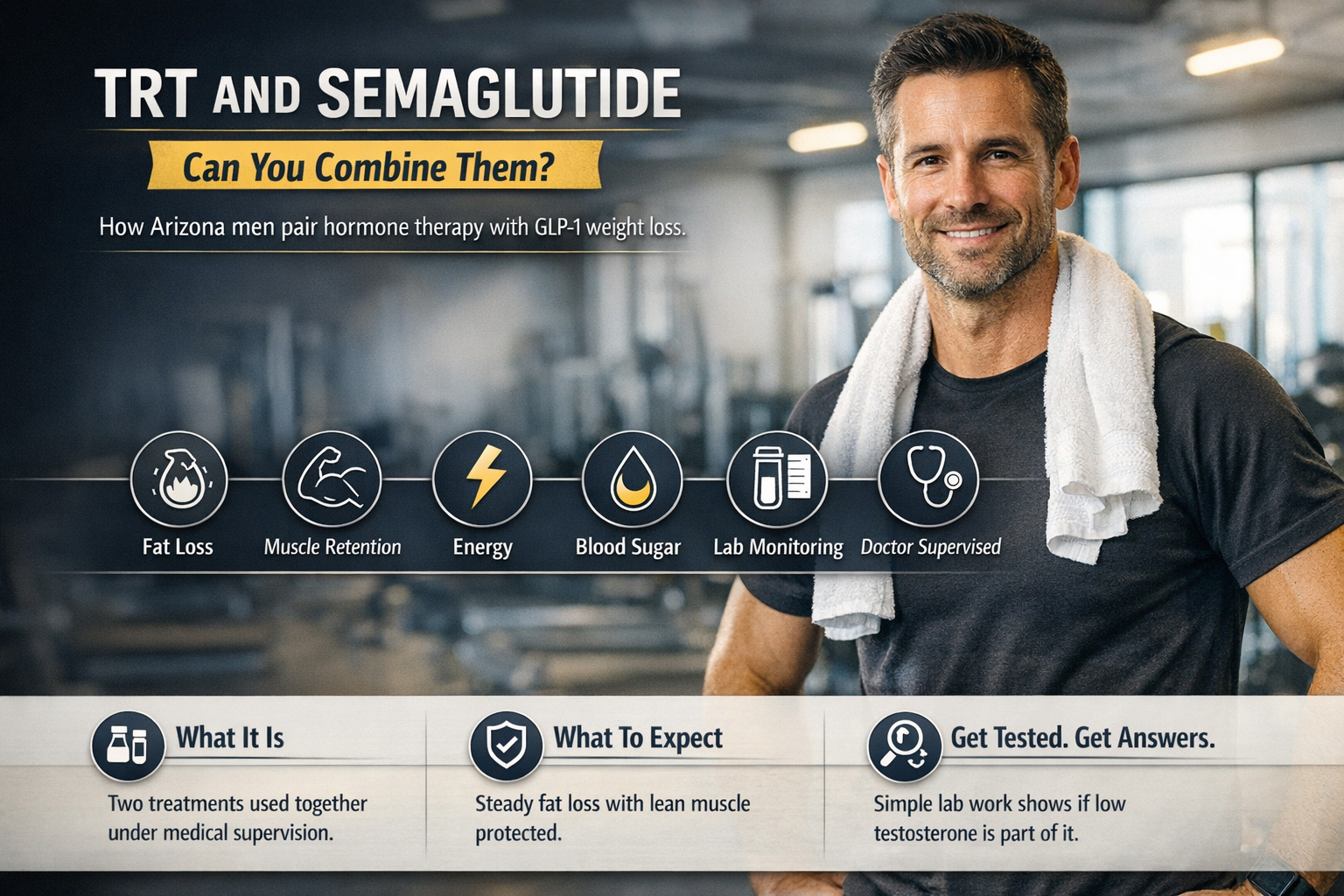
Can You Take TRT and Semaglutide Together? An Arizona Guide
If you are an Arizona man carrying 30 or 40 extra pounds and also dragging through the day with low energy, low libido, and shrinking muscle, you have probably wondered whether you can take TRT and semaglutide together. It is one of the most common questions we hear at AZTRT — and the short version is that these two treatments are not competitors. In the right patient, testosterone replacement therapy and GLP-1 weight loss medication address two halves of the same problem.
This guide covers how the combination works, what the research actually supports, who is a good candidate, what gets monitored, and how Phoenix-area men typically get started.
Why low testosterone and excess weight travel together
Body fat is not hormonally neutral. Fat tissue contains the aromatase enzyme, which converts testosterone into estradiol — so the more fat a man carries, the more testosterone he loses to conversion. That lower testosterone then makes it harder to build and hold muscle, which slows metabolism, which makes fat easier to gain. Clinicians call this the hypogonadal-obesity cycle, and it is why obesity is one of the strongest risk factors for low testosterone in men.
Harvard Health has covered the same pattern for years, noting that rising body mass index tracks closely with falling testosterone levels. If you have been reading about low testosterone and stubborn belly fat, this is the mechanism behind it.
Here is the encouraging part: the cycle runs in both directions. A systematic review found that meaningful weight loss can substantially reverse obesity-associated hypogonadism. Some men who lose significant weight see their own testosterone production recover without ever needing therapy. Others do not — and that is where the combination conversation begins.
What semaglutide does — and what it costs you
Semaglutide is a GLP-1 receptor agonist. It slows gastric emptying, signals fullness to the brain, and improves blood sugar regulation. For men who have white-knuckled through diet after diet, it often works because it removes the constant food noise rather than relying on willpower.
The trade-off is body composition. GLP-1 weight loss is not purely fat loss. Research on changes in lean body mass with GLP-1-based therapies shows that lean tissue typically accounts for roughly 20–40% of total weight lost, which is broadly comparable to any calorie-deficit approach including bariatric surgery. Lose 50 pounds, and a meaningful share of it may be muscle.
For a 30-year-old that may not matter much. For a 50-year-old Arizona man who is already losing muscle to age and possibly to low T, it matters a lot — muscle is metabolic real estate, and losing it makes the weight easier to regain. If you want the fuller picture on GLP-1 medication itself, we cover how GLP-1 weight loss works for men in Arizona in a separate guide.
Where TRT fits in
Testosterone's most consistent, best-documented effect is on body composition: more lean mass, less fat mass. That is precisely the variable semaglutide is working against. Used together in a man who genuinely has low testosterone, the logic is straightforward — the GLP-1 drives the deficit, and the testosterone helps defend the muscle inside that deficit.
Be careful with expectations here. TRT is not a fat-loss drug. It does not suppress appetite, and men who start testosterone without changing anything else usually see modest weight change at best. Its role in this pairing is protective, not propulsive. Our guide to what TRT realistically does for muscle growth lays out honest expectations.
Not sure if low T is part of your weight problem?
Doctor-supervised • Arizona-based • Telehealth available
Get Started — Free Assessment →Is it safe to take them at the same time?
Testosterone and semaglutide act through entirely separate pathways — androgen receptors versus GLP-1 receptors — and there is no recognized pharmacological interaction between them. That is why many hormone and weight-management clinics across the Phoenix metro will run both concurrently.
"No interaction" is not the same as "no monitoring," though. Each medication carries its own considerations:
- Testosterone: can raise hematocrit (red blood cell concentration), affect estradiol, suppress natural production and sperm count, and requires periodic PSA checks in older men.
- Semaglutide: commonly causes nausea, reflux, and constipation during dose escalation; carries warnings around pancreatitis, gallbladder disease, and thyroid C-cell tumors in specific patient groups.
- Both together: rapid weight loss can shift how you feel on a given testosterone dose, since losing fat reduces aromatization — some men need dose adjustments as the pounds come off.
That last point is underappreciated and genuinely important. A testosterone dose dialed in at 260 pounds may behave differently at 210 pounds. This is an argument for real follow-up labs, not a set-and-forget protocol.
Who is actually a good candidate?
The combination tends to make sense for a man who checks most of these boxes:
- Clinically confirmed low testosterone on at least two morning blood draws, alongside symptoms — not a single borderline result.
- A BMI in the obesity range, or overweight with a metabolic complication like prediabetes, hypertension, or fatty liver.
- A history of losing weight and regaining it, often with visible muscle loss each cycle.
- No plans for near-term fertility — testosterone suppresses sperm production, and that needs a separate conversation before starting.
- Willingness to lift weights and eat adequate protein. Neither medication replaces resistance training.
It is a poor fit if your testosterone is normal and you simply want a physique edge, if you are trying to conceive, or if you are unwilling to do follow-up bloodwork. A good Arizona clinic will tell you no in those cases.
What monitoring looks like
Before starting either medication, expect a baseline panel: total and free testosterone, LH and FSH, estradiol, complete blood count with hematocrit, comprehensive metabolic panel, lipids, PSA where age-appropriate, A1c, and thyroid. Our breakdown of the bloodwork you need before starting TRT walks through what each marker actually tells your provider.
After that, most Arizona men on a combined protocol are rechecked at roughly 8–12 weeks, then every 6 months once stable. Weight, waist circumference, and ideally a body composition measurement matter as much as the lab numbers here — the whole point of adding testosterone is what happens to lean mass, and the scale alone will not tell you that.
How Arizona men typically start
Arizona is a straightforward state for this. Telehealth rules allow licensed providers to evaluate, prescribe, and manage both testosterone and GLP-1 medications remotely, and lab draws can be done at Labcorp, Sonora Quest, or Banner locations throughout Phoenix, Scottsdale, Mesa, Chandler, Gilbert, Tempe, and Tucson. Most men complete labs close to home and handle every consult from their phone — which is how online TRT in Arizona through telehealth works in practice.
One local note worth mentioning: Arizona summers make hydration and heat management non-trivial. GLP-1 medications reduce appetite and often fluid intake, and testosterone can raise hematocrit — both push in the same direction during a 112-degree Phoenix July. Drink more than you think you need, and tell your provider if you feel unusually lightheaded during dose escalation.
Get your labs run and find out where you stand
Doctor-supervised • Arizona-based • Telehealth available
Get Started — Free Assessment →Should you try weight loss first?
This is a fair question, and reasonable clinicians disagree. Because weight loss alone can restore testosterone in some men, one defensible approach is to run semaglutide first, lose the weight, then retest testosterone in 6–12 months and only add TRT if levels stay low.
The counterargument: that sequence risks losing substantial muscle along the way, and a man with severe symptoms may not want to wait a year to feel better. There is no single right answer — it depends on how low your levels are, how severe your symptoms are, your age, and your fertility plans. That is a conversation to have with a provider who is willing to explain the trade-offs rather than default to whatever they sell.
Frequently asked questions
Can you take TRT and semaglutide at the same time?
Yes. There is no known direct interaction between testosterone and semaglutide, and they act on separate biological pathways. Many Arizona clinics prescribe both concurrently for men with confirmed low testosterone and obesity. Both still require baseline and follow-up bloodwork, and testosterone dosing may need adjustment as you lose weight.
Does testosterone help you keep muscle while on semaglutide?
That is the main rationale for combining them. GLP-1 weight loss typically includes a meaningful share of lean tissue, and testosterone's most reliable effect is increasing lean mass and reducing fat mass. Testosterone is not a substitute for resistance training and adequate protein, which remain the foundation of preserving muscle in a deficit.
Will losing weight raise my testosterone without TRT?
Sometimes. Research shows that significant weight loss can substantially reverse obesity-related testosterone suppression, particularly in men whose low levels are driven by excess body fat rather than a primary testicular problem. Not every man recovers fully, which is why retesting after weight loss is worthwhile before assuming lifelong therapy is required.
Sources
- Approach to the Patient: Low Testosterone Concentrations in Men With Obesity — NIH National Library of Medicine (PMC)
- Body weight loss reverts obesity-associated hypogonadotropic hypogonadism: a systematic review and meta-analysis — PubMed
- Changes in lean body mass with glucagon-like peptide-1-based therapies and mitigation strategies — PubMed
- Obesity: Unhealthy and Unmanly — Harvard Health Publishing
