
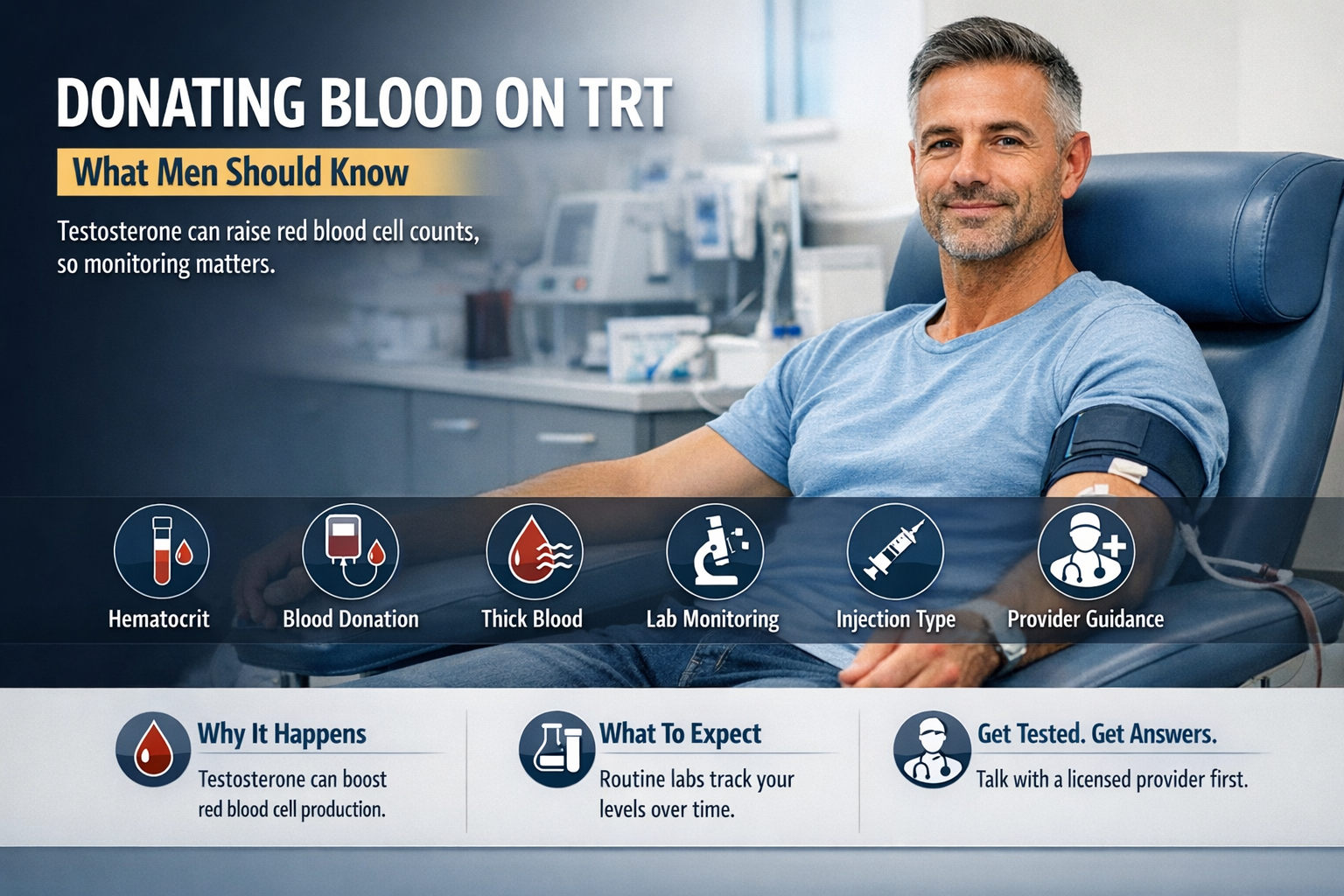
Can You Donate Blood on TRT? What Arizona Men Should Know
If you're on TRT in Arizona and you've watched your hematocrit creep up on your quarterly labs, you've probably asked the obvious question: can you donate blood on TRT, and will it help? It's one of the most common questions men bring to a Phoenix TRT clinic after their first six months of treatment — and the answer is mostly reassuring, with a few important details worth understanding before you drive to a donation center in Scottsdale, Mesa, or Tempe.
Testosterone replacement therapy stimulates red blood cell production. That's not a defect in the treatment; it's a known, expected, dose-related physiological effect. For most men it stays well within a safe range. For some, it drifts high enough that a provider wants to intervene. Blood donation sits right at the intersection of those two realities, which is exactly why it generates so much confusion.
Why testosterone raises your red blood cell count
Testosterone drives erythropoiesis — the manufacture of red blood cells — through more than one pathway. Research on testosterone therapy and secondary erythrocytosis describes testosterone raising erythropoietin (EPO, the hormone that signals your bone marrow to build red cells), resetting the EPO-to-hemoglobin "set point," and suppressing hepcidin, the protein that gatekeeps how much iron your body makes available for red cell production. More EPO plus more free iron equals more red blood cells.
Two lab numbers track this:
- Hemoglobin — the oxygen-carrying protein inside red blood cells.
- Hematocrit (Hct) — the percentage of your blood volume made up of red blood cells.
When hematocrit climbs too high, blood becomes more viscous — thicker and slower-flowing. That's the clinical concern behind the monitoring, and it's the reason a good clinic runs a complete blood count on a set schedule rather than only checking your testosterone. If you want the full picture on that number, we've written a deeper guide to why TRT and hematocrit monitoring matters and what the thresholds actually mean.
One nuance that surprises a lot of men: your risk isn't uniform across all forms of testosterone. Injectable testosterone produces higher peak levels and is associated with more erythrocytosis than transdermal preparations, which is one of several reasons the delivery method you use — injections, gels, pellets, or creams is worth an honest conversation with your provider rather than a default choice.
So can you actually donate blood while on TRT?
In most cases, yes. Blood donation eligibility is based on your health status and your lab values at the time of donation — not on whether you take a prescription hormone. The American Red Cross donor eligibility requirements center on being in good general health, meeting age and weight minimums, and passing an on-site hemoglobin check. Whole blood donation is permitted roughly every 56 days.
Men on testosterone therapy are, in fact, a well-recognized group within the donor population. One analysis of blood donors receiving testosterone replacement therapy at a large U.S. blood service organization found a measurable and identifiable share of donors on TRT, which tells you plainly that this is a routine, accepted situation at donation centers — not an edge case that will get you turned away at the door.
A few practical points for Arizona men:
- Disclose your medications. Testosterone is a prescription therapy, and the screening questionnaire asks about medications. Be straightforward; it's not disqualifying.
- Hemoglobin can be too high, not just too low. Donation centers screen for a minimum hemoglobin, but there is also an upper limit. If your levels are markedly elevated, a center may defer you and refer you back to your physician.
- Timing and hydration matter more here. In Phoenix summer heat, dehydration concentrates your blood and can nudge a reading higher. Hydrate well the day before any lab draw or donation.
- Frequency is capped. Standard donation intervals apply to everyone. If your provider believes you need blood removed more often than that, you're no longer talking about donation.
Wondering where your hematocrit stands?
Doctor-supervised • Arizona-based • Telehealth available
Get Started — Free Assessment →Blood donation vs. therapeutic phlebotomy: not the same thing
This is where most of the confusion lives, so it's worth drawing the line clearly.
Voluntary blood donation is you giving blood for someone else's benefit, on the standard schedule, subject to standard eligibility. Any reduction in your own hematocrit is a side effect, not the purpose.
Therapeutic phlebotomy is a medical procedure ordered by a physician to remove blood specifically to lower an elevated red cell mass. It typically requires a written order, and depending on the facility and the underlying diagnosis, the collected blood may not be eligible for transfusion.
The distinction matters clinically. Endocrine Society guidance referenced in a review asking whether phlebotomy can be justified in testosterone-induced erythrocytosis describes discontinuing or adjusting therapy, or offering therapeutic phlebotomy, once hematocrit passes 54%. That same review also makes an important, less-advertised point: the evidence that routine phlebotomy actually reduces clot risk in this population is thinner than most people assume, and repeated phlebotomy depletes iron stores and lowers tissue oxygen levels, which carries its own theoretical downsides. The reasonable takeaway isn't "phlebotomy is bad" — it's that this should be a shared decision with a provider who is watching your numbers, not a self-managed routine.
What a well-run clinic does instead of guessing
If your hematocrit is trending upward, donation is rarely the first or only lever. A thoughtful provider will typically look at:
- Dose. Erythrocytosis is dose-dependent. Reducing the weekly dose is often the cleanest fix.
- Frequency. Splitting the same weekly total into smaller, more frequent injections flattens peak levels and often eases the pressure on red cell production.
- Delivery route. Moving from injections to a transdermal option can lower the risk profile for some men.
- Sleep apnea screening. Untreated obstructive sleep apnea independently raises hematocrit. If you snore heavily, that's a genuinely important thread to pull.
- Smoking, altitude, and hydration. All three shift red cell numbers. Northern Arizona residents at elevation naturally run higher than men at Phoenix-valley altitude.
- Cardiovascular context. Your overall risk picture matters when deciding how aggressive to be. Our overview of TRT and heart health covers what the current evidence does and doesn't show.
None of this means TRT is dangerous. It means TRT is a monitored medical therapy rather than a supplement — which is exactly the framing in our broader guide to the real risks and side effects of testosterone therapy.
Donating blood on TRT in Arizona: the practical version
Arizona men have plenty of options — Vitalant and American Red Cross centers operate throughout the Phoenix metro, Tucson, and the surrounding communities, alongside frequent mobile drives. If you're an eligible donor and you'd like to give, being on TRT generally isn't an obstacle.
What we'd ask you to avoid is using donation as a self-prescribed treatment for a lab value you haven't discussed with a clinician. Repeatedly donating to chase a number down, without iron studies or a real diagnostic workup, can leave you iron-depleted and fatigued while masking a trend your provider needed to see. Bring your labs to your provider first. If you're managing your therapy through online TRT in Arizona via telehealth, your quarterly bloodwork gives your provider exactly the data needed to make that call with you.
Get TRT that's actually monitored.
Doctor-supervised • Arizona-based • Telehealth available
Get Started — Free Assessment →Frequently asked questions
How often can you donate blood on TRT?
The same schedule that applies to every donor applies to you: whole blood donation is generally permitted about every 56 days, up to roughly six times a year. Being on testosterone doesn't earn you a shorter interval. If your provider believes blood needs to be removed more frequently than that for medical reasons, that's therapeutic phlebotomy under a physician's order, not voluntary donation.
Does donating blood lower your testosterone levels?
Donating a unit of whole blood does not meaningfully reduce your circulating testosterone. Testosterone is carried in plasma bound to proteins, and your body replaces plasma volume within a day or two. What donation does reduce is red cell mass, which is why it's often discussed in the context of an elevated hematocrit rather than as anything that undercuts your therapy.
What hematocrit is too high on TRT?
Clinical guidance commonly flags a hematocrit above 54% as the point at which a provider should intervene — by reducing or pausing testosterone, adjusting the dosing schedule, or discussing therapeutic phlebotomy. Values below that are usually managed by continued monitoring and dose adjustment. Your individual threshold depends on your cardiovascular history, so this is a number to interpret with your clinician rather than from a chart online.
Sources
- Testosterone therapy and secondary erythrocytosis — PubMed, National Library of Medicine
- Testosterone therapy-induced erythrocytosis: can phlebotomy be justified? — PubMed Central, National Library of Medicine
- Blood Donation Eligibility Requirements — American Red Cross
- The prevalence and demographic determinants of blood donors receiving testosterone replacement therapy at a large USA blood service organization — PubMed Central, National Library of Medicine
