
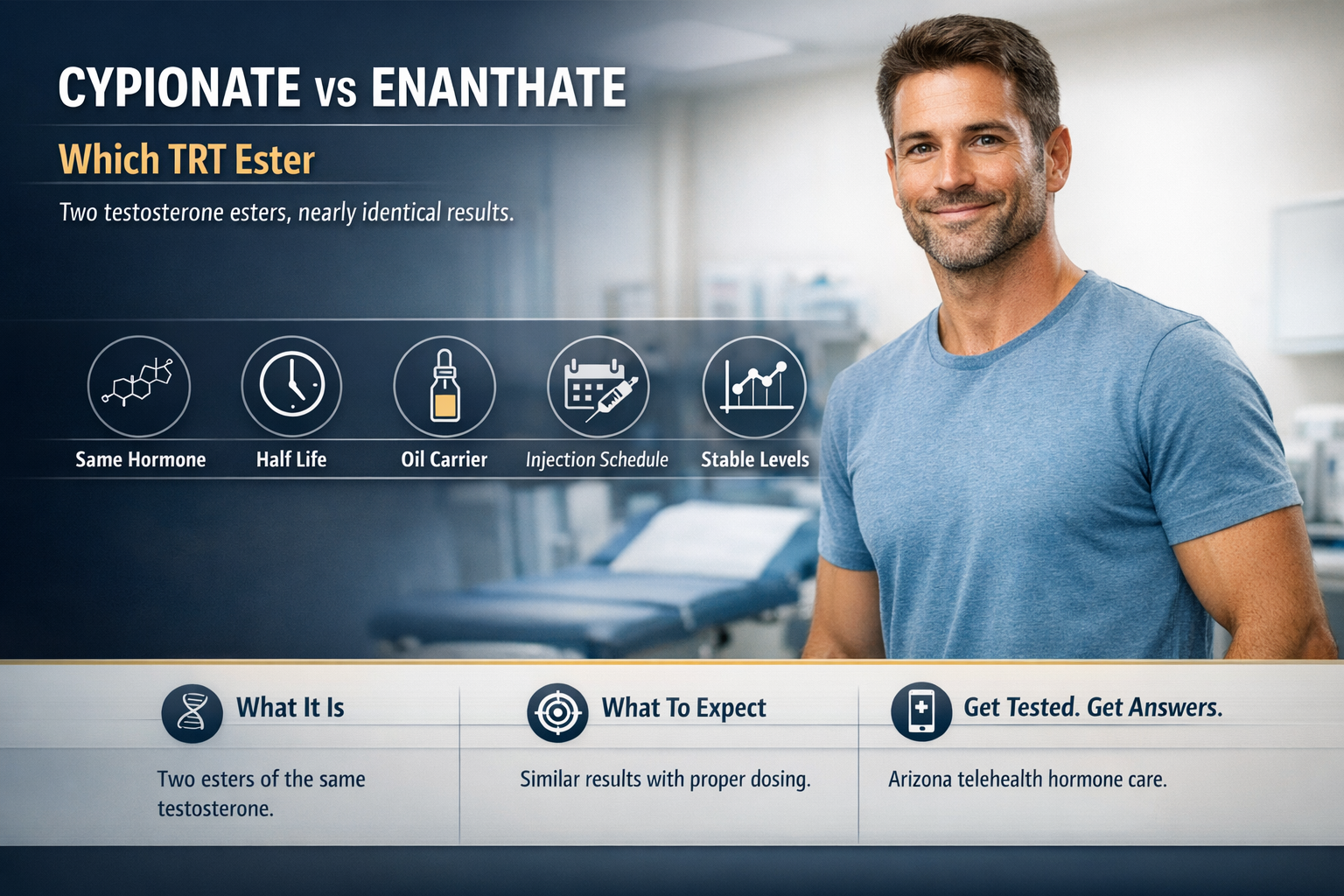
Testosterone Cypionate vs. Enanthate: What's the Difference?
If you have started researching testosterone replacement therapy, you have probably run into the testosterone cypionate vs. enanthate debate on forums, YouTube, and Reddit — often with strong opinions and very little data behind them. Here is the practical truth: both are injectable testosterone. Both are FDA-approved for men with clinically diagnosed hypogonadism. Both bind the same androgen receptors and produce the same hormone in your bloodstream. The differences are real but small, and they matter mostly at the margins.
At AZTRT, we treat men across the Phoenix metro — Scottsdale, Mesa, Tempe, Chandler, Gilbert, and Tucson — and this question comes up in almost every consultation. Below is a plain-English breakdown of what actually separates these two esters, what does not, and how an Arizona-based provider decides which one to put you on.
What is an "ester" and why does it matter?
Pure testosterone injected into muscle is cleared from the body in minutes. To make it usable as a therapy, a fatty acid chain — the ester — is chemically attached at the 17β position. That ester makes the molecule oil-soluble, so it sits in a depot at the injection site and releases slowly over days instead of minutes. Enzymes in your body then clip the ester off, leaving behind identical testosterone.
This is the single most important thing to understand: the ester is a delivery mechanism, not a different drug. Once cypionate or enanthate is cleaved, what circulates in your blood is testosterone — molecularly indistinguishable between the two. Anyone who tells you one ester "builds more muscle" or "feels stronger" is describing a dosing or timing difference, not a pharmacological one.
Testosterone cypionate vs. enanthate: the actual differences
1. Ester length and half-life
Cypionate carries an eight-carbon cyclopentylpropionate chain; enanthate carries a seven-carbon heptanoate chain. That extra carbon slows cypionate's release slightly. In practice, published pharmacokinetic data on injectable testosterone esters put both in a similar range — commonly cited as roughly 8 days for cypionate and 5–8 days for enanthate, with substantial overlap and considerable variation between individuals. Many clinical references treat the two as effectively interchangeable.
Does a one-day difference in half-life change how you feel? For the vast majority of men, no. What changes how you feel is dose frequency, which is why most modern protocols split the weekly dose rather than using the old every-two-weeks approach. If you are curious about scheduling specifics, we cover how often you take TRT injections in more depth.
2. Carrier oil and preservative
This is the difference that occasionally matters clinically. Testosterone cypionate is typically suspended in cottonseed oil with benzyl alcohol as a preservative. Enanthate is typically suspended in sesame oil with chlorobutanol. If you have a sesame allergy — or you have reacted badly to one formulation in the past — that is a legitimate reason to switch esters. Some men also report that one oil feels thinner and injects more comfortably than the other, which is a viscosity issue rather than a hormone issue.
3. Availability and cost
In the United States, testosterone cypionate is by far the more commonly prescribed of the two, which generally makes it cheaper and easier for pharmacies to keep in stock. Enanthate is widely available but shows up more often in compounded or specialty preparations. During national supply disruptions, having a provider willing to switch you between esters is genuinely useful — another reason the interchangeability point matters.
4. Injection route
Both esters can be given intramuscularly or subcutaneously. Subcutaneous injection with a small insulin syringe has become increasingly common because it is less painful and, in published research, produces stable serum testosterone concentrations between injections. If you are new to this and the needle is the part making you nervous, our walkthrough on how to self-inject testosterone at home covers technique step by step.
Not sure which protocol fits you?
Doctor-supervised • Arizona-based • Telehealth available
Get Started — Free Assessment →What does NOT differ between the two
- The hormone itself. After the ester is cleaved, the circulating molecule is identical. Your total and free testosterone labs cannot tell which ester you used.
- Side effect profile. Elevated hematocrit, estrogen conversion, acne, water retention, testicular shrinkage, and suppressed fertility are effects of testosterone therapy in general — not of one ester over the other. Mayo Clinic notes that testosterone therapy can raise red blood cell counts and worsen sleep apnea regardless of formulation.
- Monitoring requirements. Both require the same follow-up bloodwork. The AUA guideline on testosterone deficiency recommends baseline hemoglobin and hematocrit before starting therapy, with reassessment at 3–6 months and then annually. This is exactly why hematocrit monitoring matters on TRT, and it applies identically to both esters.
- Legal status. Both are Schedule III controlled substances requiring a prescription and a documented diagnosis. There is no legitimate over-the-counter version of either.
How Arizona providers actually choose
In real clinical practice, ester selection usually comes down to four practical factors rather than pharmacology:
- What your pharmacy can reliably fill. Continuity beats theoretical optimization. A protocol you can actually refill every month in Phoenix or Tucson is better than one that leaves you scrambling.
- Allergy and tolerance history. Sesame allergy points toward cypionate; a poor reaction to benzyl alcohol points toward enanthate.
- Cost and insurance coverage. Cypionate is usually the lower-cost generic option in the US market.
- Your labs and symptom response. If trough levels look flat and symptoms are lingering, the fix is almost always adjusting dose or frequency — not swapping esters.
That last point deserves emphasis. Men who feel "off" on TRT and blame the ester are usually dealing with something else: a dose that is too high or too low, injections spaced too far apart, unmanaged estradiol, an untreated sleep problem, or simply not enough time on therapy for the benefits to show up. Getting an accurate baseline first is what prevents that guessing game, which is why we walk every new patient through the bloodwork you need before starting TRT. And if you have not settled on injections at all yet, it is worth reading how injections compare to gels, creams, and pellets before you commit.
Can you switch from one to the other?
Yes, and it is common. Because the esters are so close in behavior, providers typically convert on a milligram-for-milligram basis and then confirm with follow-up labs about six to eight weeks later, once levels have stabilized. Some men notice a brief adjustment period; most notice nothing at all. What you should never do is switch on your own or source testosterone outside a licensed prescriber — product purity, dosing accuracy, and the monitoring that keeps therapy safe all disappear the moment you leave a medical setting.
The bottom line for Arizona men
Testosterone cypionate vs. enanthate is one of the least consequential decisions in your TRT protocol. Both are legitimate, well-studied, FDA-approved options. The variables that will actually determine whether therapy works for you are dose, injection frequency, consistent lab monitoring, managing side effects early, and working with a provider who adjusts based on how you feel rather than a one-size-fits-all script. Arizona telehealth makes that ongoing relationship easier than it used to be — labs at a local draw site, visits from home, and refills without a drive across the Valley.
Frequently asked questions
Is testosterone cypionate stronger than enanthate?
No. Milligram for milligram they deliver the same hormone. Cypionate's slightly longer ester means marginally more of the injected weight is ester and slightly less is testosterone, but the difference is a few percent and has no meaningful clinical effect at standard TRT doses.
Which testosterone ester is best for TRT?
For most men, whichever one your provider can prescribe reliably and you tolerate well. Cypionate is the more common choice in the United States because of availability and cost. Enanthate is a good alternative if you have a cottonseed oil or benzyl alcohol sensitivity.
Can I switch from testosterone enanthate to cypionate?
Yes, with your prescriber's guidance. Conversions are usually one-to-one by milligram, followed by repeat labs after roughly six to eight weeks to confirm your levels landed where they should. Never change esters, doses, or sources on your own.
Stop guessing. Start with real labs.
Doctor-supervised • Arizona-based • Telehealth available
Get Started — Free Assessment →Sources
- Evaluation and Management of Testosterone Deficiency: AUA Guideline — American Urological Association
- Testosterone therapy: Potential benefits and risks as you age — Mayo Clinic
- Pharmacokinetics of testosterone therapies in relation to diurnal variation of serum testosterone levels as men age — PubMed Central (NIH)
- Serum Testosterone Concentrations Remain Stable Between Injections in Patients Receiving Subcutaneous Testosterone — PubMed Central (NIH)
