
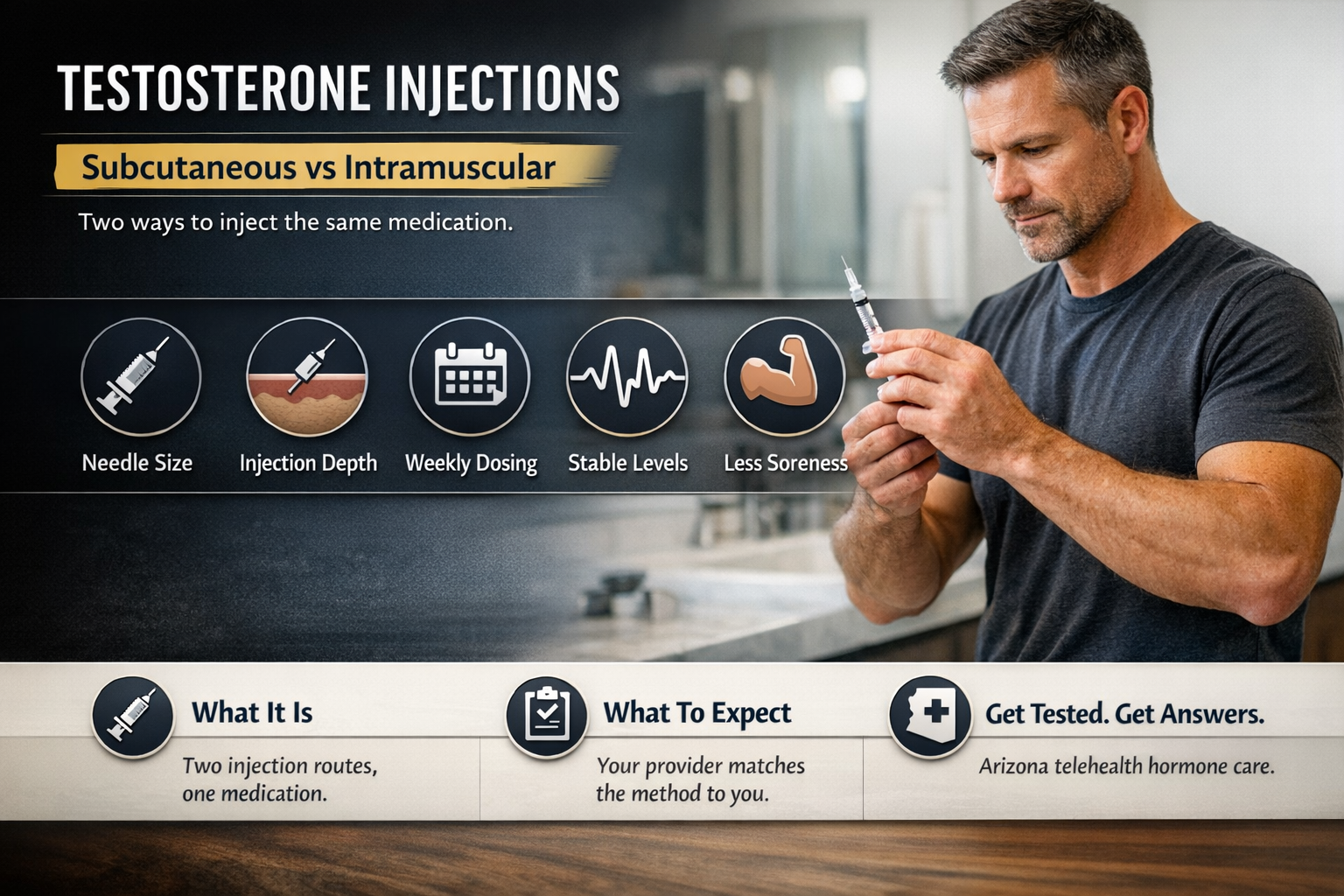
Subcutaneous vs. Intramuscular Testosterone Injections
If you are researching subcutaneous vs. intramuscular testosterone injections, you are almost certainly at one of two points: you are about to start TRT in Arizona and your provider mentioned both options, or you have been injecting into your glute for months and you are tired of the soreness. Either way, the question is a good one — and the answer is more encouraging than most men expect.
Here is the core truth: the testosterone in the vial is identical. Testosterone cypionate is testosterone cypionate whether it goes into fat or muscle. What changes is needle length, comfort, absorption speed, and how realistically you will keep doing it every week for years. That last factor matters more than the pharmacology.
What is the actual difference between SubQ and IM?
The distinction is tissue depth.
- Intramuscular (IM) delivers testosterone deep into muscle tissue — typically the ventrogluteal (side of the hip), the vastus lateralis (outer thigh), or the deltoid. Muscle is highly vascular, so the oil depot is absorbed relatively quickly. Needles are usually 1 to 1.5 inches, 22–25 gauge.
- Subcutaneous (SubQ) delivers testosterone into the fatty layer just beneath the skin — usually the abdomen, love-handle area, or upper outer thigh. Fat has less blood flow, so the depot releases a little more slowly and evenly. Needles are typically half an inch or shorter, 27–31 gauge — roughly the size a diabetic uses for insulin.
Both routes are FDA-recognized delivery methods for testosterone esters, and major clinical references list intramuscular and subcutaneous routes side by side for the same medications. Neither is experimental. Neither is a workaround.
Why most Arizona TRT clinics now default to SubQ
Ten years ago, IM was the standard because that is how testosterone had always been given in a doctor's office. The shift toward SubQ happened for practical reasons.
1. It hurts substantially less
A 29-gauge, half-inch needle into belly fat is a fundamentally different experience from a 23-gauge, inch-and-a-half needle into glute muscle. Most men describe SubQ as a pinch and nothing more. Post-injection soreness — the dull ache that can make leg day miserable for two days after a quad shot — largely disappears.
2. It is far easier to do yourself
Injecting your own glute requires either a mirror, a twist, or a partner. Injecting your own stomach requires neither. Clinical guidance for subcutaneous testosterone explicitly frames it as something a provider teaches you to prepare and administer at home, which is exactly how telehealth TRT is designed to work. If you are new to this, our walkthrough on how to self-inject testosterone at home covers the full step-by-step process for both routes.
3. Adherence is the whole ballgame
TRT only works if you actually take it. A protocol you dread is a protocol you skip. Men on comfortable weekly SubQ injections tend to stay consistent for years; men who dread the glute shot are the ones who "forget" and end up riding a hormonal roller coaster.
Not sure which injection method fits you?
Doctor-supervised • Arizona-based • Telehealth available
Get Started — Free Assessment →Does one produce better testosterone levels?
This is the question men actually care about, and the honest answer is: they are comparable, with a possible edge to subcutaneous on side-effect profile.
Because muscle is more vascular, IM injections tend to produce a sharper peak in the first 24–48 hours followed by a steeper decline. SubQ releases from the fat depot a bit more gradually, which flattens that curve. In practice, on a weekly or twice-weekly schedule, both routes land men comfortably in the normal range.
Where it gets interesting is downstream. A dual-institutional comparison of hypogonadal men found that both routes significantly raised testosterone, but that subcutaneous delivery was associated with lower post-therapy hematocrit and estradiol than intramuscular testosterone cypionate. That fits the mechanism: lower peaks mean less substrate for aromatization into estrogen and less stimulus for red blood cell production. It is one study rather than a settled conclusion, but it is consistent with what many clinics observe.
Those two markers are exactly what your provider watches over time. If you want the background, we cover why TRT and hematocrit monitoring matters in detail — it is one of the few genuinely non-negotiable labs on therapy.
Does the ester matter? Cypionate vs. enanthate
Both testosterone cypionate and testosterone enanthate can be given SubQ or IM. Cypionate is the more common prescription in the United States; enanthate is used in the FDA-approved subcutaneous auto-injector product. The half-lives differ by roughly a day, which is largely irrelevant on a weekly protocol. If you want the fuller comparison, see our breakdown of testosterone cypionate vs. enanthate.
Dosing frequency matters more than route or ester. Splitting a weekly dose into two smaller injections smooths levels regardless of whether you go SubQ or IM — which is why our guide to how often you take TRT injections spends more time on frequency than on needle placement.
When IM is still the better choice
SubQ is not universally superior. Situations where a provider may recommend intramuscular:
- Higher volumes. Subcutaneous tissue tolerates roughly 1 mL comfortably. Larger single doses can cause a visible lump, redness, or a lingering knot in the fat.
- Very low body fat. Men with minimal subcutaneous fat may struggle to pinch a reliable site.
- Persistent site reactions. A minority of men develop itchy, red, inflamed welts at SubQ sites. Switching to IM usually resolves it immediately.
- Absorption that does not match labs. Occasionally trough levels come back lower than expected on SubQ; switching routes is a reasonable adjustment.
Injections are also not the only option — gels, creams, and pellets each have their place, and our comparison of TRT injections vs. gels vs. pellets lays out the tradeoffs if needles are a dealbreaker for you.
What this looks like in Arizona
For men across Phoenix, Scottsdale, Mesa, Chandler, Gilbert, and Tucson, the route question has a practical local dimension. Arizona telehealth rules allow a licensed provider to evaluate you, order labs at a local draw site, and prescribe testosterone that ships to your door — but only if you can administer it yourself. SubQ makes that model work. A weekly stomach injection takes about ninety seconds in your bathroom before work.
One Arizona-specific note: heat. Testosterone in oil should be stored at room temperature and out of direct sunlight. A Phoenix car in July can exceed 150°F. Do not leave vials in the glovebox, and bring shipments inside promptly during summer months.
Whatever route you choose, the monitoring is the same. Baseline hemoglobin and hematocrit before starting, follow-up labs at three to six months, then annually, is the framework laid out in the American Urological Association's testosterone deficiency guideline. Any clinic that skips that structure is not practicing responsible TRT, regardless of how convenient the injections are.
Start TRT the easy way — from home in Arizona
Doctor-supervised • Arizona-based • Telehealth available
Get Started — Free Assessment →Frequently asked questions
Is subcutaneous testosterone as effective as intramuscular?
Yes. Both routes deliver the same medication and both reliably raise testosterone into the normal range on a weekly or twice-weekly schedule. Comparative research suggests subcutaneous delivery may produce slightly lower peaks, which in turn can mean lower hematocrit and estradiol. Effectiveness is judged by your labs and symptoms, not by the route.
Can I switch from intramuscular to subcutaneous injections?
Usually yes, and many men do. Talk to your prescribing provider first — the dose typically stays the same, but you will need shorter, finer needles and you should recheck labs after several weeks to confirm your levels held. Do not change route on your own without telling your clinic.
Where do you inject subcutaneous testosterone?
The most common sites are the abdomen roughly two inches away from the navel, the love-handle area, and the upper outer thigh. Pinch a fold of fat, insert at a 45 to 90 degree angle depending on needle length, inject slowly, and rotate sites each week to avoid irritation or scar tissue.
Sources
- Comparison of Outcomes for Hypogonadal Men Treated with Intramuscular Testosterone Cypionate versus Subcutaneous Testosterone Enanthate — PubMed (Journal of Urology)
- Subcutaneous Testosterone Injection: Uses & Side Effects — Cleveland Clinic
- Testosterone (Intramuscular Route, Subcutaneous Route) — Mayo Clinic
- Evaluation and Management of Testosterone Deficiency: AUA Guideline — American Urological Association
