
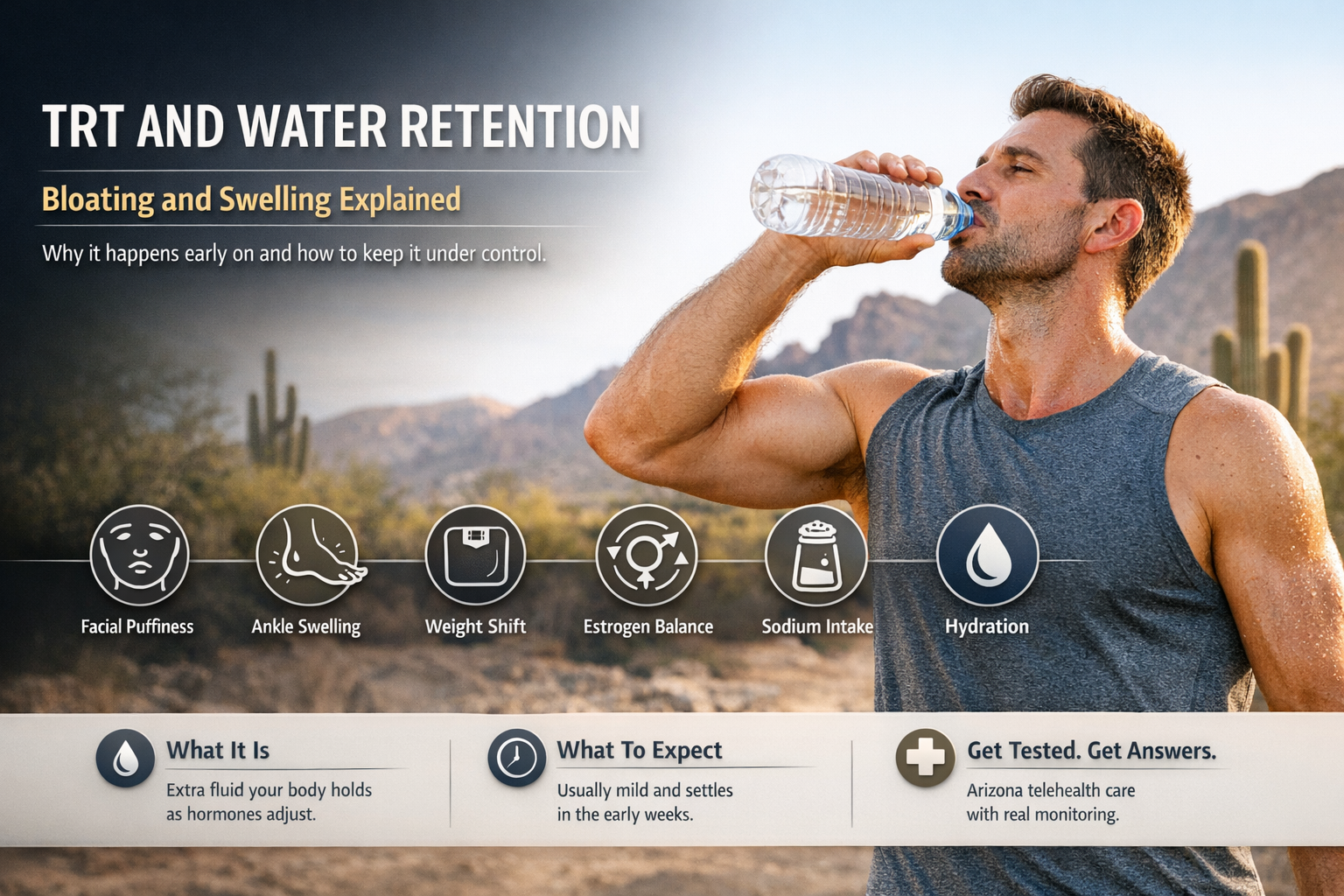
Does TRT Cause Water Retention? Bloating & Swelling Explained
If you started testosterone replacement therapy a few weeks ago and your wedding ring feels tight, your face looks a little fuller in photos, or your socks are leaving a mark by dinnertime, you are not imagining it. TRT water retention is real, it is well documented, and it is one of the first things Arizona men ask about once treatment gets going. The good news: it is usually mild, usually temporary, and almost always manageable with the right dosing and monitoring.
Here is what is actually happening in your body, how long it typically lasts, when it is a warning sign, and what a good clinic does about it.
Why does testosterone make you hold water?
Two separate mechanisms are at work, and they often overlap.
1. Androgens promote sodium and water retention directly
Testosterone acts on the kidneys to increase sodium reabsorption — and water follows sodium. This is a recognized property of the entire androgen class, not something unique to one brand or ester. Clinical references note that androgen replacement can promote retention of sodium and water, with edema listed as a possible effect, particularly in men who already have cardiac, kidney or liver disease. Prescribing information from Mayo Clinic lists swelling of the fingers, hands, feet or lower legs among the effects to watch for on injectable testosterone.
2. Estradiol rises alongside testosterone
The bigger driver for most men is estrogen. A portion of the testosterone you take is converted by the aromatase enzyme into estradiol (E2). That is normal and necessary — estradiol is an essential hormone in men, not a villain, and it supports bone density, libido and mood. But when E2 climbs faster than your body adapts, it increases sodium-retaining signaling and you hold more extracellular fluid. That is the puffy, soft, slightly swollen look men describe in month one.
This is exactly why managing estrogen (E2) on testosterone therapy is part of a properly run protocol rather than an afterthought. Men carrying more body fat tend to aromatize more testosterone into estradiol at the same dose, which is why two men on identical prescriptions can have very different fluid responses.
What TRT water retention actually looks like
- Facial puffiness — especially around the eyes in the morning
- Ring and watch tightness in the hands and fingers
- Ankle or lower-leg swelling that gets worse as the day goes on
- A fast scale jump — two to five pounds in a week or two, faster than real tissue can be built
- A softer, smoother look despite training well
- Mild abdominal bloating or a full feeling that is not digestive
A useful test: real muscle takes months to build. If the scale moved five pounds in ten days, that is fluid. This is also a common reason men misread their early progress — which is worth keeping in mind alongside what you already know about low testosterone and weight gain, since body composition and fluid balance move on completely different timelines.
Puffy, bloated, or unsure if your dose is right?
Arizona-licensed providers • Arizona-based • Telehealth available
Get Started — Free Assessment →How long does it last?
For most men, noticeable fluid retention appears within the first one to three weeks of starting therapy or after a dose increase, peaks somewhere in weeks two through six, and fades as hormone levels stabilize. By the three-month mark, the majority of men on a well-titrated protocol are no longer thinking about it.
It also tends to reappear briefly any time the protocol changes — a dose bump, a switch in injection frequency, or adding a new medication. That is expected and not a reason to quit. It fits the broader arc of what most men experience across their first several months, which we cover in more depth in our guide to how long TRT takes to work.
How to reduce water retention on TRT
Split your dose
Large, infrequent injections create a sharp testosterone spike, and a sharp spike means a sharp estradiol spike. Moving from one large weekly shot to two smaller half-doses — or in some protocols, smaller doses even more often — smooths the peaks considerably and is frequently the single most effective fix. This is one of the practical reasons how often you take TRT injections matters as much as the total weekly amount.
Get your dose right, not high
More testosterone is not better testosterone. Supraphysiologic doses aromatize more aggressively and drive more fluid retention along with other unwanted effects. Aiming for a healthy physiologic range, confirmed by labs, prevents most of the problem before it starts.
Watch sodium — and don't cut water
Sodium is the lever that fluid follows. Cutting back on processed foods, restaurant meals, sauces and salty snacks often produces a visible change within a week. Counterintuitively, drinking less water makes retention worse, because dehydration prompts your body to hold onto what it has. In Arizona this matters more than almost anywhere else — a Phoenix summer commute, a round of golf in Scottsdale, or a hike in Mesa can leave you meaningfully dehydrated before you feel thirsty. Consistent hydration and electrolytes are part of the protocol here, not an afterthought.
Move daily
Muscle contraction is how your body pumps fluid out of the lower legs. Walking, resistance training, and simply not sitting for eight straight hours all help. Elevating your legs in the evening helps with ankle swelling specifically.
Test estradiol, don't guess
Do not self-prescribe an aromatase inhibitor because you feel puffy. Crashing estradiol causes joint pain, low libido, mood problems and bone loss — often worse than the fluid you were trying to fix. E2 should be measured, interpreted alongside symptoms, and adjusted by a clinician.
When water retention is a red flag
Mild, symmetrical, temporary puffiness is common. The following are not, and warrant prompt medical attention rather than a wait-and-see approach:
- Swelling in one leg only, especially with pain, warmth or redness
- Shortness of breath, especially when lying flat
- Rapid weight gain of several pounds in a couple of days
- A noticeable drop in how much you are urinating
- Chest pressure or a racing heart
These can signal a blood clot, a cardiac issue, or kidney strain. Cleveland Clinic advises contacting your provider promptly about swelling and breathing symptoms on testosterone injections. Men with pre-existing heart, kidney or liver conditions need closer monitoring on TRT generally.
Fluid retention also travels with a couple of related concerns worth tracking on the same lab panel — notably blood pressure, which is why we wrote a full breakdown of whether TRT raises blood pressure, and the wider picture of TRT risks and side effects.
What monitoring should look like
A clinic that only checks total testosterone is not giving you the full picture. Reasonable follow-up on TRT includes total and free testosterone, estradiol, hematocrit and hemoglobin, a comprehensive metabolic panel covering kidney and liver function, PSA where age-appropriate, and blood pressure — typically at six to eight weeks after starting or changing a dose, then periodically once you are stable. Symptoms like swelling are read alongside those numbers, not in isolation.
At AZTRT, that follow-up happens by telehealth for men across Phoenix, Scottsdale, Mesa, Tempe, Chandler, Gilbert and Tucson, with labs drawn locally — so adjusting a protocol because you are holding fluid does not require taking a half-day off work.
Get a protocol built around your labs — not a template
Arizona-licensed providers • Arizona-based • Telehealth available
Get Started — Free Assessment →Frequently asked questions
How long does water retention last on TRT?
Most men notice it within the first one to three weeks, see it peak around weeks two to six, and find it largely resolves by the second or third month as hormone levels stabilize. It can return briefly after any dose or protocol change. Swelling that persists beyond a few months, worsens, or affects only one leg should be evaluated by your provider.
Is bloating on testosterone fat gain or water?
Almost always water, if it appeared quickly. Fat and muscle both change over months, not days — so a three-to-five-pound rise within a week or two of starting TRT is fluid. The look is also different: fluid retention reads as soft, smooth puffiness in the face, hands and ankles rather than localized fat gain.
Should I take an aromatase inhibitor to stop water retention?
Not on your own. Estradiol is a necessary hormone in men, and driving it too low can cause joint pain, low libido, mood changes and reduced bone density — often a worse trade than the fluid itself. The first steps are usually a dose adjustment, more frequent smaller injections, and sodium and hydration changes. Any medication decision should follow an estradiol lab result and a clinician's review.
Sources
- Androgen Replacement, StatPearls — NCBI Bookshelf, National Library of Medicine
- Testosterone Cypionate (Intramuscular Route): Side Effects and Uses — Mayo Clinic
- Testosterone Injection: Uses and Side Effects — Cleveland Clinic
- Mechanisms in Endocrinology: Estradiol as a Male Hormone — European Journal of Endocrinology (PubMed)
