
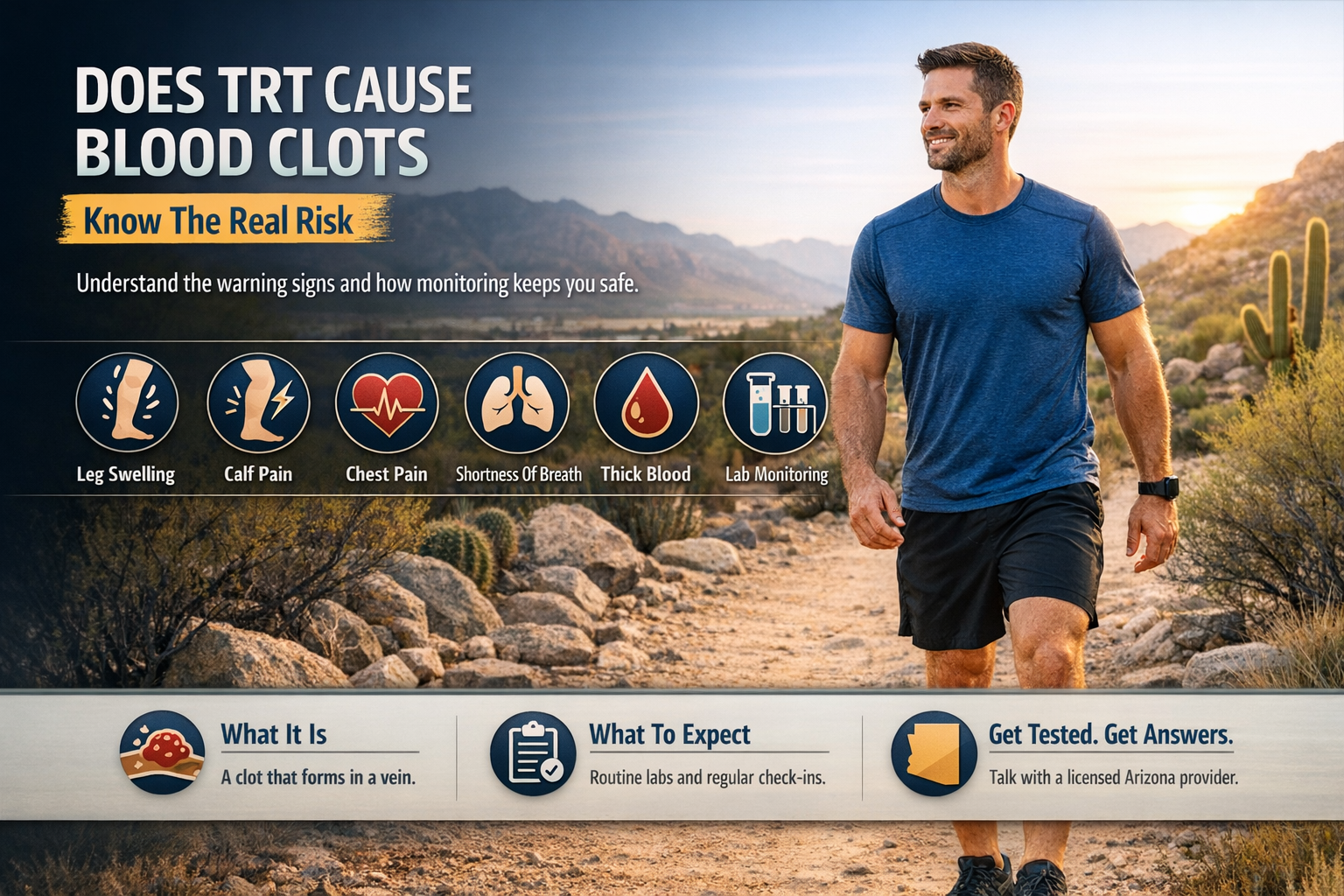
Does TRT Cause Blood Clots? What Arizona Men Should Know
If you have started researching testosterone therapy, you have probably run into a scary-sounding line on the label: TRT and blood clots. It is a fair question, and the honest answer has more nuance than either the alarmist forums or the clinics that gloss over it will tell you. Blood clots — specifically deep vein thrombosis (DVT) and pulmonary embolism (PE) — are a recognized but uncommon risk of testosterone replacement therapy, and the men most affected usually have other risk factors stacked on top.
Here is what the evidence actually shows, what the FDA warning means, what to watch for, and how a properly monitored TRT program in Phoenix, Scottsdale, Mesa, or anywhere else in Arizona manages this risk from day one.
What is a blood clot, and what does TRT have to do with it?
A venous thromboembolism (VTE) is a clot that forms inside a vein. When it forms in a deep vein — usually the calf or thigh — it is called deep vein thrombosis. If a piece of that clot breaks loose and travels to the lungs, it becomes a pulmonary embolism, which is a medical emergency.
Testosterone connects to this in two ways:
- Red blood cell production. Testosterone signals your bone marrow to make more red blood cells. That is part of why energy and endurance often improve on therapy. Pushed too far, it thickens the blood — a condition called erythrocytosis or secondary polycythemia. This is exactly why hematocrit is monitored closely on TRT.
- Clotting factors independent of red cell count. This is the part most people miss. The FDA specifically noted post-market reports of venous clots in men who did not have elevated red cell counts, which suggests thickened blood is not the whole story.
What the FDA warning actually says
In 2014, following reports of venous clots, the FDA required a class-wide venous thromboembolism warning on all approved testosterone products. That warning covers DVT and PE and applies to injections, gels, creams, pellets and patches alike.
Two things are worth understanding about that label:
- A warning is not proof of causation. It reflects a signal serious enough that regulators wanted it stated consistently and clearly across every product.
- The warning is still there today. When the FDA updated testosterone labeling in 2025 after the large TRAVERSE cardiovascular safety trial, it softened some cardiovascular language and added blood pressure warnings — but the venous clot warning stayed.
How big is the risk, really?
Absolute risk for a healthy man is low. The most useful modern data comes from the TRAVERSE trial, which randomized more than 5,000 men aged 45 to 80 with existing or high cardiovascular risk to testosterone or placebo. The trial found no significant increase in major adverse cardiovascular events, though it did observe a small numerical increase in pulmonary embolism in the testosterone group. That is a meaningful nuance: in a high-risk population, testosterone did not turn out to be the cardiovascular villain many feared, but venous clots remained on the watch list.
Other observational research has suggested the elevated risk clusters in the first six months of therapy, which is one reason early follow-up labs matter so much. If you want the broader safety picture beyond clotting, our guide to TRT and heart health walks through what the cardiovascular evidence does and does not show.
Who is actually at higher risk?
Testosterone rarely acts alone. Risk climbs when it is layered on top of:
- A personal or family history of DVT or PE
- An inherited clotting disorder such as Factor V Leiden or antiphospholipid syndrome
- Untreated obstructive sleep apnea
- Obesity, smoking, or heavy alcohol use
- Recent surgery, a long hospitalization, or extended immobility
- Long-haul flights — relevant for the Phoenix business traveler doing regular cross-country trips
- Chronic dehydration, which is a genuine Arizona concern in July and August
- Supraphysiologic dosing — running levels far above the normal male range
That last item deserves emphasis. Most of the horror stories circulating online involve men self-dosing at levels no legitimate clinic would prescribe, without labs. Therapeutic TRT aimed at restoring a normal range behaves very differently from a bodybuilding cycle.
Want TRT that's actually monitored?
Arizona-licensed providers • Arizona-based • Telehealth available
Get Started — Free Assessment →Warning signs you should never ignore
Whether or not you are on testosterone, these symptoms warrant same-day medical attention. Classic signs of deep vein thrombosis include:
- Swelling in one leg, ankle or foot — usually just one side, not both
- Cramping or aching pain that often starts in the calf
- Skin in the affected area that feels warm to the touch
- Reddish, bluish or unusually pale skin discoloration over the area
Signs that a clot may have reached the lungs — call 911:
- Sudden shortness of breath
- Chest pain that worsens when you breathe in or cough
- Coughing up blood
- Rapid heartbeat, lightheadedness or fainting
Do not wait these out. A DVT caught early is highly treatable; a PE that is ignored is not.
How a good Arizona TRT program manages this risk
Risk management here is not complicated — it is just a matter of actually doing it. A responsible protocol includes:
- A thorough intake before your first dose. Personal and family clotting history, sleep apnea screening, smoking status and current medications all belong in the conversation. This is part of the reason comprehensive bloodwork before starting TRT is non-negotiable, not a formality.
- Baseline and follow-up CBC. Hematocrit and hemoglobin get checked before you start, again at roughly 3 and 6 months, then periodically. Rising hematocrit is the earliest lever a provider can pull.
- Dose adjustment first. If hematocrit creeps up, lowering the dose or switching to smaller, more frequent injections usually settles it — smoother peaks mean less stimulation of red cell production.
- Therapeutic phlebotomy or blood donation when appropriate. Many men manage elevated hematocrit simply by donating blood while on TRT, under provider guidance.
- Watching the rest of the picture. Blood pressure gets tracked alongside blood counts, since the two often move together — see our breakdown of whether TRT raises blood pressure.
The Arizona angle is real, too. Summers here run long and hot, and dehydration concentrates the blood on its own. Men on TRT in Phoenix, Tempe, Gilbert or Tucson should be deliberate about hydration and electrolytes between May and September, particularly if they train outdoors or work in the field. It is a small habit that meaningfully supports healthy blood viscosity.
Should a history of clots rule out TRT entirely?
Not automatically — but it changes the conversation. Guidance on testosterone therapy risks as men age emphasizes weighing individual benefit against individual risk rather than applying a blanket rule. A man with a prior unprovoked DVT, an inherited thrombophilia, or one who is already on anticoagulation needs a coordinated decision involving his prescriber and, often, a hematologist. Some men in that category proceed with tighter monitoring and conservative dosing. Others reasonably decide the benefit does not justify the risk.
What should never happen is starting testosterone from an online source without anyone knowing your clotting history. That is where preventable harm actually comes from.
Get real answers about your risk
Arizona-licensed providers • Arizona-based • Telehealth available
Get Started — Free Assessment →The bottom line
Testosterone therapy carries a small, real, and manageable venous clot risk. The FDA warning exists for good reason, and it deserves respect rather than dismissal. But for a healthy man with no clotting history, treated at a physiologic dose with labs drawn on schedule, that risk stays very low — and it is far more controllable than the long-term consequences of leaving genuine hypogonadism untreated.
The variable that matters most is not whether you take testosterone. It is whether someone is actually watching your numbers.
Frequently asked questions
How common are blood clots on TRT?
They are uncommon. Large randomized data has not shown a dramatic spike in clot events, though a small numerical increase in pulmonary embolism was observed in the TRAVERSE trial. Most men on monitored, physiologic-dose testosterone never experience a clotting event. Risk rises mainly when testosterone is layered onto existing risk factors like a clotting disorder, untreated sleep apnea, smoking, or supraphysiologic dosing.
Does donating blood prevent clots on testosterone?
Blood donation or therapeutic phlebotomy lowers hematocrit, which reduces blood thickness — a helpful step when red cell counts climb. But it does not address clotting-factor changes that can occur independently of hematocrit, so it is one tool rather than a complete safeguard. Dose adjustment and ongoing lab monitoring remain the foundation, and any phlebotomy should be directed by your provider.
Can you take TRT if you are already on a blood thinner?
Sometimes, but it requires coordinated care. Men on anticoagulation are typically being treated for a condition that already raises clot risk, so the decision involves both the TRT prescriber and the physician managing the anticoagulation — often a hematologist or cardiologist. If therapy proceeds, expect conservative dosing and more frequent monitoring. This is not a decision to make from an online questionnaire alone.
Sources
- FDA Issues Class-Wide Labeling Changes for Testosterone Products — U.S. Food and Drug Administration
- Long Term Cardiovascular Safety of Testosterone Therapy: A Review of the TRAVERSE Study — PubMed Central (NIH)
- Deep Vein Thrombosis (DVT): Symptoms and Causes — Mayo Clinic
- Testosterone Therapy: Potential Benefits and Risks as You Age — Mayo Clinic
