
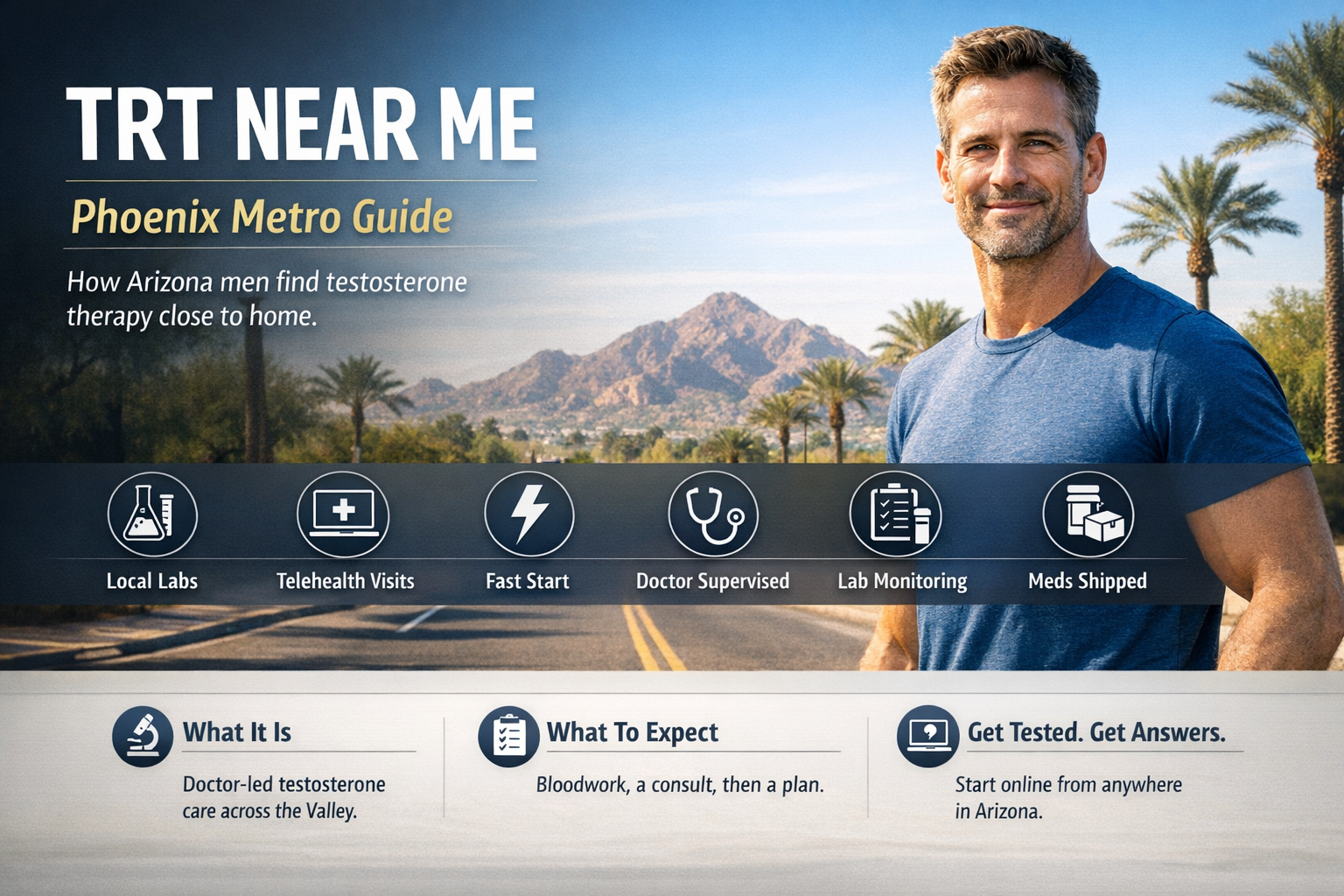
TRT Near Me: A Phoenix Metro Guide for Arizona Men
If you have typed "TRT near me" into Google from somewhere in the Phoenix metro, you have probably noticed the same thing everyone else does: a map pack of wellness clinics, a few med spas, a hospital system or two, and no obvious way to tell them apart. This guide explains what testosterone replacement therapy actually requires, how men across the Valley — Phoenix, Scottsdale, Mesa, Tempe, Chandler, Gilbert, Glendale, Peoria, Surprise, Queen Creek and beyond — typically get started, and how to judge a TRT provider on something more useful than driving distance.
What men are really asking when they search "TRT near me"
Almost nobody searching that phrase is looking for a building. They are looking for three things: someone who will actually test their hormones properly, someone who will prescribe treatment if the numbers and symptoms warrant it, and someone who will keep an eye on things afterward. Proximity is a proxy for convenience, not for quality.
That distinction matters because of how TRT works mechanically. The diagnosis is made from bloodwork, not from a physical exam. The prescription is written by a licensed clinician. The medication — usually testosterone cypionate for self-injection — is dispensed by a pharmacy. And follow-up is mostly more bloodwork plus a conversation about how you feel. None of those four steps require you to sit in a waiting room in a specific ZIP code.
Why the Valley is unusually well suited to remote TRT care
The Phoenix metro sprawls across roughly 15,000 square miles. A man in Buckeye and a man in Apache Junction are ninety minutes apart on a good traffic day. For a treatment that involves a handful of blood draws a year and a weekly injection you administer yourself at home, driving across the Valley for routine visits adds friction without adding clinical value.
This is why online TRT in Arizona through telehealth has become the default for so many men here. Your consult happens by video. Your labs are drawn at a collection site near you. Your medication ships to your door or goes to a pharmacy you choose. The clinical standard is identical — what changes is the commute.
City by city: what "near me" looks like across the Phoenix metro
- Phoenix and Central Phoenix — the densest cluster of clinics and lab draw sites in the state, and the most variable in quality.
- Scottsdale and North Scottsdale — heavy concentration of med spas and concierge wellness practices, often at premium pricing.
- Mesa, Gilbert, Chandler and Tempe — the East Valley has excellent lab coverage and a large population of working men in their 30s and 40s.
- Glendale, Peoria, Surprise and Avondale — fewer dedicated hormone clinics in the West Valley, which is exactly where telehealth closes the gap.
- Queen Creek, San Tan Valley and the far East Valley — growing fast, still underserved for specialty men's health.
- Prescott, Flagstaff, Yuma and Tucson — outside the metro entirely, where an Arizona-licensed telehealth provider is often the only practical option.
Wherever you are on that list, the sequence is the same. It starts with figuring out whether your symptoms line up with a hormone problem at all.
Do you actually need TRT? Start with symptoms, then labs
Low testosterone is not diagnosed by how you feel alone, and it is not diagnosed by a single number alone. It requires both. Clinically, male hypogonadism means low testosterone levels together with symptoms — commonly persistent fatigue, reduced libido, erectile difficulty, loss of muscle despite training, increased body fat, low mood and poor concentration.
If several of those sound familiar, read through the most common signs of low testosterone in men before you book anything. Plenty of men who search "TRT near me" turn out to have a thyroid issue, a sleep disorder, or a medication side effect instead — which is another argument for a provider who runs a full panel rather than a single testosterone value.
Find out where your levels actually stand
Doctor-supervised • Arizona-based • Telehealth available
Get Started — Free Assessment →The testing step: why morning bloodwork is non-negotiable
Testosterone follows a daily rhythm and peaks in the early morning. It also varies enough from day to day that one draw can mislead. For that reason, the American Urological Association recommends that the diagnosis be based on two separate early-morning total testosterone measurements, generally using a total testosterone below 300 ng/dL as the supporting threshold alongside symptoms.
Practically, that means a draw between roughly 7:00 and 11:00 a.m., repeated on a second day. Any provider willing to start you on testosterone from one afternoon blood test is skipping a step. If you want the full walkthrough of ordering, timing and interpreting the panel, see our guide on how to get your testosterone tested in Arizona.
Where Phoenix-area men get labs drawn
This is the one part of TRT that genuinely is location-dependent — and it is the easy part. Arizona has dense commercial lab coverage, with major national lab networks operating patient service centers throughout Maricopa and Pinal counties, plus hospital outpatient labs and a number of independent draw sites. Most men find a location within a ten-minute drive, book an early slot, and are out in fifteen minutes.
A good provider sends you a lab order, tells you which sites are closest to your address, and receives the results directly. You should never be asked to chase down your own paperwork.
What happens after you start — and why monitoring separates good clinics from bad ones
Starting therapy is not the finish line. Testosterone changes more than one lab value, and the follow-up schedule is where a serious clinic earns its keep. Guideline-based care calls for rechecking testosterone and hematocrit roughly three to six months after starting, again at twelve months, and annually thereafter, with PSA and prostate assessment on a defined schedule for appropriate age groups.
Hematocrit is the one men underestimate. Testosterone can thicken the blood, and left unchecked that is a real risk — which is precisely why the monitoring schedule exists. When you are comparing providers, ask directly: how often will you recheck my labs, and is that included in the price?
How to judge a TRT provider — and the red flags
The Urology Care Foundation's plain-language summary of what the AUA guideline means for patients is a useful yardstick: proper testing, a real diagnosis, informed discussion of risks and benefits, and ongoing follow-up. Measure any clinic against that.
Green flags: a licensed Arizona clinician reviews your labs and talks to you directly; a full hormone panel rather than a single value; two morning draws before treatment; monitoring included; clear, flat pricing. Red flags: testosterone offered after a questionnaire alone, aggressive upselling of peptides and add-ons, no mention of follow-up labs, or a price that only makes sense after you buy a long prepaid package. Our deeper breakdown of what to look for in a Phoenix TRT clinic covers the comparison in detail.
What it costs around the Valley
Pricing in the Phoenix metro varies widely, and the headline number is rarely the whole number. Some clinics quote a low monthly medication fee and bill labs, consults and injection supplies separately; others bundle everything. Concierge practices in Scottsdale and Paradise Valley typically sit at the top of the range. Before committing anywhere, read through how much TRT costs in Arizona so you know which line items to ask about.
The bottom line on "TRT near me"
The nearest clinic is not automatically the right one, and in a metro this spread out, the nearest clinic may still be a forty-minute drive. What you actually need is an Arizona-licensed provider who tests you properly, explains the results, prescribes only when it is warranted, and monitors you for as long as you are on therapy. That care can be delivered from a Phoenix office or through a video visit from your kitchen table — the standard should not change either way.
TRT for Arizona men, wherever you are in the Valley
Doctor-supervised • Arizona-based • Telehealth available
Get Started — Free Assessment →Frequently asked questions
Do I have to visit a clinic in person to get TRT in Arizona?
Not usually. Arizona permits licensed clinicians to evaluate and prescribe through telehealth, so the consult can happen by video. You will still need in-person bloodwork at a lab draw site, but that is typically a short visit at a location near your home or work rather than a trip to the clinic itself.
How do I find a good TRT clinic near me in Phoenix?
Judge providers on process, not proximity. Look for a licensed Arizona clinician who orders a full hormone panel, requires two early-morning testosterone draws before prescribing, includes follow-up lab monitoring in the plan, and publishes flat pricing. Treat questionnaire-only prescribing and heavy add-on upselling as reasons to walk away.
How fast can I start TRT if I live in the Phoenix metro?
It depends mostly on lab scheduling. Many men complete an initial consult within a few days, get their first morning draw shortly after, and repeat it on a second morning. Once both results and your symptom history are reviewed, treatment can usually begin within a couple of weeks — assuming the labs support a diagnosis.
Sources
- Testosterone Deficiency Guideline — American Urological Association
- Testosterone Therapy for Hypogonadism Guideline Resources — Endocrine Society
- Low Testosterone (Low T): Hypogonadism, Symptoms & Treatment — Cleveland Clinic
- How the AUA Guideline on Testosterone Deficiency May Impact You — Urology Care Foundation
