
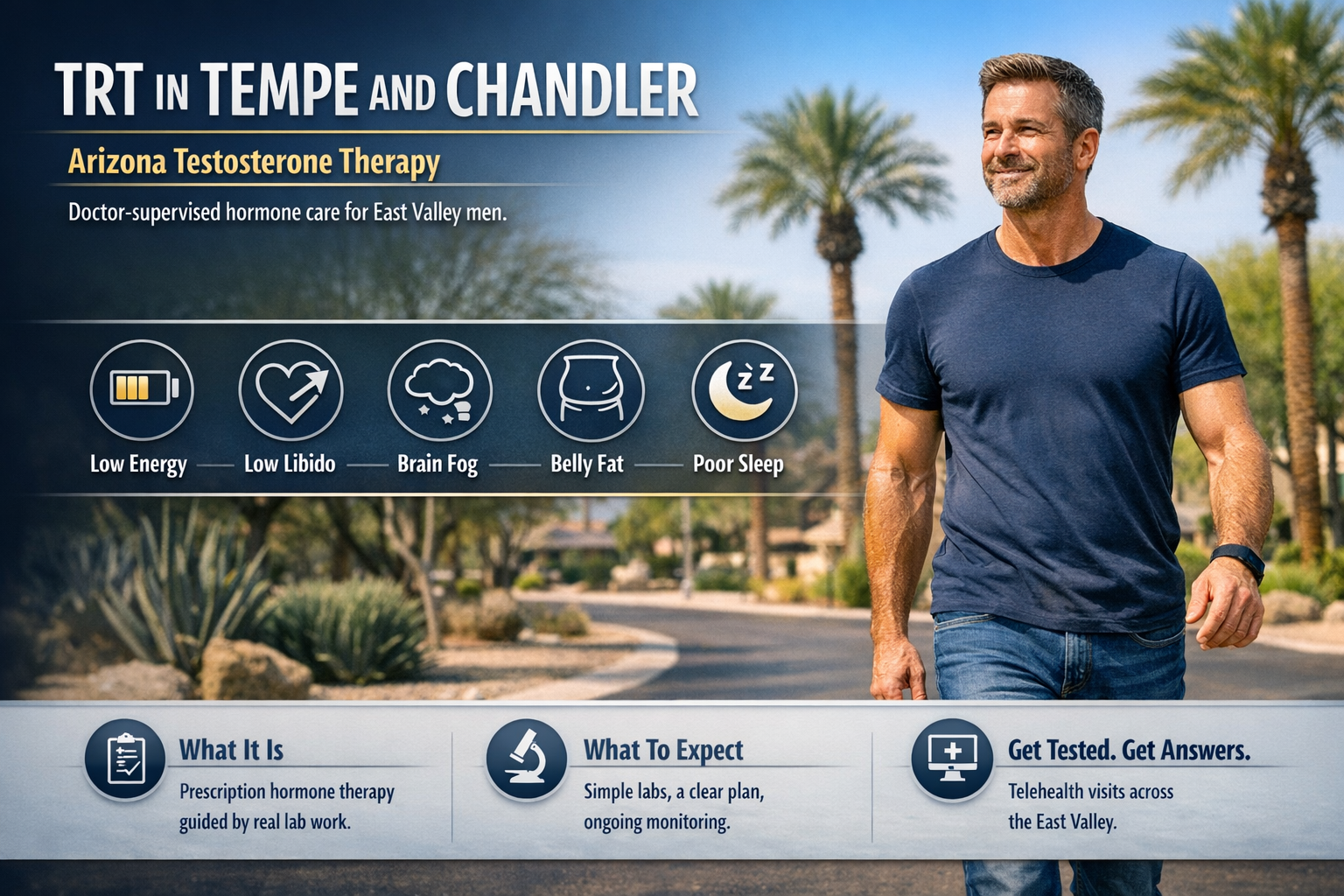
TRT in Tempe & Chandler, AZ: Testosterone Therapy Guide
If you have been searching for TRT in Tempe or Chandler, AZ, you are probably less interested in the biochemistry than in one practical question: how do I actually get this done without burning a week of PTO? The East Valley is full of men in their 30s, 40s, and 50s juggling work at ASU, Intel, Chandler's tech corridor, or their own business — and low testosterone rarely announces itself loudly enough to justify taking a whole morning off. This guide walks through how testosterone replacement therapy works for Arizona men, what the diagnostic process looks like, and what to expect once you start.
What TRT is — and what it isn't
Testosterone replacement therapy is a prescription medical treatment that restores testosterone to a healthy physiological range in men who have both low lab values and symptoms of deficiency. That second half matters. A number on its own is not a diagnosis, and neither is feeling tired.
TRT is not a performance-enhancing cycle, and it is not the supermarket supplement aisle. It is an ongoing, monitored therapy that uses FDA-approved testosterone preparations — most commonly testosterone cypionate injections, though gels, creams, and pellets exist — under the supervision of a licensed clinician who tracks your labs over time.
Signs worth taking seriously in the East Valley
Low testosterone tends to creep in rather than crash down. Mayo Clinic notes that hypogonadism in adult men can reduce sex drive, energy, muscle mass, and bone density. In practice, the men who call us from Tempe and Chandler describe some combination of:
- Flat energy by mid-afternoon, even after a full night's sleep
- Noticeably lower libido or weaker erections
- Mental fog — losing the thread in meetings, slower recall
- Strength plateaus or lost muscle despite consistent training
- Stubborn weight gain around the midsection
- Irritability, low mood, or a general loss of drive
Plenty of these overlap with sleep apnea, thyroid problems, depression, and simple overwork — which is exactly why bloodwork, not a symptom checklist, makes the call. If you want the fuller picture first, our breakdown of the most common signs of low testosterone in men covers what to watch for and when it's worth testing.
How low testosterone is actually diagnosed
The American Urological Association's testosterone deficiency guideline sets a clear standard: a diagnosis requires total testosterone below 300 ng/dL on at least two separate early-morning blood draws, paired with symptoms or signs. Cleveland Clinic uses the same practical threshold, noting that providers call it hypogonadism only when low levels appear alongside symptoms.
Testosterone peaks in the morning and drifts down through the day, so a 4 p.m. draw can make a normal man look deficient. Early morning, fasted, twice — that's the standard. A thorough workup also includes free testosterone, SHBG, estradiol, LH, a complete blood count, PSA where age-appropriate, and a metabolic panel. If you want the logistics spelled out, here is our step-by-step guide to getting your testosterone tested in Arizona, including which local draw sites to use.
Find out where your testosterone actually stands.
Doctor-supervised • Arizona-based • Telehealth available
Get Started — Free Assessment →How TRT works if you live in Tempe or Chandler
Arizona telehealth law allows a licensed Arizona provider to evaluate you, order labs, and prescribe testosterone after a virtual visit. For most East Valley men that turns a multi-appointment process into something you can fit around a lunch break. Here's the sequence.
1. The consultation
A video or phone visit covering symptoms, medical history, medications, family history, and your goals. This is also where fertility plans get discussed, because that changes the treatment plan — testosterone suppresses the body's own sperm production, so men who want children soon are often better served by hCG, enclomiphene, or a combination protocol.
2. Bloodwork at a lab near you
You'll get an order for an early-morning draw at a patient service center close to home — there are Quest and Labcorp locations along Rural Road and Baseline in Tempe, and near Chandler Regional and the Chandler Fashion Center area, plus plenty of options in Gilbert and Mesa if that's an easier stop on your commute.
3. Reviewing results and building a protocol
Your provider walks you through the numbers, confirms whether the picture meets diagnostic criteria, and rules out causes that should be treated first. If TRT is appropriate, you agree on a delivery method and starting dose. Medication and supplies ship to your address in Tempe or Chandler.
4. Ongoing monitoring
Follow-up labs typically land around 6–12 weeks after starting, then at regular intervals. Monitoring tracks testosterone levels, hematocrit, estradiol, and PSA. This is the part that separates real medical care from a subscription that mails you vials — if a clinic isn't rechecking your blood, walk away. The same principles apply to telehealth testosterone therapy anywhere in Arizona, whether you're in the East Valley or further out.
What results actually look like
Improvements arrive in a predictable order rather than all at once. Libido and mood often shift first, within the first three to six weeks. Energy and mental clarity tend to follow. Changes in body composition — lean mass up, fat mass down — are the slowest and depend heavily on whether you're training and eating like someone who wants them. Six months is a fair window to judge the full effect.
What TRT will not do is replace sleep, fix a bad diet, or turn an untrained body into an athletic one. It removes a hormonal ceiling. The work still has to happen underneath it.
Safety, side effects, and honest expectations
TRT is generally well tolerated when it's dosed correctly and monitored. Mayo Clinic points out that most risks from testosterone therapy stem from doses that are too high, and that many side effects resolve when the dose comes down — which is the whole argument for regular follow-up visits.
The issues worth watching: a rise in red blood cell count (hematocrit), acne or oily skin, fluid retention early on, suppressed fertility, and estradiol shifting out of range. Men with untreated severe sleep apnea, active prostate or breast cancer, or plans to conceive in the near term need a more careful conversation before starting.
Choosing a clinic — and what it costs
The East Valley has no shortage of places willing to sell you testosterone. The ones worth your money share a few traits: a licensed Arizona provider you actually speak with, a full lab panel before any prescription, scheduled follow-up bloodwork built into the program, transparent pricing with no surprise fees, and a willingness to tell you that you don't need TRT if your labs say so.
Most Arizona TRT is cash-pay, which tends to be simpler and more predictable than routing it through insurance. We break the numbers down in our guide to what TRT costs in Arizona. And if you're comparing options across the East Valley, our overview of starting testosterone therapy in Mesa covers the same process from a neighboring city.
Ready to stop guessing and start testing?
Doctor-supervised • Arizona-based • Telehealth available
Get Started — Free Assessment →Frequently asked questions
How do I get TRT in Tempe or Chandler without going to a clinic in person?
Arizona allows licensed providers to evaluate and prescribe testosterone through telehealth. You complete a virtual consultation, get an order for early-morning bloodwork at a lab near you, review results with your provider, and have medication shipped to your home. The only in-person step is the blood draw.
How long does it take to start TRT in the East Valley?
Most men go from first consultation to first dose in roughly one to two weeks. The timeline depends mainly on how quickly you get to the lab and how fast results come back — typically two to five business days for a standard hormone panel.
What testosterone level is low enough to qualify for treatment?
Clinical guidelines use total testosterone under 300 ng/dL, confirmed on two separate early-morning draws, together with symptoms. Some men with borderline totals still qualify if free testosterone is low, which is why a full panel matters more than a single number.
Sources
