
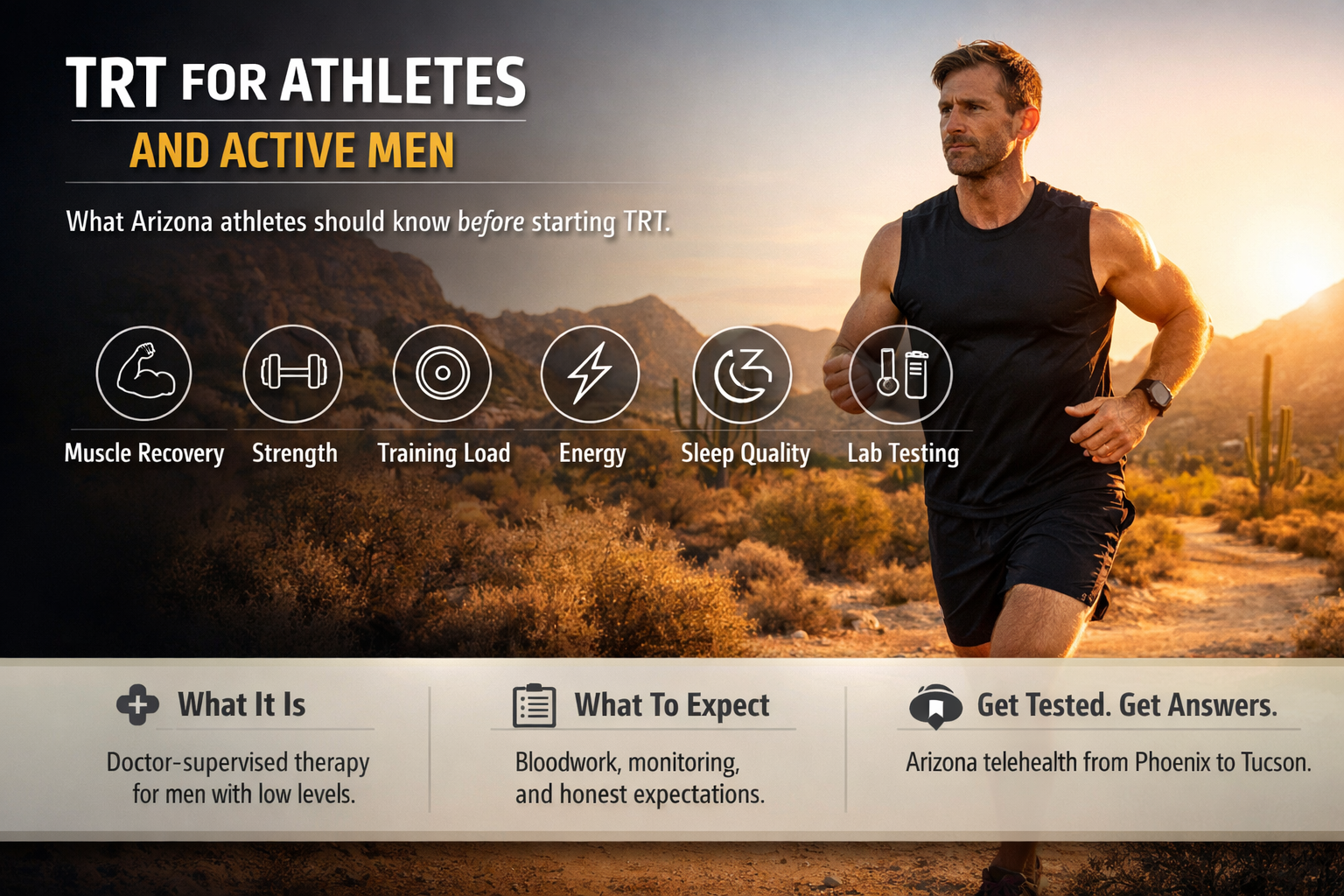
TRT for Athletes and Active Men: An Arizona Guide
TRT for athletes and active men is one of the most misunderstood corners of men's health. If you train hard in Phoenix, ride at South Mountain, lift five days a week in Scottsdale, or run masters track in Tucson, you have probably heard testosterone replacement therapy described two very different ways: as a shortcut that gives you an unfair edge, or as the only thing that will get your body back to where it used to be. Neither framing is accurate. Here is the honest version — what testosterone therapy actually does for trained men, when low testosterone is the real problem versus a symptom of how you're training, and the anti-doping rules every competitive Arizona athlete needs to understand before a single injection.
Athletes can absolutely have low testosterone — sometimes because of training
There is a persistent assumption that fit men don't get low T. In practice, some of the lowest testosterone readings we see belong to lean, disciplined, high-volume trainers. The reason is physiological: the hypothalamic-pituitary-gonadal axis is sensitive to energy availability and training stress. When the body perceives a sustained energy deficit, it dials down reproductive and anabolic signaling to conserve resources.
This is well described in the sports medicine literature. Researchers have documented that intensive endurance training can suppress resting testosterone and disrupt the HPG axis in men, a pattern that overlaps with what the International Olympic Committee calls Relative Energy Deficiency in Sport (RED-S). The important nuance: this kind of suppression is often functional and reversible. Restore calories, reduce training load, fix sleep, and levels frequently recover on their own.
That distinction matters enormously. A 34-year-old triathlete in a 700-calorie daily deficit with a total testosterone of 240 ng/dL does not have the same problem as a 34-year-old who eats well, sleeps well, trains moderately, and still reads 240 ng/dL. The first man may need a nutrition and recovery correction. The second may need treatment. Sorting those apart is exactly what a proper workup does, which is why understanding how low testosterone is diagnosed is the essential first step before anyone talks about therapy.
What TRT actually does for muscle and performance
Here's where expectations need calibrating. In men with confirmed deficiency, testosterone therapy reliably improves body composition. Studies consistently show that testosterone increases lean body mass and muscle strength, primarily through hypertrophy of both type I and type II muscle fibers and an increase in satellite cell number.
But two caveats separate reality from the internet version:
- Strength gains don't automatically become performance gains. Research has repeatedly found that testosterone supplementation increases measured muscle strength without producing proportional improvements in functional performance measures like gait speed or endurance capacity. More muscle is not the same as a faster 10K.
- Training still does the heavy lifting. Testosterone's effects on muscle are augmented by exercise training, but for many outcomes a well-designed exercise program delivers most of the benefit, with testosterone adding less on top than men expect. TRT is not a substitute for programming, protein, and sleep.
The men who see the most dramatic change are usually those who were genuinely deficient and whose training had stalled despite consistent effort. If that sounds familiar, it's worth reading why some men are losing muscle despite working out — it's one of the more telling signs that hormones, not effort, are the limiting factor.
Training hard and still going backward?
Arizona-licensed providers • Arizona-based • Telehealth available
Get Started — Free Assessment →The anti-doping question every competitive athlete must answer first
If you compete in any drug-tested sport — USA Cycling, USA Triathlon, masters track and field, powerlifting federations, collegiate athletics, combat sports sanctioned by a state commission — this section is non-negotiable.
Testosterone is a prohibited substance both in and out of competition. Holding a legitimate prescription from a licensed physician does not, by itself, make you compliant. Athletes in a testing pool must obtain a Therapeutic Use Exemption (TUE) before starting a prohibited medication, and testosterone TUEs are among the hardest to secure. Approval generally requires documented organic hypogonadism with an identifiable structural or genetic cause. Functional low testosterone driven by obesity, aging, stress, or overtraining typically does not qualify, and a history of anabolic steroid use is generally disqualifying.
Practical guidance for Arizona athletes:
- Identify your governing body and whether you are in a registered testing pool.
- Check the current prohibited list and your federation's TUE process before your first prescription, not after a positive test.
- Bring the TUE requirement into your very first clinical conversation so your provider can document appropriately — or help you evaluate non-prohibited alternatives.
If you're a recreational athlete who races for fun and isn't subject to testing, none of this applies to you clinically. But if there is any chance you'll enter a sanctioned event, sort it out first.
The side effects that matter most for active men
Every man on testosterone therapy needs monitoring, but two issues deserve special attention in athletes.
Hematocrit and blood viscosity
Testosterone stimulates red blood cell production. In a sedentary man that's a monitored side effect; in an endurance athlete who is already training at altitude, dehydrating in Arizona summer heat, or has a naturally high baseline, it can push hematocrit into a range that requires dose adjustment or therapeutic phlebotomy. This is the single most common reason an otherwise well-managed athlete needs a protocol change, which is why regular hematocrit monitoring on TRT is not optional. Arizona's heat makes hydration a real variable here — a dehydrated draw can read artificially high.
Fertility suppression
Exogenous testosterone suppresses natural production and sperm output. For a 27-year-old competitive athlete who plans to have children, that's a central decision point, not a footnote. Options exist — including protocols that preserve testicular function — but they need to be planned from day one.
Beyond those two, the general safety picture applies: estrogen management, blood pressure, prostate monitoring, and periodic labs. A broader overview of TRT risks and side effects is worth reading before you commit.
What a good clinical process looks like for an active man
Guideline-based care is specific. The American Urological Association's testosterone deficiency guideline calls for diagnosis based on two separate early-morning total testosterone measurements alongside genuine symptoms — not a single reading, and not symptoms alone. For athletes, a thorough evaluation should also cover:
- Training and nutrition history. Weekly volume, intensity, caloric intake, and recent weight change. If you're in an energy deficit, that gets addressed before anything else.
- Sleep. Most testosterone release happens during sleep; chronic restriction meaningfully lowers levels.
- Supplement and PED history. Prior use of prohormones or anabolic steroids changes both the clinical picture and TUE eligibility.
- Full hormone panel. Total and free testosterone, LH, FSH, estradiol, SHBG, prolactin, plus CBC and metabolic markers.
If treatment is appropriate, expect a phased response rather than an overnight transformation — libido and energy typically shift first, with body composition changes accruing over months. Our breakdown of how long TRT takes to work lays out the realistic timeline.
Arizona-specific considerations
Two things make Arizona a little different for active men on hormone therapy. First, heat: summer training in Phoenix, Mesa, Chandler, and Gilbert means significant fluid loss, which affects both how you feel on therapy and how your bloodwork reads. Schedule labs in the morning, well hydrated. Second, access: telehealth means a rider in Flagstaff, a lifter in Tempe, and a runner in Tucson can all get the same monitored care without a weekly drive, with labs drawn at a local Arizona collection site.
Find out what your numbers actually say
Arizona-licensed providers • Arizona-based • Telehealth available
Get Started — Free Assessment →Frequently asked questions
Can athletes take TRT legally?
Yes, with a valid prescription for diagnosed testosterone deficiency — it is a legal medical treatment. But legality and sport eligibility are separate questions. In drug-tested sports, testosterone is prohibited in and out of competition, and you need an approved Therapeutic Use Exemption from your governing body before starting. A prescription alone will not protect you from an anti-doping violation.
Does working out too much lower testosterone?
It can. High training volume combined with insufficient calories or sleep can suppress the hypothalamic-pituitary-gonadal axis and lower resting testosterone, a pattern associated with Relative Energy Deficiency in Sport. This form of low testosterone is often reversible once energy availability, training load, and recovery are corrected, which is why those factors should be evaluated before starting therapy.
Will TRT make me faster or stronger if my levels are normal?
If your testosterone is already in a healthy range, therapy is not clinically indicated and carries risks without a corresponding medical benefit — including suppressed natural production, elevated hematocrit, and reduced fertility. TRT is treatment for a diagnosed deficiency, not a performance program. Men with normal levels get better results from training, nutrition, and sleep.
Sources
- Testosterone Deficiency Guideline — American Urological Association
- Therapeutic Use Exemptions (TUEs) — World Anti-Doping Agency
- Hypogonadism in Exercising Males: Dysfunction or Adaptive-Regulatory Adjustment? — PubMed Central
- Comparing the Impacts of Testosterone and Exercise on Lean Body Mass, Strength and Aerobic Fitness in Aging Men — PubMed Central
