
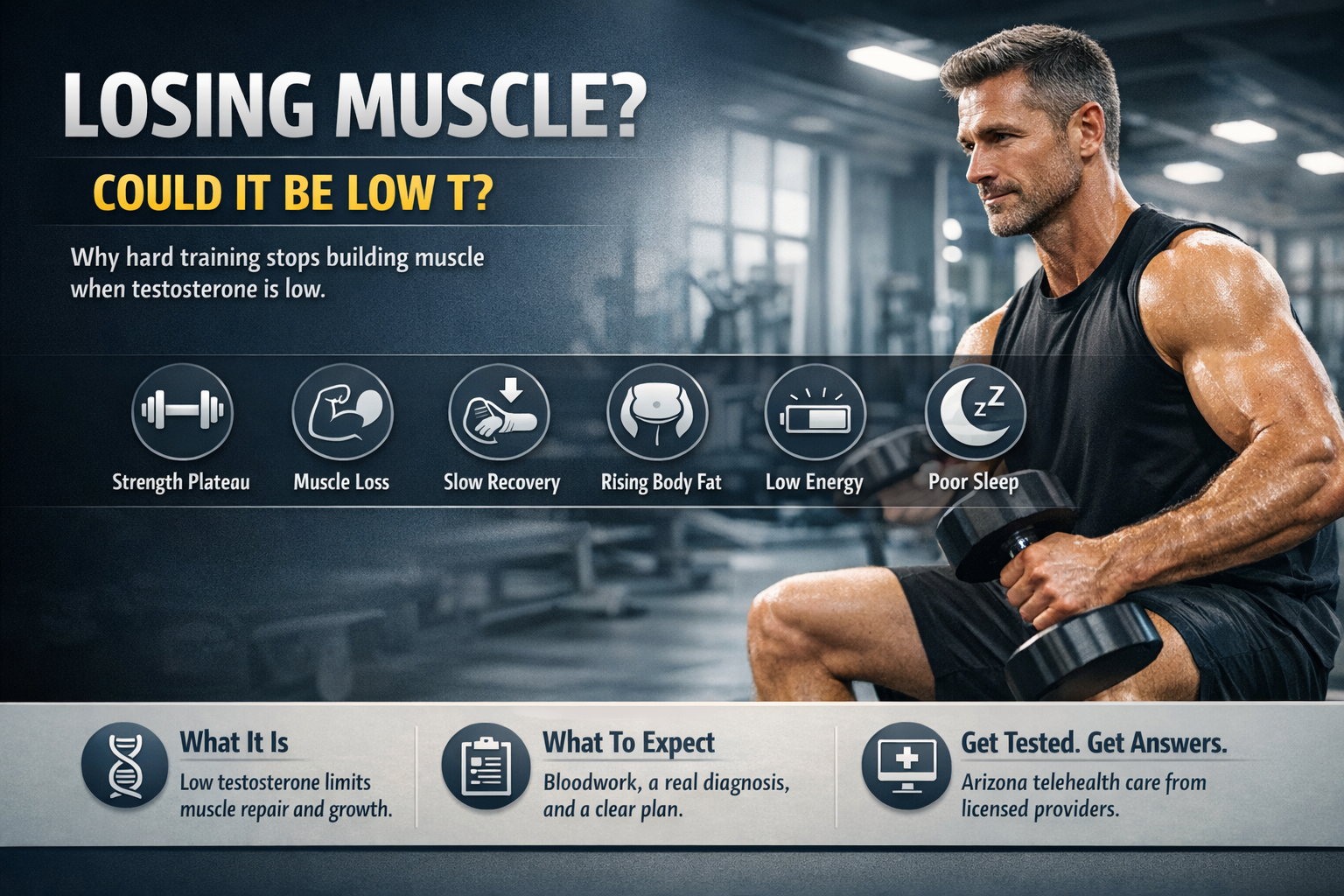
Losing Muscle Despite Working Out? It Could Be Low T
You have not changed anything. Same gym, same program, same three or four days a week. But the mirror says otherwise: your arms look flatter, your lifts have stalled or gone backward, and the weight you are gaining is not muscle. Losing muscle despite working out is one of the most frustrating experiences a man can have — and in men over 30, low testosterone is one of the first things worth ruling out.
At AZTRT, we work with men across Phoenix, Scottsdale, Mesa, Tempe, Chandler, Gilbert, and Tucson who describe the same pattern. They are not lazy. They are doing the work. The hormone that makes the work pay off has quietly dropped. Here is how to tell the difference between a training problem and a hormone problem, and what to do about it.
Why testosterone controls whether your training builds muscle
Lifting weights creates the stimulus. Testosterone is a major part of the signal that turns that stimulus into new tissue. It increases muscle protein synthesis, supports satellite cell activity, and helps limit the muscle breakdown that happens between sessions. When testosterone is adequate, hard training and enough protein produce steady gains. When it is low, the same effort yields diminishing returns.
This relationship is well documented in the medical literature. Clinical research on testosterone and sarcopenia — age-related muscle loss consistently links declining androgen levels to reductions in lean mass and strength in men. Mayo Clinic also lists decreased muscle mass among the recognized signs of male hypogonadism, alongside fatigue, low libido, and mood changes.
The important nuance: low testosterone rarely causes dramatic overnight muscle loss. It is usually a slow erosion over months or years. Most men do not notice the day it started. They notice the year they realized their bench press had gone down and their waistline had gone up.
Seven signs it is a hormone problem, not a training problem
Any one of these on its own is not diagnostic. Together, they build a picture worth investigating:
- Strength is regressing on a program that used to work. Not plateauing — actively going backward, despite consistent attendance.
- Recovery takes days instead of a day. Soreness lingers, and you dread the next session in a way you did not at 28.
- Body composition is shifting the wrong direction. Muscle down, abdominal fat up, at roughly the same body weight. This is one of the more telling patterns.
- Fatigue that sleep does not fix. If you are dragging through the afternoon no matter what, read our breakdown of chronic fatigue and low testosterone.
- Libido and morning erections have faded. Sexual symptoms often appear alongside the physical ones.
- Mood, motivation, or focus have flattened. The gym feels like a chore rather than an outlet.
- Pump and vascularity have disappeared. Many men describe workouts that simply feel "dead" compared to a few years ago.
If several of these sound familiar, it is worth reviewing the full list of common signs of low testosterone in men before assuming you just need a new program.
Training hard and still losing ground?
Arizona-licensed providers • Arizona-based • Telehealth available
Get Started — Free Assessment →What else causes muscle loss in men who train
Honest medicine means ruling things out, not jumping to conclusions. Low testosterone is one cause among several, and sometimes more than one is at play.
You are not eating enough protein or enough total calories
This is the single most common non-hormonal reason. Men in their 40s often eat like men in their 20s who happened to be eating more. If you are under roughly 0.7–1 gram of protein per pound of target body weight, or in a persistent calorie deficit, muscle loss is expected regardless of hormones.
Chronic under-sleeping
Sleep is when the majority of growth hormone release and tissue repair happens. Poor sleep also suppresses testosterone directly, so this problem often compounds.
Overtraining and under-recovering
High training volume with high work stress and no deload weeks produces the same symptoms as low T: fatigue, declining performance, low motivation. In the Phoenix summer, add dehydration and heat stress to the list.
Thyroid disease, anemia, or other medical conditions
Hypothyroidism, iron deficiency, sleep apnea, uncontrolled diabetes, and certain medications all cause muscle loss and fatigue. This is exactly why a proper workup includes more than a single testosterone number.
Normal aging
Men lose lean mass gradually after about age 30 even with normal hormones. Training slows this considerably — but if training has stopped slowing it, something has changed.
How to find out for certain
There is no way to diagnose low testosterone from symptoms alone. The symptoms are too nonspecific. Diagnosis requires blood work, done correctly.
The American Urological Association guideline defines low testosterone as consistently below 300 ng/dL on two separate early-morning measurements, combined with symptoms or signs. Two measurements matter because testosterone fluctuates; a single afternoon draw can be misleading in either direction. A thorough panel also includes free testosterone, SHBG, LH and FSH, estradiol, a CBC, a comprehensive metabolic panel, PSA where age-appropriate, and thyroid markers to catch the conditions listed above.
Our guide to how low testosterone is diagnosed walks through what each marker means and why the timing of the draw matters so much.
Getting tested in Arizona
Arizona men have straightforward options. Sonora Quest and LabCorp draw sites are widespread across the Phoenix metro and Tucson, and most offer early-morning appointments — important, since accurate testing generally means a draw before roughly 10 a.m. Telehealth is fully permitted for hormone care in Arizona, which means an online clinic can order your labs at a local draw site, review results with you over video, and manage treatment without office visits.
If you want the practical walkthrough, see our step-by-step guide to getting your testosterone tested in Arizona, including what to ask for and how to prepare.
If it is low T, what actually changes
Treatment is not a shortcut and it is not magic. What it does is restore the hormonal environment in which training works again. Research comparing testosterone therapy and exercise on lean body mass and strength in aging men shows measurable improvements in lean mass with treatment — and the best outcomes when training and treatment happen together, not one instead of the other.
A realistic timeline for most men: energy and mood often shift in the first three to six weeks, strength and training quality follow over the next two to three months, and visible body composition change generally takes three to six months of consistent training, adequate protein, and stable levels. Individual results vary considerably. For a fuller picture, see what to expect from TRT and muscle growth.
Treatment also requires ongoing monitoring — hematocrit, estradiol, PSA, and symptom response — which is why testosterone therapy is a prescription treatment managed by a licensed provider, not a supplement you order online.
Find out if low testosterone is the reason
Arizona-licensed providers • Arizona-based • Telehealth available
Get Started — Free Assessment →Frequently asked questions
Can low testosterone cause muscle loss even if I work out?
Yes. Training provides the stimulus, but testosterone is a primary hormonal driver of muscle protein synthesis. When levels are low, the same workouts produce noticeably less growth and may not fully offset normal muscle breakdown. Decreased muscle mass is a recognized symptom of male hypogonadism, and many men notice strength regression before anything else.
How do I know if it's low T or just overtraining?
You cannot tell from symptoms alone — they overlap almost completely. Overtraining typically improves after one to two weeks of reduced volume and better sleep. If a genuine deload and a month of solid sleep and nutrition change nothing, blood work is the next step. Testing is the only way to separate the two.
Will I regain the muscle I lost if I start TRT?
Many men do regain lean mass, but treatment works alongside training and nutrition rather than replacing them. Studies show improvements in lean body mass with testosterone therapy, with the strongest results when resistance training continues. Results vary by age, starting levels, training history, and consistency, and no outcome can be guaranteed.
Sources
- Male Hypogonadism: Symptoms & Causes — Mayo Clinic
- Evaluation and Management of Testosterone Deficiency Guideline — American Urological Association
- Relationship between Testosterone and Sarcopenia in Older-Adult Men: A Narrative Review — PubMed Central (NIH)
- Comparing the Impacts of Testosterone and Exercise on Lean Body Mass, Strength and Aerobic Fitness in Aging Men — PubMed Central (NIH)
