
Very Low Testosterone and Death Risk: 2024 Study
Medically reviewed by Lauren Orta, FNP-C
Across 20 studies of community-dwelling men, those with testosterone under 213 ng/dL had higher risk of dying from any cause. Under 153 ng/dL, heart-related death risk rose too.
TL;DR
- Researchers pooled individual data from 9 long-term studies (255,830 person-years) plus summary data from 11 more (24,109 men).
- Testosterone under 213 ng/dL was linked to higher all-cause mortality. Under 153 ng/dL, higher cardiovascular death risk.
- Above those levels, testosterone wasn't clearly tied to death risk after adjusting for health factors.
- This links low levels to risk. It does not prove TRT lowers that risk.
What the study did
This was an individual participant data meta-analysis in Annals of Internal Medicine (2024), led by Bu Yeap and a large international team (PubMed 38739921; full text on PMC; DOI 10.7326/M23-2781).
It included only prospective studies of men living in the community, with at least 5 years of follow-up and hormones measured by mass spectrometry, the most accurate method. Nine studies shared raw data on individual men (255,830 participant-years), and 11 more contributed summary results (24,109 men). Results were adjusted for age, BMI, smoking, alcohol, activity, blood pressure, diabetes, kidney function and cholesterol.
What it found
- All-cause mortality: men with baseline testosterone below 7.4 nmol/L (under 213 ng/dL) had higher risk of death from any cause.
- Heart-related death: men below 5.3 nmol/L (under 153 ng/dL) had higher cardiovascular mortality.
- Not a straight line: in fully adjusted models, only men with very low testosterone had clearly higher risk. Men in the low-normal range didn't.
- Other hormones: high LH (above 10 IU/L) and very low estradiol were also linked to higher mortality. Lower SHBG was linked to lower mortality (HR 0.85 comparing lowest to highest fifth).
What it means for you
Very low testosterone isn't just a libido or energy problem. In large, well-measured populations, it travels with a higher risk of dying. That's a strong reason to get tested properly if you have symptoms, instead of guessing.
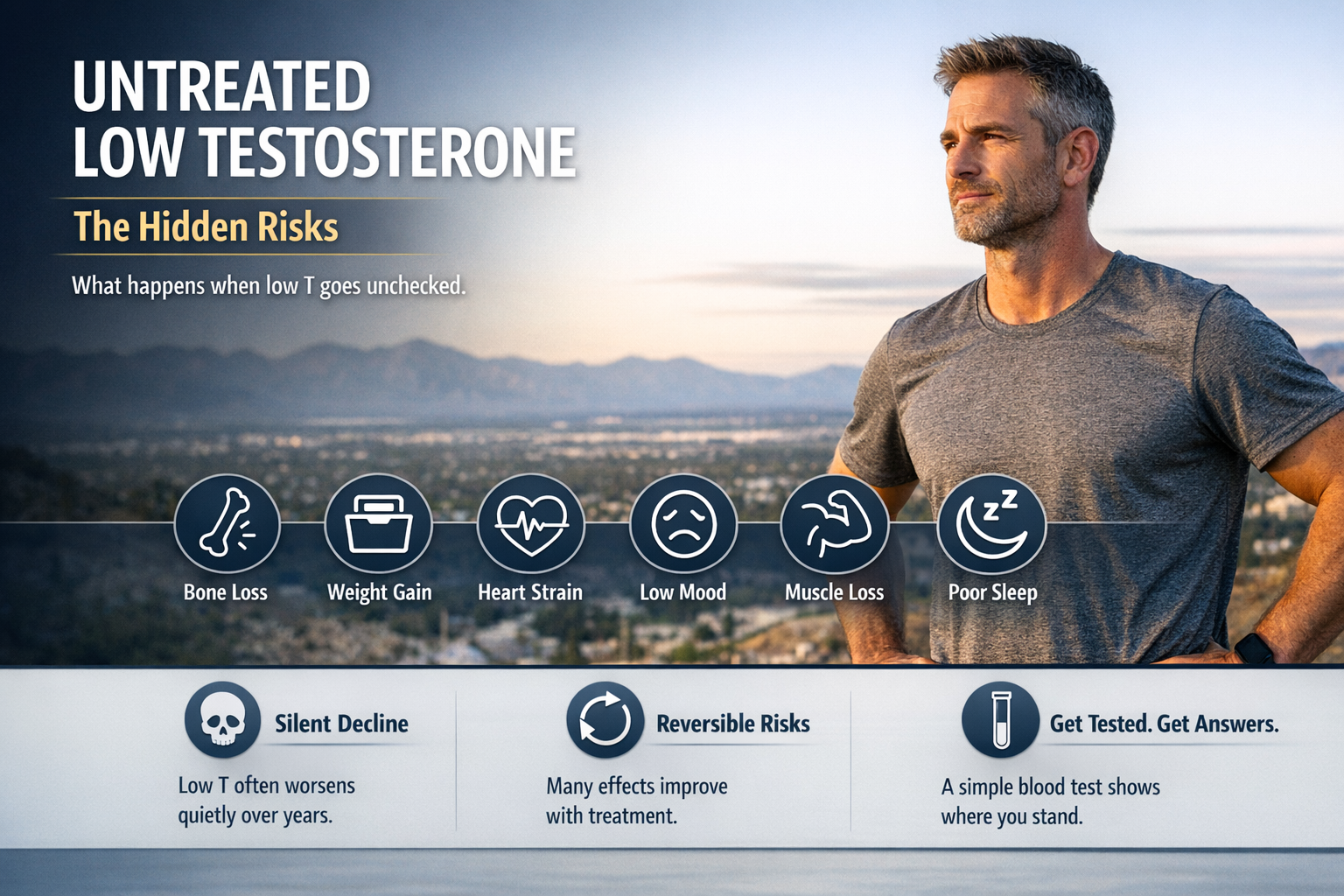
It also explains why proper labs matter: total testosterone, free testosterone, SHBG and LH each tell part of the story. Read what testosterone level is considered low, how low T is diagnosed, free vs total testosterone and what SHBG is. For the broader picture, see the risks of untreated low testosterone.
The fine print
- Observational. Very low T could be a marker of poor health rather than a cause of it, even after adjustment.
- It does not show that TRT lowers death risk. The best randomized data so far (TRAVERSE, Lincoff et al., NEJM 2023) was designed to test heart safety, and found TRT did not raise major cardiac events versus placebo. It was not built to prove a survival benefit.
- Studies varied, and some missing data was imputed.
- Typical ages across the studies ranged from 49 to 76, and typical baseline testosterone from 357 to 588 ng/dL.
- Funding included government sources and Lawley Pharmaceuticals.
FAQ
What testosterone level is linked to higher death risk?
In this 2024 meta-analysis, men with testosterone under 213 ng/dL (7.4 nmol/L) had higher all-cause mortality, and men under 153 ng/dL (5.3 nmol/L) had higher cardiovascular mortality.
Does TRT lower the risk of death?
This study can't answer that. It looked at hormone levels, not treatment. Randomized trials so far show TRT did not raise major cardiac events, but haven't proven it extends life.
How big was the study?
Nine studies with individual data (255,830 participant-years) plus 11 studies with summary data (24,109 men), all with at least 5 years of follow-up.
Should I get my testosterone checked?
If you have symptoms like low drive, fatigue or loss of muscle, a proper morning blood test is the place to start.
Next step
Wondering where your number sits? Start with a free consult and real labs. Book a free consult or learn about TRT at AZTRT. AZTRT serves men in Arizona through licensed telehealth providers.
Sources
- Yeap BB et al. Associations of Testosterone and Related Hormones With All-Cause and Cardiovascular Mortality and Incident Cardiovascular Disease in Men: Individual Participant Data Meta-analyses. Ann Intern Med. 2024;177(6):768-781. PubMed · DOI
- Lincoff AM et al. Cardiovascular Safety of Testosterone-Replacement Therapy. N Engl J Med. 2023;389(2):107-117. PubMed · DOI
This article is for education, not medical advice. Treatment decisions are made with a licensed provider after an evaluation and labs. Results vary.
