
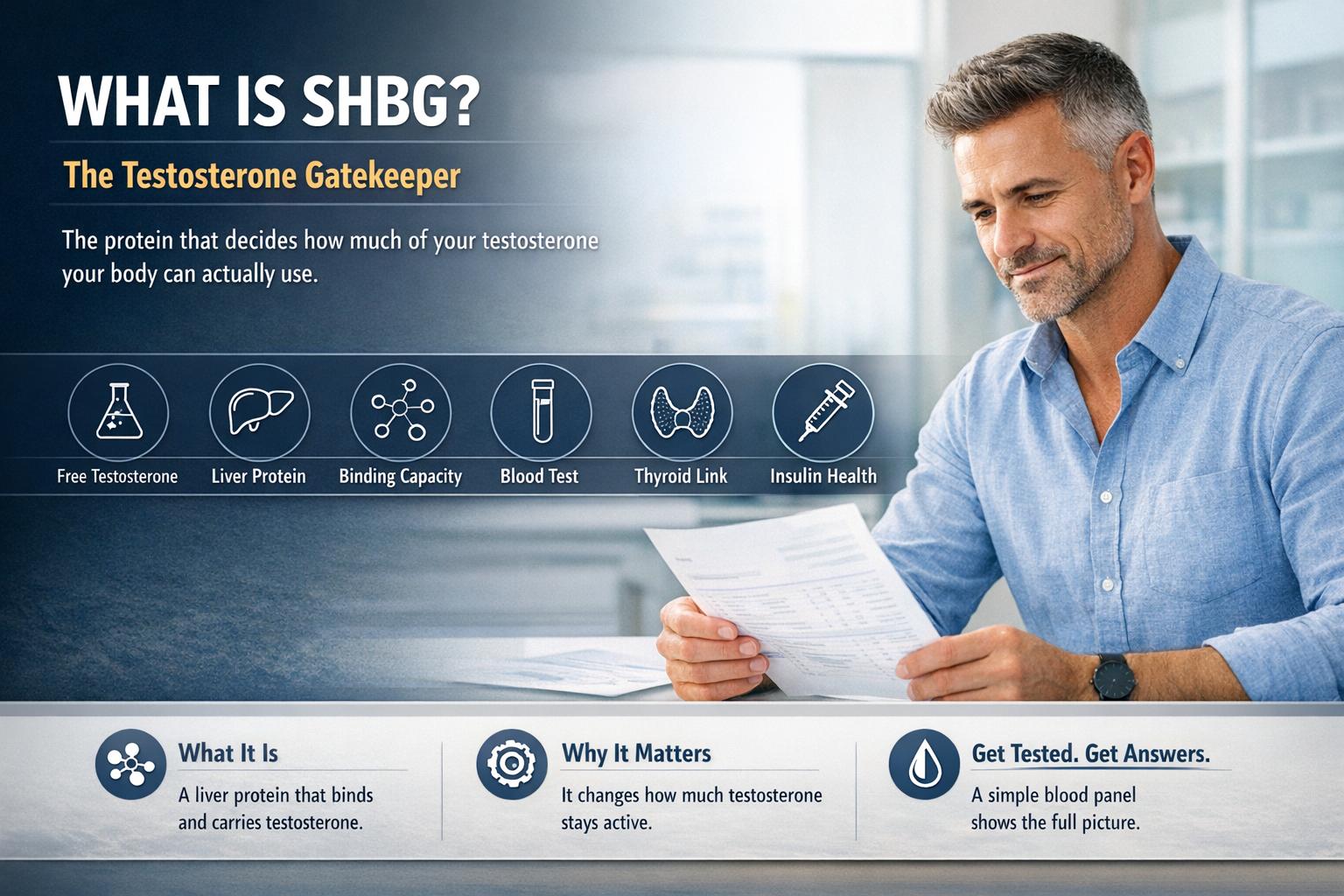
What Is SHBG and How Does It Affect Your Testosterone?
If you have had your hormones checked and your provider mentioned SHBG, you are probably wondering what it actually does — and why it matters more than most men realize. SHBG, or sex hormone-binding globulin, is the protein that determines how much of your testosterone your body can actually use. It is one of the most misunderstood numbers on a men's hormone panel, and it explains a frustrating scenario we see constantly at our Phoenix-area practice: a man with a "normal" testosterone result who still feels exhausted, foggy, and flat.
Here is what SHBG is, what pushes it up or down, and how it changes the way your lab results should be read.
What is SHBG?
SHBG is a glycoprotein produced primarily by your liver and released into your bloodstream. Its job is transport: it binds to sex steroids — testosterone, dihydrotestosterone (DHT), and estradiol — and ferries them through circulation.
But transport comes with a catch. When testosterone is bound tightly to SHBG, it cannot cross into your cells and do its work. It is essentially in storage. In a typical adult man, only about 1–2% of circulating testosterone is completely free, while the majority is bound to SHBG and the remainder is loosely bound to albumin. That loosely bound albumin fraction detaches easily, so free testosterone plus albumin-bound testosterone together make up what clinicians call bioavailable testosterone.
Think of it like a bus system. Total testosterone counts every passenger in the city. SHBG is the bus that most of them are riding, doors locked. Free testosterone is the handful of people actually walking around getting things done. If you only count passengers and never ask how many are stuck on the bus, you will badly misjudge how much work is getting done.
Why SHBG changes how your testosterone results should be read
Because SHBG binds so much of your testosterone, it is a major driver of your total testosterone number — sometimes independently of how much testosterone your testes are actually producing.
This creates two clinically important patterns:
- High SHBG, normal-looking total testosterone, low free testosterone. This man's total T reads reassuringly mid-range, so a rushed lab review calls it normal. But most of that testosterone is bound and unusable, and he has the full symptom picture — low libido, fatigue, poor recovery, mental fog. High SHBG is a classic reason a "normal" result gets misread.
- Low SHBG, low-looking total testosterone, adequate free testosterone. Here the total number looks alarming, but because so little is bound, the free fraction may be acceptable. Treating on the total number alone risks treating a man who does not need it.
This is exactly why understanding the difference between free and total testosterone is foundational before you interpret any hormone panel. It is also why the Endocrine Society explicitly recommends obtaining a free testosterone measurement in men whose total testosterone is borderline or who have a condition that alters SHBG — using equilibrium dialysis or an accurate calculation based on total testosterone, SHBG, and albumin.
In practical terms: SHBG is not an optional add-on. If your panel did not include it and your symptoms do not match your numbers, you are missing a piece of the puzzle. It is also why a proper men's hormone panel goes well beyond a single testosterone value.
Normal labs but you still feel off? Let's look deeper.
Doctor-supervised • Arizona-based • Telehealth available
Get Started — Free Assessment →What causes high SHBG?
SHBG production rises in response to several conditions and exposures. Common contributors in men include:
- Aging. SHBG tends to climb steadily through midlife and beyond, which is a key reason free testosterone often declines faster than total testosterone with age.
- Hyperthyroidism. An overactive thyroid meaningfully increases SHBG output.
- Liver disease. Since the liver makes SHBG, chronic liver conditions can shift levels.
- Significant caloric restriction or very low body fat. Aggressive dieting and endurance-heavy training can push SHBG up.
- Certain medications, including some anticonvulsants and estrogen-containing therapies.
What causes low SHBG?
Low SHBG is arguably the more common finding in the men we evaluate across Phoenix, Scottsdale, Mesa, and Tempe — and it usually points somewhere metabolic. Research consistently links low SHBG with insulin resistance and metabolic syndrome in men, independent of testosterone itself. Drivers include:
- Obesity and excess visceral fat — the strongest and most modifiable contributor
- Insulin resistance and type 2 diabetes
- Non-alcoholic fatty liver disease
- Hypothyroidism
- Certain steroid medications
That metabolic connection is worth sitting with. A low SHBG result is often the earliest quiet signal that insulin resistance is building — sometimes years before blood sugar looks abnormal on a standard panel. It also overlaps heavily with the cycle described in low testosterone and stubborn belly fat, where excess fat tissue and hormone disruption reinforce each other in both directions. For many men, addressing body composition improves SHBG, free testosterone, and metabolic health together.
What is a normal SHBG level?
Reference ranges vary by lab and assay, but adult men typically fall somewhere around 10–60 nmol/L. Two cautions matter more than the number itself:
- SHBG is almost never interpreted alone. Its value comes from context — paired with total testosterone, free testosterone, albumin, LH, and often thyroid and metabolic markers.
- "Within range" is not the same as optimal for you. An SHBG at the top of the range in a 38-year-old with textbook low-T symptoms deserves attention, even though a lab printout will not flag it.
Timing and technique also matter. Testosterone follows a daily rhythm, so testosterone blood tests are typically drawn in the morning, and a borderline result should be confirmed on a second draw rather than acted on immediately — which is part of the broader process behind how low testosterone is properly diagnosed.
How SHBG affects TRT
SHBG does not just shape diagnosis — it shapes treatment, too.
Men with low SHBG tend to clear testosterone faster and convert more of it, since more testosterone is free and available to aromatase. They often do better with smaller, more frequent dosing rather than large infrequent injections, which helps blunt the peaks that drive estradiol upward. Estrogen management becomes a more active part of the conversation, which we cover in depth in our guide to managing estrogen (E2) on TRT.
Men with high SHBG may need their response judged on free testosterone rather than total. It is common for these men to show a high total testosterone on treatment while free testosterone lags — a result that looks like overtreatment on paper but does not match how they feel. Dosing decisions here should follow symptoms and free T, not the headline number.
Either way, the lesson is the same: SHBG is a reason two men on identical protocols can have very different experiences, and a reason follow-up labs should include more than total testosterone.
Getting your SHBG checked in Arizona
SHBG is a standard, inexpensive blood test available at essentially every major lab across the Phoenix metro — Phoenix, Scottsdale, Mesa, Tempe, Chandler, Gilbert, and Tucson all have convenient draw sites. It requires no special preparation beyond the usual guidance for a morning testosterone draw.
At AZTRT, SHBG is part of our standard evaluation rather than an upgrade, precisely because leaving it off is how men get told they are "fine" when they are not. Our process is telehealth-based for Arizona residents: you complete an intake, get a lab order for a location near you, and review the full panel with a licensed provider. If you are unsure where to begin, our walkthrough on how to get your testosterone tested in Arizona covers the logistics step by step.
Get the full picture — not just one number.
Doctor-supervised • Arizona-based • Telehealth available
Get Started — Free Assessment →The bottom line
SHBG is the gatekeeper between the testosterone in your blood and the testosterone your body can actually use. High SHBG can hide a real deficiency behind a normal-looking total; low SHBG can make a low total look worse than it is while flagging metabolic problems worth addressing on their own. Either way, a hormone panel without SHBG is an incomplete panel — and if your symptoms and your lab report disagree, SHBG is one of the first places a good provider should look.
Frequently asked questions
Can you have normal testosterone but still have symptoms because of SHBG?
Yes, and it is one of the most common reasons men get dismissed. If SHBG is high, a large share of your total testosterone is bound and unavailable to your tissues, so free testosterone can be low even when total testosterone reads mid-range. Symptoms track much more closely with free testosterone than with total. This is why guidelines recommend measuring free testosterone whenever SHBG is altered or total testosterone is borderline.
How do you lower SHBG naturally?
Because low SHBG is tied to insulin resistance and excess body fat, the reverse is also true: the levers that raise SHBG are largely metabolic. Losing visceral fat, improving insulin sensitivity through resistance training and reduced refined-carbohydrate intake, correcting an untreated thyroid problem, reducing alcohol, and improving sleep can all shift SHBG. There is no reliable supplement for this, and any meaningful change should be tracked with repeat labs and interpreted alongside your other hormone markers rather than chased in isolation.
Should SHBG be included in a standard testosterone test?
For any man being evaluated for low testosterone, yes. Total testosterone alone cannot tell you how much is bioavailable, and SHBG is required to calculate free testosterone accurately. A useful men's hormone panel generally includes total testosterone, SHBG, albumin, free or calculated free testosterone, LH, estradiol, and a CBC, plus thyroid and metabolic markers when the picture warrants it.
Sources
- Definition, Prevalence, and Risk Factors of Low Sex Hormone-Binding Globulin in US Adults — PubMed Central (NIH)
- Testosterone Therapy for Hypogonadism: Clinical Practice Guideline — Endocrine Society
- Association of Testosterone and Sex Hormone-Binding Globulin With Metabolic Syndrome and Insulin Resistance in Men — PubMed Central (NIH)
- Testosterone Test: What It Is, How It's Done & Results — Cleveland Clinic
