
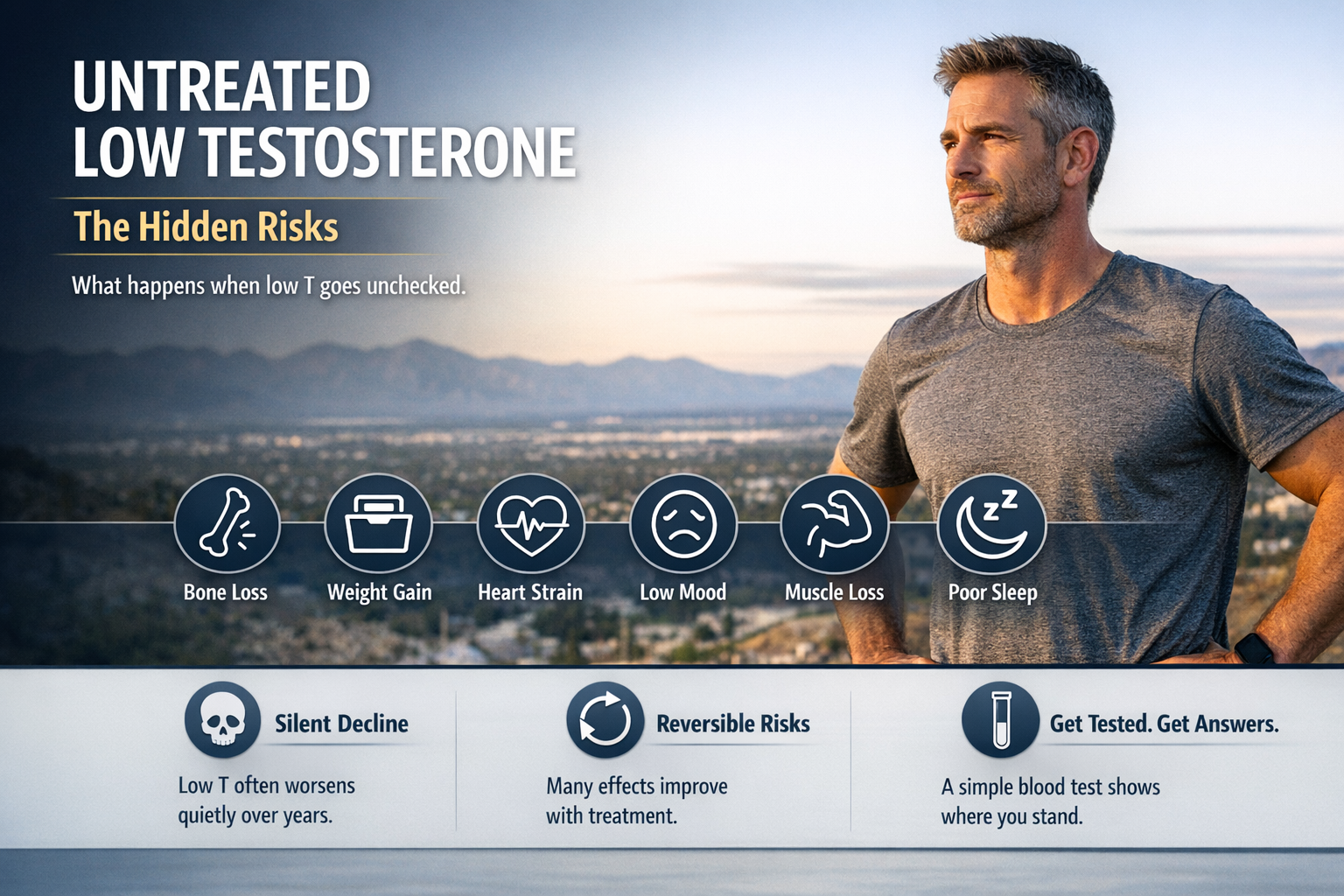
The Risks of Leaving Low Testosterone Untreated: What to Know
Many men in Phoenix, Scottsdale, Mesa, and across Arizona discover they have low testosterone and then decide to "wait and see." It's an understandable instinct — the symptoms of untreated low testosterone often creep in slowly, so they're easy to dismiss as normal aging or stress. But testosterone deficiency is a medical condition, not just a quality-of-life nuisance, and the research on what happens when it goes unaddressed for years is worth taking seriously before you put off that conversation with a provider.
This guide walks through the documented risks of leaving low testosterone untreated, what the science actually says (and doesn't say), and what a sensible next step looks like for Arizona men.
Low testosterone rarely stays "just" low energy
Testosterone isn't only a sex hormone. It plays a central role in maintaining bone density, muscle mass, red blood cell production, fat distribution, mood, and cognitive drive. According to the Cleveland Clinic's overview of male hypogonadism, low testosterone affects a meaningful share of adult men, and the effects extend well beyond the bedroom.
That's why the early warning signs — fatigue, low motivation, reduced libido, irritability — are best understood as the visible tip of a larger physiological shift. If you're noticing several of the common signs of low testosterone in men, the question isn't just "can I live with this?" It's "what is this doing to my body over the next five, ten, or twenty years?"
The physical risks of untreated low T
1. Bone loss and osteoporosis
Testosterone helps maintain bone mineral density. When levels stay low for years, bone tissue thins — a process most men never feel until a fracture happens. Mayo Clinic lists osteoporosis among the recognized complications of male hypogonadism, alongside erectile dysfunction, infertility, muscle loss, and enlarged breast tissue (gynecomastia). Osteoporosis is often thought of as a women's disease, but hypogonadal men are a well-documented at-risk group.
2. Muscle loss and fat gain — a two-way street
Low testosterone makes it harder to build and keep muscle, and easier to accumulate visceral (belly) fat. This creates an unfortunate feedback loop: excess fat tissue converts testosterone to estrogen and promotes inflammation, which can suppress testosterone further. Many men experience this as slowly gaining belly fat despite no major change in diet — and then finding it unusually difficult to lose.
3. Metabolic risk: diabetes and metabolic syndrome
The metabolic consequences may be the most underappreciated risk of all. A 2023 review in the Journal of Endocrinological Investigation found that male hypogonadism is associated with a spectrum of cardiometabolic complications — including insulin resistance, type 2 diabetes, dyslipidemia (unhealthy cholesterol), and metabolic syndrome. In other words, chronically low testosterone doesn't exist in a silo; it tends to travel with the conditions that drive long-term health decline.
Wondering what your levels actually are?
Doctor-supervised • Arizona-based • Telehealth available
Get Started — Free Assessment →Cardiovascular risk: what the evidence shows
The relationship between testosterone and heart health has been studied intensively, and the observational data points in a consistent direction: men with testosterone deficiency tend to fare worse. A review published in the International Journal of Clinical Practice reported that testosterone deficiency is associated with increased cardiovascular risk and higher all-cause and cardiovascular mortality in adult men.
Two important caveats. First, association is not proof of causation — low testosterone may partly be a marker of poor overall health rather than the sole driver. Second, this does not mean testosterone therapy is a heart treatment; it isn't, and no one should start TRT expecting cardiac benefits. What the evidence does support is this: persistently low testosterone is not a neutral finding, and it belongs in the same conversation as blood pressure, cholesterol, and blood sugar when you assess your long-term health. For a deeper look at what modern trials say about therapy itself, see our guide to TRT and heart health.
The mental and emotional toll
Untreated low testosterone doesn't only show up in lab values — it shows up in how you feel and function every day. Low mood, irritability, brain fog, and loss of drive are among the most commonly reported symptoms, and research has repeatedly linked testosterone deficiency with depressive symptoms in men. We cover that connection in detail in our article on whether low testosterone can cause depression.
The practical danger here is momentum. Low motivation makes men less likely to exercise; poor sleep and low mood make stress harder to manage; both feed back into lower testosterone. Years can pass this way — careers, marriages, and health habits quietly absorbing the cost — while the underlying hormonal issue goes unmeasured and unaddressed.
Quality of life: the compounding cost of waiting
Ask most men who eventually got treated what they regret, and the most common answer is simple: waiting so long. The risks above — bone, muscle, metabolic, cardiovascular, mental — share a common feature: they compound. Bone density lost over a decade is harder to rebuild than bone density maintained. Visceral fat accumulated over years brings its own health risks that outlast the hormonal cause. A stalled career or strained relationship doesn't automatically rebound when energy returns.
None of this is meant to alarm — plenty of men with borderline-low levels and no symptoms do fine with lifestyle changes and monitoring. The point is that "do nothing and don't measure anything" is the one strategy with no upside.
The good news: low T is one of the most fixable problems in men's health
Unlike many chronic conditions, testosterone deficiency is straightforward to diagnose and very treatable. Diagnosis starts with a morning blood test measuring total (and ideally free) testosterone, repeated to confirm, along with an evaluation of your symptoms and health history. If you're in Arizona, the process is simpler than most men expect — here's exactly how to get your testosterone tested in Arizona, using local labs in the Phoenix metro area with results reviewed by a licensed provider via telehealth.
If your levels are confirmed low and symptoms fit, doctor-supervised treatment can restore levels to the healthy range, with regular bloodwork to keep everything — hematocrit, estradiol, PSA — properly monitored. And if your levels come back normal, you've ruled out a major variable and can focus on sleep, training, stress, and nutrition with confidence.
Don't let another year go by guessing.
Doctor-supervised • Arizona-based • Telehealth available
Get Started — Free Assessment →Frequently asked questions
What happens if low testosterone is left untreated?
Over time, untreated low testosterone is associated with loss of bone density (raising osteoporosis and fracture risk), reduced muscle mass, increased body fat, higher risk of type 2 diabetes and metabolic syndrome, persistent low mood and fatigue, and — in observational studies — increased cardiovascular risk. Symptoms and risks tend to compound gradually rather than appear suddenly.
Can low testosterone go away on its own?
Sometimes. If low T is driven by a reversible cause — poor sleep, obesity, high stress, certain medications, or an acute illness — addressing that cause can restore levels. But age-related or primary testosterone deficiency generally does not resolve on its own, which is why confirmed low levels with symptoms warrant medical evaluation rather than waiting.
How do I find out if my testosterone is low in Arizona?
Get a morning blood test (ideally before 10 a.m.) measuring total and free testosterone, repeated on a second day to confirm. In Arizona, telehealth TRT clinics like AZTRT can order labs at local draw sites across the Phoenix metro and statewide, then review results with you online — no in-office visits required.
Sources
- Low Testosterone (Male Hypogonadism) — Cleveland Clinic
- Male Hypogonadism: Symptoms & Causes — Mayo Clinic
- The Complications of Male Hypogonadism: Is It Just a Matter of Low Testosterone? — PMC / National Library of Medicine
- Relationship Between Testosterone Deficiency and Cardiovascular Risk and Mortality in Adult Men — PubMed / National Library of Medicine
