
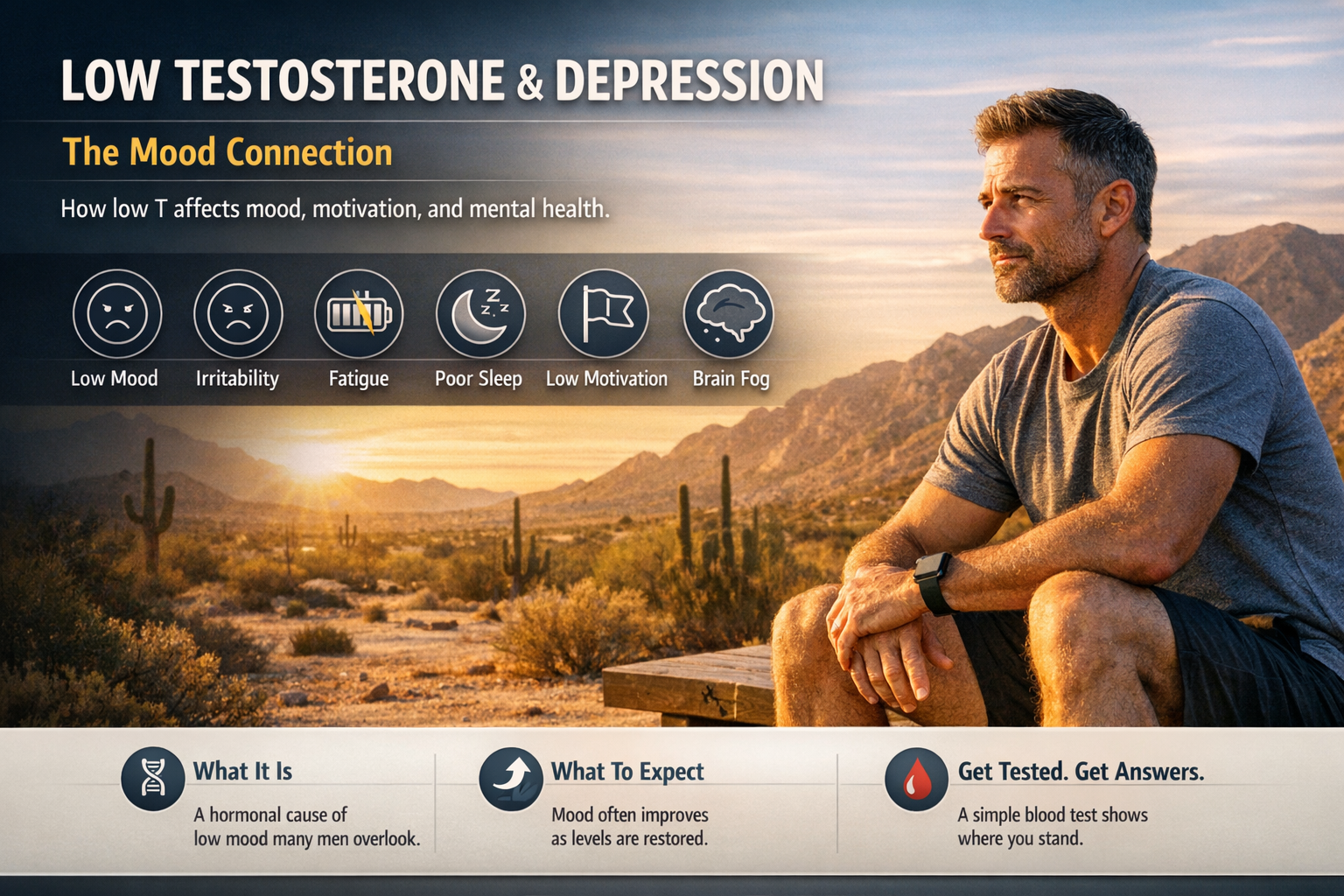
Can Low Testosterone Cause Depression? What Men Should Know
Can low testosterone cause depression? For a lot of men in Phoenix and across Arizona, the answer is more connected than they realize. Testosterone isn't just about muscle and libido — it acts directly on the brain, influencing mood, motivation, and emotional resilience. When levels drop, many men describe feeling flat, irritable, and unmotivated, sometimes for years, without ever suspecting a hormone problem. This article walks through what the science actually says about low testosterone and depression, how to tell the difference between the two, and how Arizona men can find out where they stand with one blood draw.
How testosterone affects your mood and brain
Testosterone receptors are found throughout the brain, including in regions that regulate mood, motivation, and stress response — such as the amygdala, hippocampus, and prefrontal cortex. The hormone influences the activity of neurotransmitter systems, including dopamine and serotonin, that antidepressant medications also target.
That's why the symptoms of low testosterone are not just physical. When levels fall below the healthy range, many men notice:
- A persistently low or "flat" mood
- Irritability and a shorter fuse than usual
- Loss of drive and motivation — at work, in the gym, at home
- Less enjoyment of things that used to feel rewarding
- Fatigue and poor sleep that make everything above worse
Notice how much that list overlaps with the standard description of depression. That overlap is exactly why low T so often goes undiagnosed in men who are struggling with their mental health.
What the research says about low T and depression
The link between low testosterone and depression is well documented, though it's important to describe it accurately. Observational studies consistently find that men with hypogonadism (clinically low testosterone) report depressive symptoms at higher rates than men with normal levels. Middle-aged and older men with borderline-low levels appear especially likely to experience what researchers sometimes call "subthreshold" depression — the flat, irritable, unmotivated state that doesn't always meet full criteria for major depressive disorder but still erodes quality of life.
What about treatment? A large meta-analysis of randomized controlled trials published in JAMA Psychiatry found that testosterone therapy was associated with a significant reduction in depressive symptoms in men, with the clearest benefit in men who had low levels to begin with. Other studies show more modest or mixed results, particularly in men whose testosterone was already normal.
The honest summary: testosterone therapy is not an antidepressant, and it isn't a treatment for major depression on its own. But for men whose low mood is being driven — in whole or in part — by clinically low testosterone, correcting the deficiency often improves mood, motivation, and energy meaningfully. The key is finding out whether low T is actually present, rather than guessing.
Depression or low testosterone? How to tell the difference
Because the symptoms overlap so heavily, lab work is the only reliable way to separate them. That said, a few patterns tend to point toward a hormonal contribution:
- Physical symptoms travel with the mood symptoms. Low libido, erectile changes, loss of morning erections, declining strength, or increased belly fat alongside low mood suggests a hormone check is warranted.
- The mood is more "flat" than sad. Men with low T often describe apathy, low drive, and irritability more than intense sadness, guilt, or hopelessness.
- It came on gradually. Testosterone decline is usually slow, so the change often creeps in over months or years rather than following a specific life event.
None of these rules is absolute — and the two conditions frequently coexist. Depression can suppress testosterone, and low testosterone can worsen depression, which is why checking your levels is a smart early step in figuring out what's going on.
Feeling Off? Find Out if Low T Is Part of the Picture
Arizona-licensed providers • Arizona-based • Telehealth available
Get Started — Free Assessment →How Arizona men can get their testosterone tested
Getting answers is simpler than most men expect. Whether you're in Phoenix, Scottsdale, Mesa, Tempe, Chandler, Gilbert, or Tucson, the process looks like this:
- Book a telehealth consultation. An Arizona-licensed provider reviews your symptoms and history from wherever you are — no clinic waiting room required.
- Get a morning blood draw. Testosterone peaks in the morning, so labs are drawn before about 10 a.m. at a local lab location near you.
- Review the full panel. A proper workup includes total and free testosterone, and typically related markers such as SHBG, estradiol, and a blood count — not just a single number.
- Get a plan. If your levels are low and your symptoms fit, your provider walks you through options; if they're normal, you've ruled out a major suspect and can focus on other causes.
Because AZTRT operates as a telehealth clinic across Arizona, the entire process — consultation, lab orders, results review, and ongoing care — happens without disrupting your work week.
What treatment looks like if low T is a factor
If bloodwork confirms low testosterone and your symptoms match, doctor-supervised testosterone replacement therapy (TRT) is the most direct way to restore healthy levels. Men whose mood symptoms were driven by low T commonly report improvements in motivation, irritability, and overall outlook over the first several weeks to months of treatment, along with better energy and sleep. Ongoing lab monitoring keeps levels — and safety markers — in the right range.
Treatment works best as part of a bigger picture. Resistance training, consistent sleep, limiting alcohol, and managing weight all support both testosterone and mood. And if you're dealing with significant depression, therapy or medication prescribed by a mental health professional can and often should run alongside hormone treatment — these approaches complement each other rather than compete.
When to seek help right away
If your low mood is severe, persistent, or includes thoughts of harming yourself, don't wait on a lab result — reach out to a mental health professional now, or call or text 988 (the Suicide & Crisis Lifeline) any time. Hormone testing can happen in parallel, but serious depression deserves immediate, dedicated care.
Get Your Mood, Energy, and Drive Back
Arizona-licensed providers • Arizona-based • Telehealth available
Get Started — Free Assessment →Frequently asked questions
Can TRT help with depression?
TRT can improve depressive symptoms in men whose testosterone is clinically low — research shows the clearest mood benefits in hypogonadal men. However, TRT is not an antidepressant and is not a standalone treatment for major depression. If your levels are normal, TRT is unlikely to fix your mood, and significant depression should always involve a mental health professional.
What testosterone level is linked to mood problems?
Most labs and guidelines consider total testosterone below roughly 300 ng/dL to be low, and mood symptoms become more common as levels fall below that range. But symptoms matter as much as the number — some men feel flat and unmotivated in the low-normal range, which is why providers look at free testosterone, related hormones, and your symptoms together.
Should I get my testosterone checked if I'm depressed?
If you're a man with low mood plus physical signs like low libido, fatigue, declining strength, or increased belly fat, checking testosterone is a reasonable early step — it's a simple morning blood test. In Arizona, you can complete the whole process through telehealth with a local lab draw. If levels are normal, you've ruled out one major cause; if they're low, you've found something treatable.
