
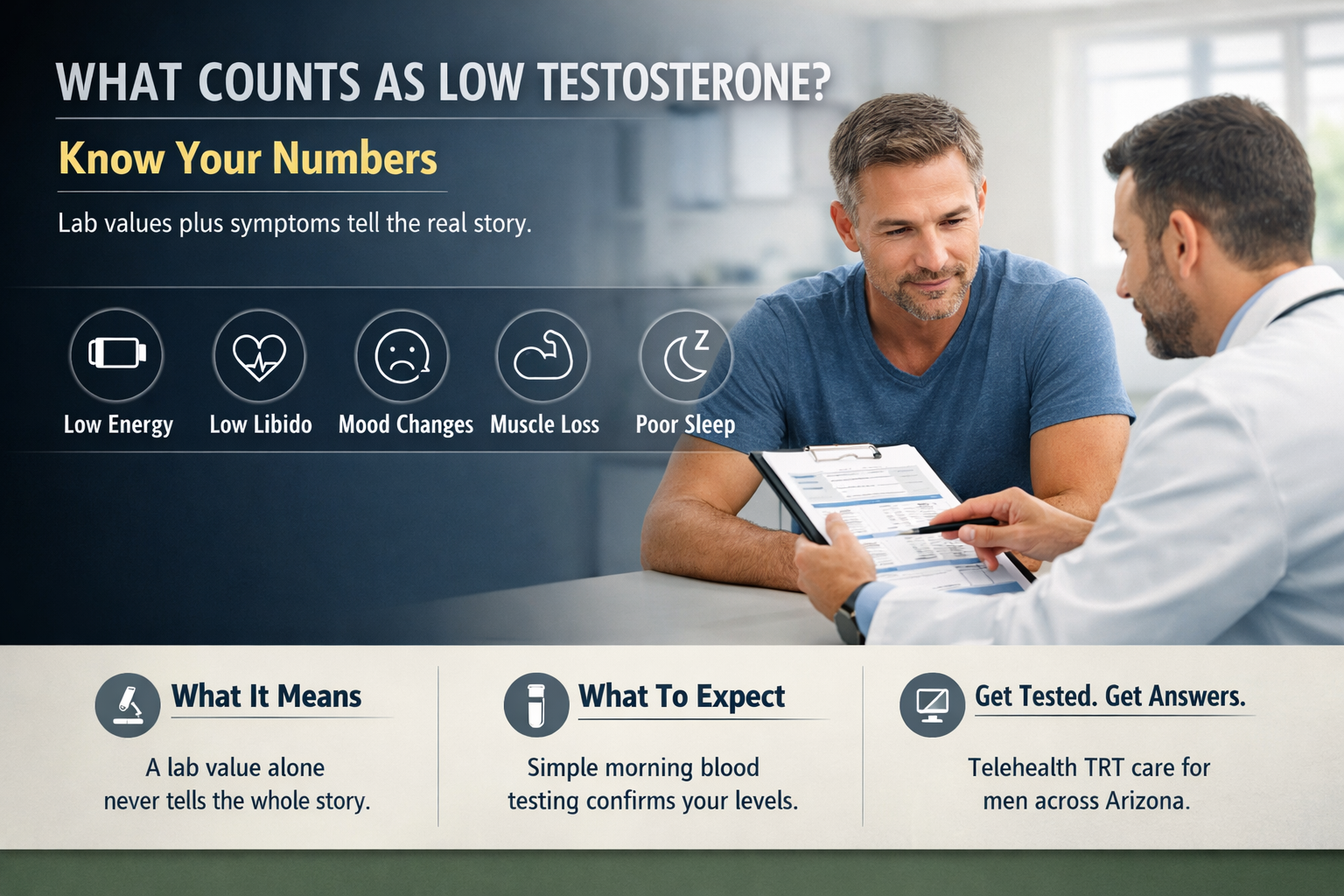
What Testosterone Level Is Considered Low? An Arizona Guide
If you've just gotten lab results back, you're probably asking one question: what testosterone level is considered low? It's one of the most common questions men in Phoenix and across Arizona bring to our clinic, and the answer is more nuanced than a single number on a lab report. The most widely used cutoff is 300 ng/dL of total testosterone, but context — your age, your symptoms, the time of day you were tested, and even which lab ran the sample — matters just as much. This guide breaks down where that 300 ng/dL threshold comes from, why some men feel terrible at "normal" levels, and how to get a reliable answer.
The short answer: below 300 ng/dL
The clearest benchmark comes from the American Urological Association, whose guideline states that clinicians should use a total testosterone level below 300 ng/dL as a reasonable cutoff in support of a testosterone deficiency diagnosis. That figure wasn't pulled out of thin air — it reflects the level below which the research shows men are most likely to benefit from treatment while keeping risks low.
Two important caveats come with that number:
- It must be confirmed twice. Testosterone fluctuates day to day, so a single low reading isn't enough. Guidelines call for two separate morning measurements before any diagnosis is made.
- Symptoms are required. A lab value below 300 ng/dL without symptoms isn't testosterone deficiency — and a value slightly above it doesn't automatically rule it out.
In other words, 300 ng/dL is a guidepost, not a verdict. If you want to see how that guidepost shifts across the decades, our breakdown of normal testosterone levels by age shows what typical ranges look like from your 20s through your 70s.
Why one number doesn't tell the whole story
Two men can have the exact same total testosterone reading and feel completely different. Here's why:
- Total vs. free testosterone. Most of the testosterone in your blood is bound to proteins and unavailable to your tissues. Only a small fraction — free testosterone — does the actual work. A man with a "normal" total level but high SHBG (a binding protein) can have functionally low free testosterone. Understanding free vs. total testosterone is essential to reading your own labs correctly.
- Lab reference ranges vary. Different labs use different assays and different "normal" ranges, which is why the same blood can look borderline at one lab and fine at another.
- Timing matters. Testosterone peaks in the early morning and can drop meaningfully by afternoon. An afternoon draw can make a healthy man look deficient.
- Age changes the picture. A level that would be unremarkable at 65 may signal a real problem in a 32-year-old.
Not Sure What Your Numbers Mean? Let's Find Out.
Doctor-supervised • Arizona-based • Telehealth available
Get Started — Free Assessment →Symptoms matter as much as the number
Guidelines are unanimous on this point: low testosterone is a clinical diagnosis, meaning it requires both a low lab value and symptoms. According to the Endocrine Society, hallmark symptoms of hypogonadism include reduced sex drive, low energy, loss of muscle and bone mass, and depressed mood. Common red flags Arizona men report include:
- Persistent fatigue that sleep doesn't fix
- Low libido or weaker erections
- Irritability, flat mood, or loss of drive
- Losing muscle despite consistent training
- Increased belly fat and brain fog
If several of these sound familiar, don't self-diagnose off one symptom — but don't dismiss them either. Our guide to the signs of low testosterone in men walks through all ten classic symptoms and when they warrant testing.
How doctors confirm a low level
A proper workup is simple but specific. The Cleveland Clinic notes that diagnosis requires at least two early-morning blood tests — typically drawn between 7 and 10 a.m., when levels peak — showing low testosterone alongside signs and symptoms. If both morning draws come back low, your provider should dig deeper. Mayo Clinic explains that follow-up testing such as luteinizing hormone (LH) helps determine whether the problem originates in the testes or in the pituitary gland — a distinction that changes the treatment plan. For a step-by-step look at the full process, see our article on how low testosterone is diagnosed.
What if your level is "normal" but you feel off?
This is the gray zone where many men get dismissed. A total testosterone of 320 or 380 ng/dL is technically above the cutoff, yet plenty of men in that range have classic low-T symptoms. In these cases, a thorough provider will check free testosterone, SHBG, estradiol, and thyroid function before concluding everything is fine. Borderline numbers with real symptoms deserve a real conversation — not a shrug. That's exactly the situation where working with a clinic that specializes in men's hormones, rather than squeezing the topic into a seven-minute primary care visit, tends to pay off.
Getting a reliable answer in Arizona
For men in Phoenix, Scottsdale, Mesa, Tempe, Chandler, Gilbert, and Tucson, getting tested is easier than most expect. AZTRT operates fully online for Arizona residents: your labs are drawn early morning at a local draw station near you, and results are reviewed with a licensed provider over telehealth — no waiting rooms, no awkward conversations. We test total and free testosterone plus the supporting markers that explain why your level is what it is. If you want the full playbook first, here's our guide to getting your testosterone tested in Arizona.
Stop Guessing. Get Your Levels Checked This Week.
Doctor-supervised • Arizona-based • Telehealth available
Get Started — Free Assessment →Frequently asked questions
Is 300 ng/dL the official cutoff for low testosterone?
It's the most widely used benchmark. The American Urological Association recommends total testosterone below 300 ng/dL as a reasonable cutoff to support a diagnosis — but only when confirmed on two separate morning tests and accompanied by symptoms. Some men above 300 ng/dL still have clinically meaningful deficiency, especially if free testosterone is low.
Can you have low testosterone symptoms with a normal total level?
Yes. Total testosterone counts hormone that's bound to proteins and unavailable to your tissues. If your SHBG is high, your free testosterone — the active fraction — can be low even when your total looks normal. That's why a complete panel matters more than a single number.
What time of day should you test testosterone?
Early morning, ideally between 7 and 10 a.m., when levels naturally peak. An afternoon draw can read significantly lower and make a normal level look deficient. Guidelines also call for a second morning test to confirm any low result before diagnosing.
Sources
