
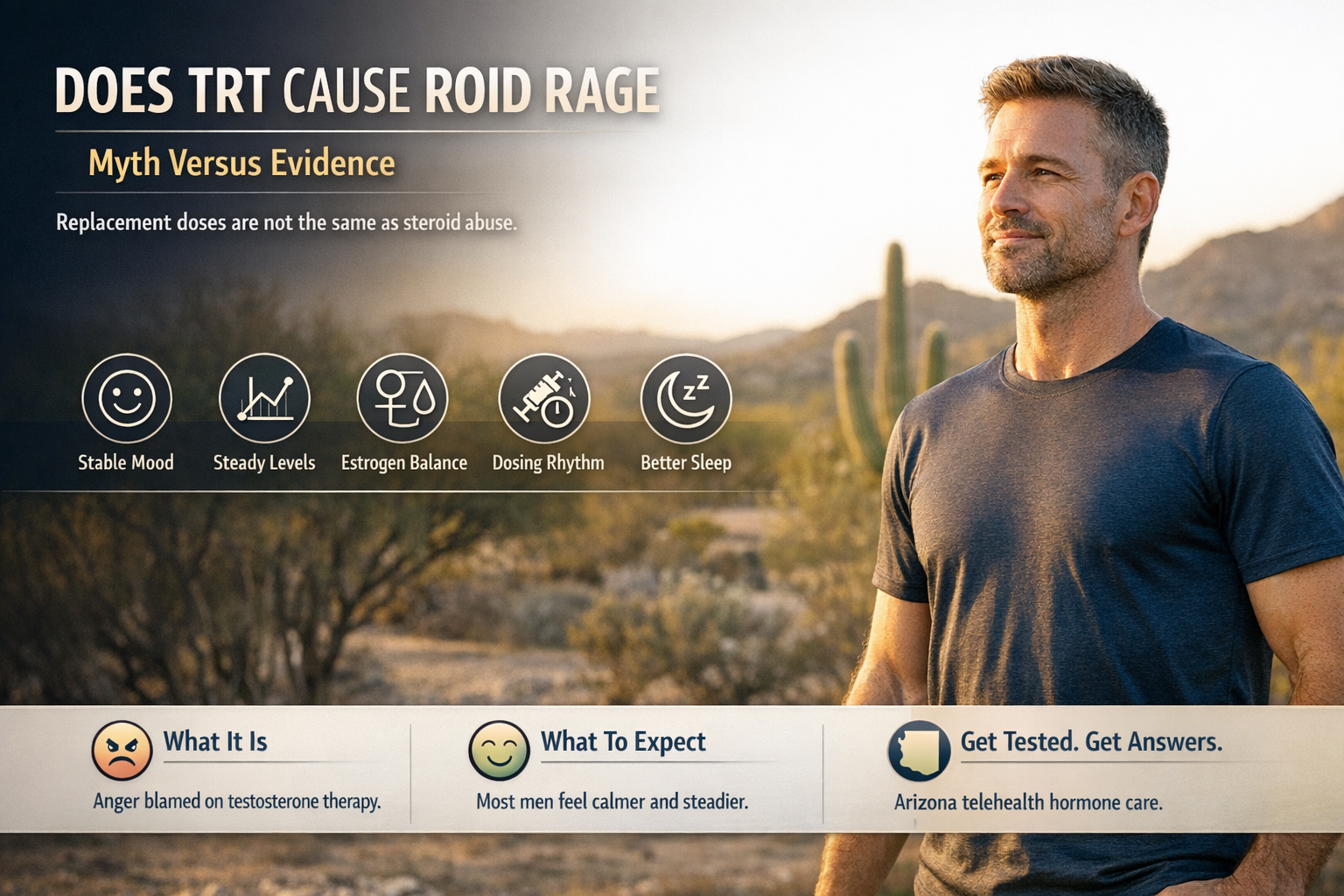
Does TRT Cause Roid Rage? Mood Swings & Anger Explained
"Does TRT cause roid rage?" is one of the most common questions Arizona men ask before starting testosterone replacement therapy — often because a spouse or friend raised it. It is a fair concern, and it deserves a straight answer grounded in evidence rather than gym-locker-room stories. The short version: the anger associated with steroids in popular culture comes from supraphysiologic anabolic steroid abuse, not from medically supervised TRT that restores testosterone to a normal range.
Below, we walk through where the "roid rage" idea came from, what the research actually shows, why some men do notice mood changes on therapy, and how a well-run Arizona TRT program keeps you steady instead of volatile.
Where the "roid rage" reputation came from
The term entered public vocabulary through bodybuilding and competitive sport, not through medicine. Anabolic steroid abuse often involves doses five to twenty times a therapeutic replacement dose, frequently stacking several compounds at once, obtained without a prescription and without lab monitoring. At those levels, hormone concentrations swing wildly and estrogen conversion runs unchecked.
Medically supervised TRT is a different intervention entirely. The goal is to bring a man whose testosterone has fallen below the reference range back into a healthy physiologic range — not above it. That distinction matters more than any other point in this article. If you are still deciding whether your symptoms even point to low testosterone, start with how low testosterone is actually diagnosed, because a proper diagnosis is what separates therapy from self-experimentation.
What the research actually shows about testosterone and anger
The evidence here is more reassuring than most men expect. In a controlled clinical research setting, even supraphysiological doses of testosterone did not increase angry behavior in healthy men — a finding that directly contradicts the popular assumption that more testosterone automatically means more aggression.
Broader reviews reach a similar conclusion. A systematic review of testosterone treatment in men found that reports of treatment-related anger or hostility were inconsistent across studies, with only a minority of trials showing any effect and little agreement among them. That is not the signature of a strong, reliable drug effect — it is the signature of noise, individual variation, and study design differences.
Major clinical references likewise do not list rage or violent aggression among the expected risks of testosterone therapy. Mayo Clinic's overview of testosterone therapy risks focuses on issues like worsening sleep apnea, acne and skin reactions, prostate effects, and red blood cell increases — the same practical concerns a good clinic monitors for.
What about individual vulnerability?
Honest answer: a small subset of men — particularly those with pre-existing psychiatric conditions, or those abusing high doses of multiple compounds — may be more susceptible to mood and behavioral effects. This is one reason a thorough intake history matters, and one reason unsupervised online testosterone is a bad idea. Your provider should know your mental health history before writing a prescription.
Worried about mood? Get real numbers first.
Arizona-licensed providers • Arizona-based • Telehealth available
Get Started — Free Assessment →Why some men on TRT genuinely do notice mood changes
Dismissing every reported mood change as myth would be just as wrong as accepting the roid rage story wholesale. Men on therapy sometimes do feel more irritable or emotionally uneven — but the cause is usually mechanical, not moral. Here are the four most common culprits.
1. Peaks and troughs from infrequent dosing
A large dose given every three or four weeks produces a sharp spike followed by a long decline. Riding that rollercoaster can feel like irritability at the top and flatness at the bottom. Splitting the same weekly amount into smaller, more frequent injections smooths the curve considerably — which is why how often you take your TRT injections has as much influence on how you feel as the dose itself.
2. Estrogen drifting out of range
Testosterone converts to estradiol via aromatase. Both too much and too little estradiol can produce moodiness, irritability, low libido, and emotional flatness — and men are frequently surprised that crashing estrogen with an aromatase inhibitor often feels worse than leaving it slightly elevated. Sensible estrogen (E2) management on TRT is about staying in range, not driving the number to zero.
3. Sleep disruption
Poor sleep degrades emotional regulation in anyone. Because testosterone therapy can worsen untreated sleep apnea in susceptible men, a man who becomes short-tempered a few months into therapy may actually be short-tempered because he stopped sleeping well. The Cleveland Clinic's overview of testosterone replacement therapy notes sleep apnea among the effects worth monitoring, which is why persistent snoring or daytime exhaustion deserves a conversation rather than a shrug.
4. The symptoms were there before therapy started
This one is easy to miss. Irritability, a short fuse, and emotional volatility are themselves classic symptoms of untreated low testosterone. Many men arrive at a clinic already snapping at their families — a pattern we cover in more depth in our guide to low testosterone, irritability, and mood swings. For those men, restoring levels usually makes mood better, not worse. Attributing the pre-existing irritability to the treatment is a common misreading.
What most Arizona men actually report on TRT
In practice, the mood feedback we hear from men on properly managed therapy runs in the opposite direction of the rage stereotype:
- Steadier baseline mood, with fewer sharp swings through the day
- More patience at home and at work, rather than less
- Improved motivation and drive returning gradually over the first few months
- Less of the low-grade irritability that comes from chronic fatigue
- Better stress tolerance during long Phoenix summer workdays
None of that is a guarantee — individual response varies, and testosterone is not a treatment for depression or anxiety. But it is a far more accurate picture of typical therapy than the caricature.
How a good Arizona clinic prevents mood problems
Mood stability on TRT is largely a monitoring problem, and monitoring is exactly what separates a real clinic from a subscription mill. A well-run Arizona program should include:
- Baseline labs and history, including total and free testosterone, estradiol, hematocrit, and a mental health history
- A dosing schedule designed for stability — typically weekly or twice-weekly injections rather than large monthly doses
- Follow-up bloodwork at roughly six to eight weeks, then periodically thereafter
- An actual provider you can reach when something feels off, so the dose gets adjusted rather than abandoned
- Attention to sleep, alcohol, and stress, all of which move mood independently of hormones
If you are weighing providers across Phoenix, Scottsdale, Mesa, Tempe, Chandler, Gilbert, or Tucson, mood management is a useful screening question. Ask how often they check estradiol and what their protocol is if a patient reports irritability. A clinic that has no answer is telling you something. Our guide to what to look for in a Phoenix TRT clinic covers the rest of the checklist, and Arizona telehealth means most of this can be handled without repeated drives across the Valley — labs are drawn locally, visits happen from your office or living room.
When to call your provider
Contact your clinician promptly if you experience a significant, persistent change in mood, new or worsening depression, unusual agitation, thoughts of harming yourself or others, or a marked personality change noticed by people close to you. These are worth evaluating rather than waiting out — and in most cases they point to something correctable, whether that is dosing, estradiol, sleep, or an unrelated issue that deserves its own treatment.
Steady levels. Steady mood. Start in Arizona.
Arizona-licensed providers • Arizona-based • Telehealth available
Get Started — Free Assessment →Frequently asked questions
Will TRT make me more aggressive?
For most men on medically supervised replacement doses, no. Controlled research has not found a consistent increase in anger or aggression at therapeutic testosterone levels, and reviews of treatment studies describe the findings as inconsistent. The aggression stereotype comes from anabolic steroid abuse at doses far above replacement, not from monitored TRT.
Why do I feel irritable a few days after my testosterone injection?
That pattern usually points to unstable hormone levels rather than testosterone itself. Large, infrequent doses create a peak-and-trough cycle, and the downslope can feel like irritability or flatness. More frequent, smaller injections typically smooth it out. Estradiol that has drifted too high or been suppressed too low is the other common cause — both are worth checking with bloodwork.
Can low testosterone itself cause mood swings?
Yes. Irritability, a short temper, low motivation, and emotional flatness are recognized symptoms of low testosterone. Many men notice these before they ever start therapy. For those men, restoring levels into a healthy range often improves mood rather than worsening it — though testosterone is not a treatment for depression or anxiety, and those conditions need their own evaluation.
Sources
- The effects of supraphysiological doses of testosterone on angry behavior in healthy eugonadal men — PubMed
- Treatment of Men for "Low Testosterone": A Systematic Review — PubMed Central (PMC)
- Testosterone therapy: Potential benefits and risks as you age — Mayo Clinic
- Testosterone Replacement Therapy (TRT): What It Is — Cleveland Clinic
