
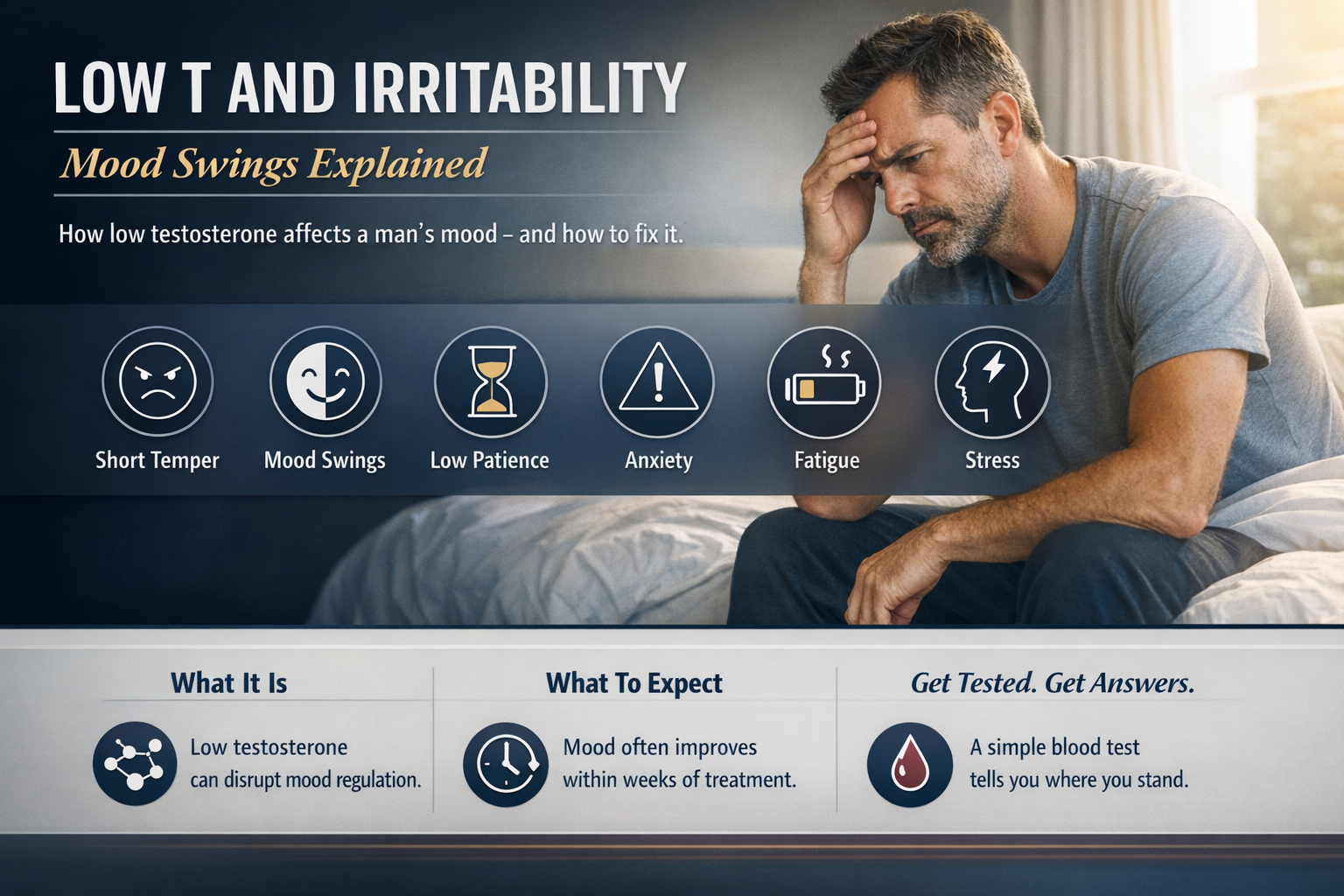
Low Testosterone and Irritability: Why Low T Causes Mood Swings
If you've been snapping at your family, gritting your teeth in traffic on the 101, or feeling a low-grade agitation you can't explain, you're not imagining it — low testosterone and irritability are closely linked. Mood swings are one of the most common (and most overlooked) symptoms of low T in men. Because the change creeps in gradually, most men blame stress, work, or "just getting older." For many Arizona men, though, the real driver is hormonal — and it's measurable with a single blood draw.
This guide covers why low testosterone affects mood, the signs that your irritability might be hormonal rather than situational, what else to rule out, and how men in Phoenix, Scottsdale, Mesa, and across Arizona can get tested quickly through telehealth.
Can low testosterone really cause irritability and mood swings?
Yes. Testosterone is not just a "muscle and libido" hormone — it acts directly on the brain. Regions that regulate emotion, including the amygdala and prefrontal cortex, carry androgen receptors, and testosterone influences the activity of mood-related neurotransmitters like serotonin and dopamine. When testosterone falls below the normal range (commonly under roughly 300 ng/dL on two morning tests), that regulatory support weakens.
The result for many men isn't classic sadness. It's edginess: a shorter temper, less patience, irritation over small things, and mood that swings from flat to frustrated over the course of a day. Researchers have even described an "irritable male syndrome" pattern associated with fluctuating or declining testosterone.
Why low T makes you feel on edge
Direct effects on brain chemistry
Testosterone supports dopamine signaling — the drive-and-reward system — and modulates serotonin, which stabilizes mood. Lower testosterone means less buffer between you and everyday frustrations. Things that used to roll off your back suddenly get under your skin.
Indirect effects that pile on
Low testosterone rarely shows up alone. It commonly brings:
- Poor sleep — low T fragments sleep, and sleep deprivation by itself makes anyone irritable.
- Fatigue — when your energy tank is empty, your patience tank empties with it.
- Lower stress tolerance — cortisol and testosterone sit in balance; when T drops, stress hits harder.
- Frustration with your own body — declining gym performance, weight gain, and low libido feed the cycle.
Each of these amplifies the others, which is why mood is often the first thing a man's partner notices — sometimes before he notices it himself.
Signs your irritability might be hormonal
Situational anger has a cause you can point to. Hormonal irritability tends to look different:
- You're snapping at people over minor things and regretting it afterward
- The edginess is persistent — most days, for weeks or months
- It arrived alongside other low-T symptoms: fatigue, low libido, poor sleep, brain fog, or losing strength despite training
- There's no major life event that explains the change
- Coffee, willpower, and "calming down" don't fix it
If several of those sound familiar, a testosterone panel is a logical next step — it either identifies the cause or rules it out.
Tired of Feeling on Edge? Find Out if Low T Is the Reason.
Arizona-licensed providers • Arizona-based • Telehealth available
Get Started — Free Assessment →Is "irritable male syndrome" a real thing?
The term was coined by researchers observing behavioral changes in males when testosterone dropped, and it's been popularized to describe the human pattern: irritability, hypersensitivity, anxiety, and frustration tied to low or fluctuating testosterone. It isn't a formal medical diagnosis, but the underlying link it describes — androgen decline affecting mood regulation — is well documented. What matters practically is simple: if your mood has changed and low T is the cause, treating the deficiency addresses the root rather than the symptom.
What else can cause irritability? (Worth ruling out)
Testosterone isn't the only suspect, and a good clinician checks the full picture. Common contributors include:
- Chronic stress and burnout — sustained cortisol elevation frays mood on its own
- Sleep apnea — extremely common in men and a double hit, since it also lowers testosterone
- Depression and anxiety disorders — irritability is a core symptom of depression in men
- Thyroid dysfunction — both high and low thyroid can change mood
- Blood sugar swings, excessive alcohol, and some medications
This is why proper evaluation matters. A legitimate TRT clinic doesn't just hand you a prescription — it runs comprehensive labs (total and free testosterone, plus related markers) and reviews your health history so treatment targets the actual problem.
How Arizona men can find out for sure
Diagnosis is straightforward:
- Morning blood draw. Testosterone peaks early, so labs are drawn before about 10 a.m. for an accurate reading.
- Confirm with a second test. Levels vary day to day; guidelines call for two low morning readings before diagnosing low T.
- Review the full panel. Total testosterone, free testosterone, and related labs are interpreted alongside your symptoms.
With AZTRT, the entire process is telehealth-based for men anywhere in Arizona. You book online, complete a quick lab visit at a draw site near you — whether you're in Phoenix, Scottsdale, Tempe, Chandler, Gilbert, Mesa, or Tucson — and review results with a licensed provider from home. No waiting rooms, no awkward conversations.
Does treating low T improve mood?
For men with confirmed low testosterone, studies show testosterone therapy can meaningfully improve mood, irritability, and overall sense of well-being — with many men noticing the mental shift within the first three to six weeks, before the physical changes fully arrive. Partners often notice it first: less snapping, more patience, a steadier baseline.
Two honest caveats. First, TRT helps mood when low T is actually the cause — it is not a treatment for depression or anxiety in men with normal levels. Second, results vary from person to person, which is why treatment should always include baseline labs, dose adjustments, and ongoing monitoring by a licensed medical provider.
Get Your Patience — and Your Drive — Back.
Arizona-licensed providers • Arizona-based • Telehealth available
Get Started — Free Assessment →Frequently asked questions
Can low testosterone make you angry and irritable?
Yes. Testosterone helps regulate mood-related brain chemistry, and when levels drop below normal, many men experience irritability, a short temper, and mood swings — often alongside fatigue, poor sleep, and low libido. It's one of the most commonly overlooked symptoms of low T.
Will TRT help with mood swings?
If your mood swings are caused by clinically low testosterone, doctor-supervised TRT often improves irritability and overall mood, with many men noticing changes within three to six weeks. TRT is not a mood treatment for men whose levels are already normal, which is why proper testing comes first.
How do I get my testosterone checked in Arizona?
Book a telehealth visit with an Arizona-licensed provider, then complete a morning blood draw at a local lab in the Phoenix metro, Tucson, or near you. AZTRT arranges the labs, reviews your total and free testosterone with you, and builds a treatment plan if levels are low.
