
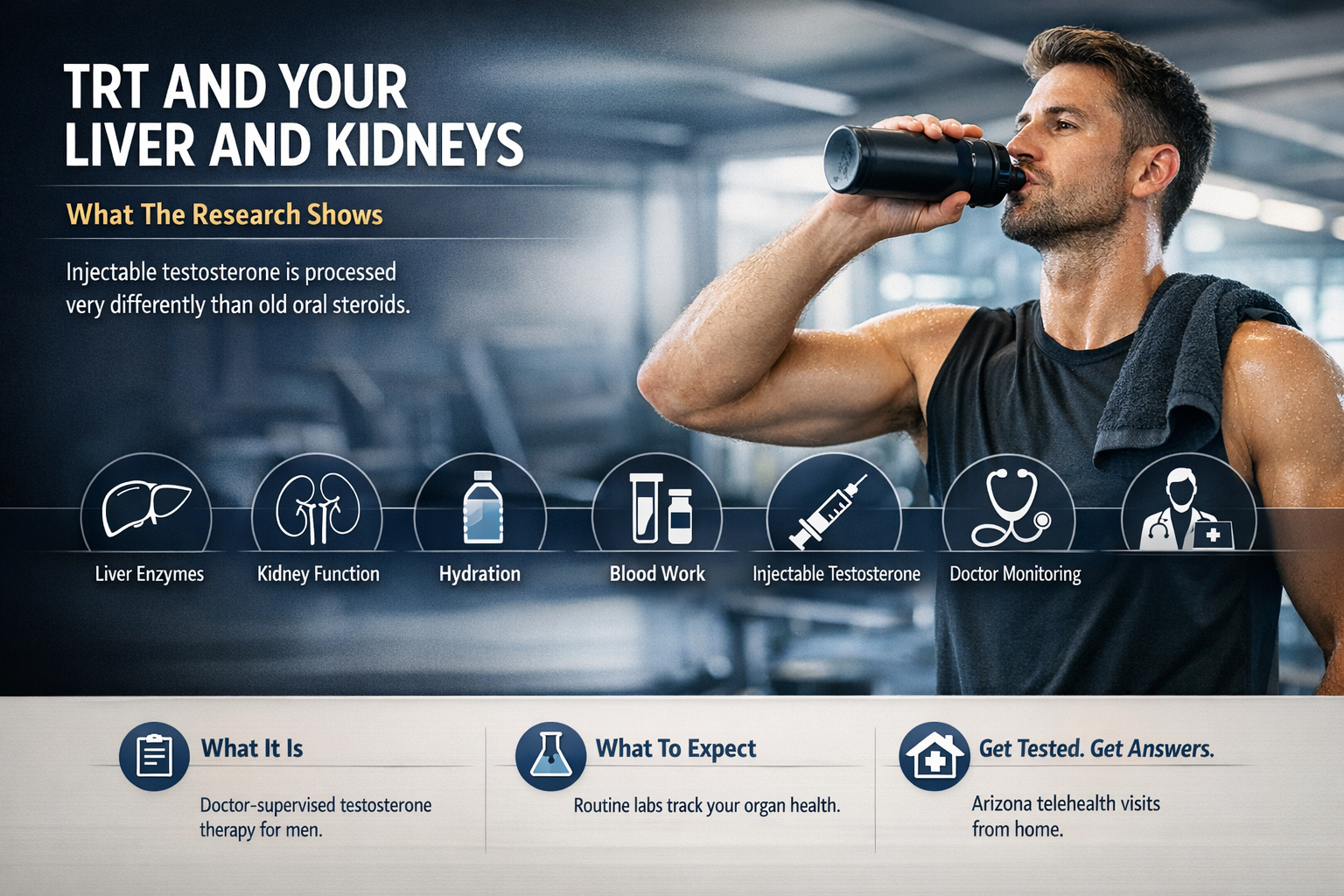
Does TRT Affect Your Liver or Kidneys? An Arizona Guide
If you have been researching testosterone replacement therapy in Arizona, you have almost certainly run into the warning that "steroids wreck your liver." It is one of the most common objections men raise before their first consultation, and it deserves a straight answer. So: does TRT affect your liver or kidneys? For the overwhelming majority of men on doctor-supervised testosterone replacement therapy, the answer is no — but the reasoning behind that answer matters, because it is not true of every form of testosterone ever made.
This guide walks through what the research actually shows about TRT, liver enzymes, and kidney function, which formulations carry real risk, which lab markers your provider should be watching, and when extra caution is warranted. Everything here applies to men in Phoenix, Scottsdale, Mesa, Tempe, and across Arizona whether you are seen in person or through telehealth.
Where the "testosterone destroys your liver" idea came from
The liver warning is not invented — it is misapplied. It traces back to a specific class of anabolic steroids called 17-alpha-alkylated androgens: oral compounds chemically modified to survive digestion so they could be swallowed as a pill. That modification is exactly what makes them hepatotoxic. Because the drug passes through the liver in concentrated form before reaching the bloodstream, these compounds are associated with elevated liver enzymes, cholestatic jaundice, and in rare cases more serious liver injury.
Modern TRT is a different medication delivered a different way. Reviews of the evidence note that reports of liver toxicity are largely limited to orally administered alkylated forms of testosterone, which is why transdermal, injectable, and newer oral formulations are preferred — particularly in men with any history of liver disease. Testosterone cypionate injected into muscle or fat tissue enters the bloodstream directly and never subjects the liver to that first-pass load.
This is also the core reason a supervised therapeutic protocol is not the same thing as what is sold in a gym parking lot. If you want the full breakdown, we covered the difference between TRT and anabolic steroids in detail — dose, intent, and formulation are all distinct.
What TRT actually does to liver function markers
Standard liver panels measure ALT, AST, GGT, alkaline phosphatase, and bilirubin. On injectable TRT at replacement doses, these values typically stay within normal limits in men with healthy livers.
There is a further wrinkle that surprises a lot of men: in hypogonadal men, treating the deficiency may actually improve liver markers rather than worsen them. In one long-term prospective registry, testosterone treatment was associated with reductions in bilirubin, triglycerides, and GGT over the study period. The proposed mechanism is indirect: low testosterone drives visceral fat accumulation and insulin resistance, and visceral fat is a primary engine of fatty liver disease. Restore the hormone, reduce the fat, and the liver often benefits.
That is a correlation drawn from treated patients, not a promise, and it is not a reason to take testosterone for liver health. It is simply useful context: the evidence does not support the idea that replacement-dose injectable testosterone is inherently hard on your liver.
One caveat worth naming. Some men on TRT add oral supplements, fat burners, or non-prescribed compounds alongside their protocol. Those — not the testosterone — are a common cause of unexplained enzyme elevations. Tell your provider everything you are taking.
Want your labs read by a real clinician?
Doctor-supervised • Arizona-based • Telehealth available
Get Started — Free Assessment →TRT and your kidneys: the real considerations
Kidney questions come up less often than liver questions, but they are more nuanced. Testosterone does not appear to be directly nephrotoxic at replacement doses. The concerns are indirect, and there are three of them.
1. Fluid retention
Testosterone promotes sodium and water retention, especially in the first weeks of treatment. In a healthy man this shows up as mild puffiness or a few pounds of scale weight and usually settles on its own — we walk through it in our guide to water retention and bloating on TRT. In a man with chronic kidney disease or heart failure, the same fluid shift is a genuine clinical issue, which is why caution is advised when using testosterone in patients with chronic renal insufficiency.
2. Hematocrit and blood viscosity
Testosterone stimulates red blood cell production. Pushed too far, thicker blood means reduced flow through small vessels, including those feeding the kidneys. This is one of the most reliably monitored effects of TRT and one of the easiest to manage — through dose adjustment, injection frequency changes, or therapeutic phlebotomy.
3. Creatinine that is not what it looks like
This one causes real confusion. TRT builds lean mass, and muscle tissue produces creatinine. More muscle can nudge serum creatinine up and make your calculated eGFR look slightly worse, without any actual decline in kidney function. A clinician who understands this will interpret the trend in context, sometimes using cystatin C instead. A provider who does not may alarm you unnecessarily.
The Arizona hydration factor
Worth a local note: Phoenix summers routinely run past 110°F, and dehydration alone concentrates both hematocrit and creatinine. If you are getting labs drawn in July after a morning outside, drink water the day before and go in properly hydrated. Otherwise you may be reading heat stress, not a medication effect.
How monitoring protects you
Nothing above is a reason to avoid TRT. It is a reason to do it with a clinician and a lab schedule rather than on your own. A responsible Arizona protocol starts with a comprehensive baseline — see the bloodwork you should have before starting TRT, which includes a metabolic panel and liver enzymes — then rechecks on a defined cadence.
Cleveland Clinic lists liver strain among the potential considerations with testosterone therapy and stresses that testosterone treatment should be matched to the individual patient and monitored rather than applied uniformly. The markers that typically get followed on TRT include:
- Complete blood count — tracking hematocrit and hemoglobin
- Comprehensive metabolic panel — creatinine, eGFR, electrolytes, ALT, AST
- Total and free testosterone — confirming you are in range, not above it
- Estradiol and PSA — standard safety surveillance
Most men are rechecked around six to twelve weeks after starting, again at six months, then one to two times per year once stable. Our overview of what gets monitored on TRT and how often covers the full schedule.
Formulation matters here too. Injectable testosterone remains the most common choice in part because its metabolic route is well characterized and it avoids the oral-pill liver concern entirely — our comparison of injections versus gels, pellets, and creams lays out the tradeoffs.
Who should be extra careful
TRT is not automatically off the table for these men, but each situation calls for individualized evaluation and tighter follow-up:
- Diagnosed liver disease, cirrhosis, or hepatitis
- Chronic kidney disease, reduced eGFR, or a single functioning kidney
- Untreated congestive heart failure or difficult-to-control fluid balance
- Baseline hematocrit already at or above the upper limit
- Heavy alcohol use, which independently stresses the liver
If any of these apply, say so during your consultation. It changes the monitoring plan, sometimes the formulation, and occasionally the recommendation itself — which is exactly how it should work.
Frequently asked questions
Does testosterone injection damage your liver?
Injectable testosterone enters the bloodstream directly and does not undergo first-pass liver metabolism, so it does not carry the hepatotoxicity risk associated with older oral 17-alpha-alkylated androgens. In men with healthy livers on replacement doses, liver enzymes generally remain in the normal range with routine monitoring.
Can TRT raise your creatinine levels?
Yes, often mildly — but usually because TRT increases lean muscle mass, and muscle produces creatinine. That can slightly lower a calculated eGFR without any true loss of kidney function. An experienced provider interprets the trend alongside your body composition and may use cystatin C for a clearer picture.
Can you take TRT if you have kidney disease?
Sometimes, but it requires individualized medical evaluation. Testosterone causes sodium and water retention, which is a meaningful concern in chronic renal insufficiency. Men with kidney disease who are candidates for TRT need a nephrologist involved, a conservative dose, and closer lab follow-up than a typical patient.
The bottom line for Arizona men
The liver fear attached to testosterone belongs to a class of oral steroids that modern TRT does not use. The kidney questions are real but manageable, and most of them come down to fluid balance, blood thickness, and correctly interpreting a creatinine value in a man who has gained muscle. None of that is dangerous when someone is watching the numbers. All of it can be when nobody is.
The practical takeaway is not "TRT is risk-free." It is that the risk profile is knowable, measurable, and controlled by the same thing that makes TRT effective in the first place: appropriate dosing and consistent lab monitoring by a licensed provider.
Start TRT the safe way in Arizona
Doctor-supervised • Arizona-based • Telehealth available
Get Started — Free Assessment →Sources
- Risks of testosterone replacement therapy in men — PMC, National Library of Medicine
- Testosterone treatment improves liver function and reduces cardiovascular risk: A long-term prospective study — PMC, National Library of Medicine
- Testosterone Replacement Therapy in Chronic Kidney Disease Patients — PMC, National Library of Medicine
- Low Testosterone Treatment: What's Right For You? — Cleveland Clinic
