
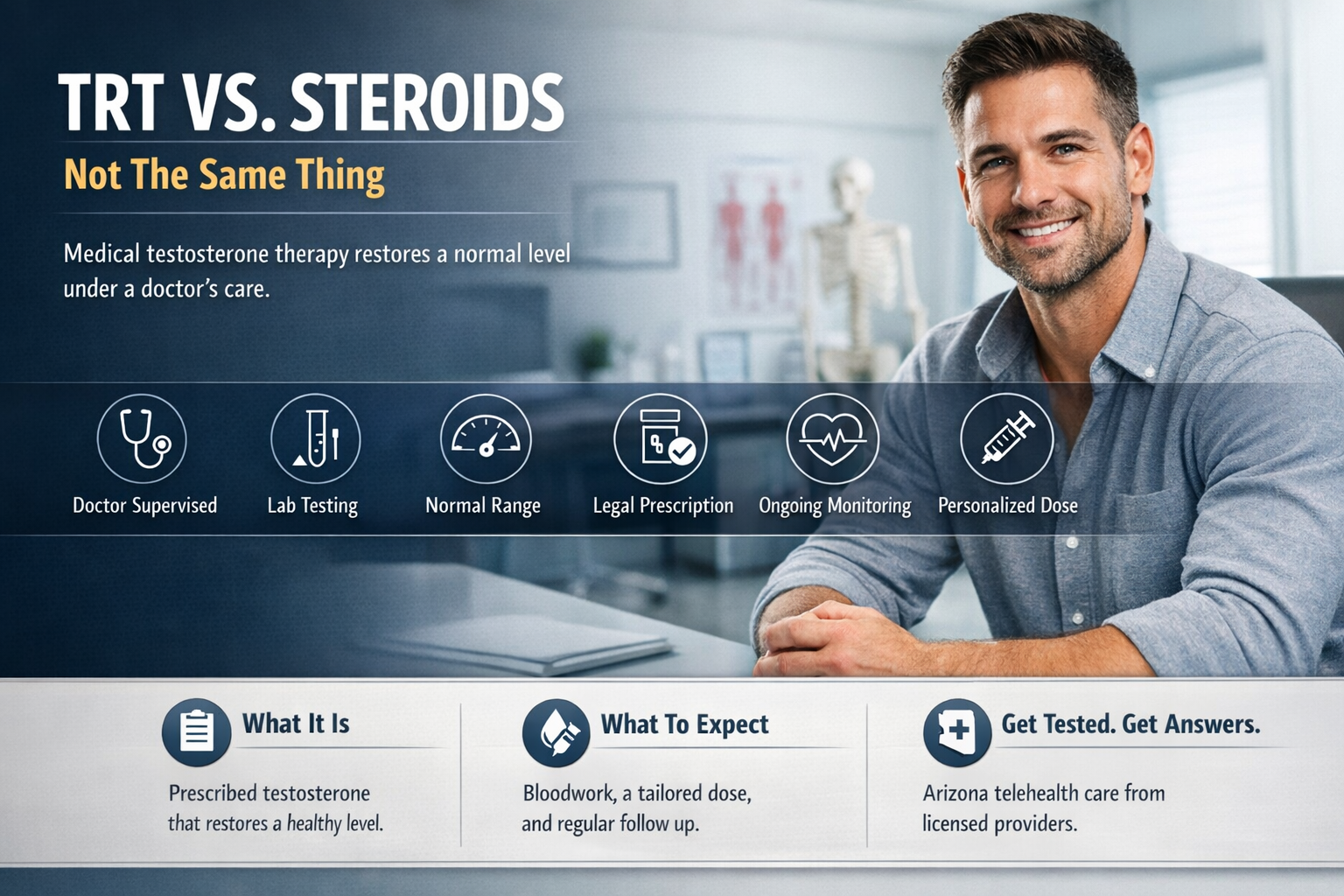
TRT vs. Steroids: What's the Difference? An Arizona Guide
If you have been looking into TRT in Arizona, you have probably run into some version of this question: "Isn't testosterone replacement therapy just steroids?" It is one of the most common hesitations men bring to a first consultation, and it deserves a straight answer. The short version is that TRT and anabolic steroid abuse use the same family of hormone, the same way that a prescribed blood pressure medication and a handful of unlabeled pills from a website are both "drugs." What separates them is dose, diagnosis, supervision, and purpose.
This guide breaks down the actual differences so Phoenix-area men can make an informed decision — and stop letting a misconception keep them from addressing a legitimate medical issue.
What TRT actually is
Testosterone replacement therapy is a prescription treatment for hypogonadism — clinically low testosterone. Major clinical bodies are specific about this: a diagnosis should only be made when a man has both symptoms consistent with testosterone deficiency and consistently low testosterone levels confirmed on repeat morning labs. That is why a reputable Arizona clinic will not simply hand you a vial after a phone call. If you want to know what that workup looks like, our guide on how low testosterone is diagnosed walks through the full process.
The goal of TRT is replacement, not enhancement. Providers aim to bring a man's level back into the healthy adult male range and keep it there — not to push it as high as possible. Treatment comes with an ongoing monitoring schedule that typically tracks total and free testosterone, hematocrit, estradiol, PSA where appropriate, and other markers. That monitoring is the treatment; it is not optional paperwork.
Key features of medical TRT
- Requires a confirmed diagnosis based on symptoms plus repeat lab testing
- Dosed to restore a normal physiologic level, not to exceed it
- Prescribed and supervised by a licensed provider
- Involves scheduled follow-up bloodwork and dose adjustments
- Uses pharmacy-sourced, regulated medication
What anabolic steroid use looks like
Non-medical anabolic-androgenic steroid (AAS) use is a different activity with a different goal. Reviews of the literature describe non-medical use as typically involving supraphysiologic dosing intended to increase lean mass, performance, or body image, frequently without medical oversight — and note that these exposure patterns differ fundamentally from those used in standard testosterone replacement therapy.
In practice that can mean weekly doses many times higher than a replacement dose, multiple compounds "stacked" together, cycles run without lab monitoring, and product sourced from unregulated channels where purity and concentration are unknown. Clinical literature on anabolic steroid use disorder documents a pattern of compulsive use, escalating doses, and continued use despite adverse effects — a profile that looks nothing like a supervised replacement protocol.
It is also worth saying plainly: testosterone is a Schedule III controlled substance in the United States. Buying it without a valid prescription is not a gray area, and the sourcing question matters for Arizona men specifically — we covered it in detail in our piece on whether it is legal to buy testosterone online in Arizona.
Find out if your testosterone is actually low.
Doctor-supervised • Arizona-based • Telehealth available
Get Started — Free Assessment →The five differences that actually matter
1. Dose
This is the single biggest distinction. Replacement dosing targets the normal adult male range. Performance dosing deliberately exceeds it, often by a wide margin. Most of the frightening headlines men associate with "steroids" come from studies of high-dose, long-term, unmonitored use — not from men on a replacement protocol.
2. Diagnosis
TRT starts with a problem to solve: documented low testosterone plus symptoms like persistent fatigue, low libido, poor recovery, or mood changes. Performance use starts with a goal to chase. A man with a total testosterone of 240 ng/dL and six months of exhaustion is in a fundamentally different situation than a man with a normal level who wants to add fifteen pounds of muscle.
3. Supervision and monitoring
Testosterone changes more than one number. It affects red blood cell production, estrogen levels, blood pressure, and lipids, among other things. On a supervised protocol those are tracked and managed. Unsupervised use skips that entirely, which is where most preventable harm happens. Our overview of TRT risks and side effects covers what gets watched and why.
4. Legality and product quality
Prescribed testosterone comes from a licensed pharmacy with verified concentration and sterility. Gray-market product carries no such assurance — underdosing, contamination, and mislabeled compounds are well-documented problems.
5. What happens to your own production
Both suppress natural testosterone production, and this is a real consideration rather than a point in TRT's favor. Any exogenous testosterone signals the brain to reduce its own output, which affects sperm production. The difference is that a supervised program discusses this upfront, screens for family planning goals, and may incorporate adjunct medications. If children are in your future, read our guide on TRT and fertility before you start anything.
"But won't it make me aggressive?"
The "roid rage" stereotype comes largely from case reports involving very high doses and polypharmacy. Restoring a deficient man to a normal range generally has the opposite effect on mood for most men — irritability and low mood are common symptoms of low testosterone. That said, mood changes can occur at any dose, and they are a reason to call your provider rather than to tough it out. We unpacked this more fully in our article on whether TRT causes roid rage and mood swings.
What this means for Arizona men
Phoenix, Scottsdale, Mesa, Tempe, Chandler, Gilbert and Tucson men all have access to the same thing: legitimate, licensed hormone care. Arizona's telehealth framework means an initial consultation and follow-ups can usually happen from home, while labs are drawn at a convenient local draw site. That combination — real diagnosis, real prescription, real monitoring, minimal disruption to a workweek — is the practical opposite of ordering something off the internet and hoping for the best.
If the steroid association has been the thing holding you back, the honest reframe is this: the question is not whether testosterone is good or bad. The question is whether your level is actually low, and whether treating it under supervision is appropriate for your health picture. That is a lab result and a conversation, not a moral judgment.
Real labs. Real providers. No guesswork.
Doctor-supervised • Arizona-based • Telehealth available
Get Started — Free Assessment →Frequently asked questions
Is TRT the same as taking steroids?
No. Both involve androgens, but TRT is a prescribed treatment that restores a diagnosed deficiency to a normal physiologic level with ongoing lab monitoring, while non-medical anabolic steroid use typically involves much higher doses taken without a diagnosis or medical supervision. The dose, purpose, legality and monitoring are all different.
Will TRT make me huge like a bodybuilder?
No. Replacement dosing brings your testosterone back to a normal male range, not above it. Most men on TRT notice improved energy, recovery, body composition and strength over several months, but the dramatic physique changes associated with performance dosing come from supraphysiologic doses, not replacement doses.
Is TRT legal in Arizona?
Yes, when prescribed by a licensed provider after an appropriate evaluation. Testosterone is a Schedule III controlled substance, so it requires a valid prescription. Obtaining testosterone without one — including from overseas or gray-market sellers — is illegal and carries additional risks around product purity and dosing accuracy.
Sources
