
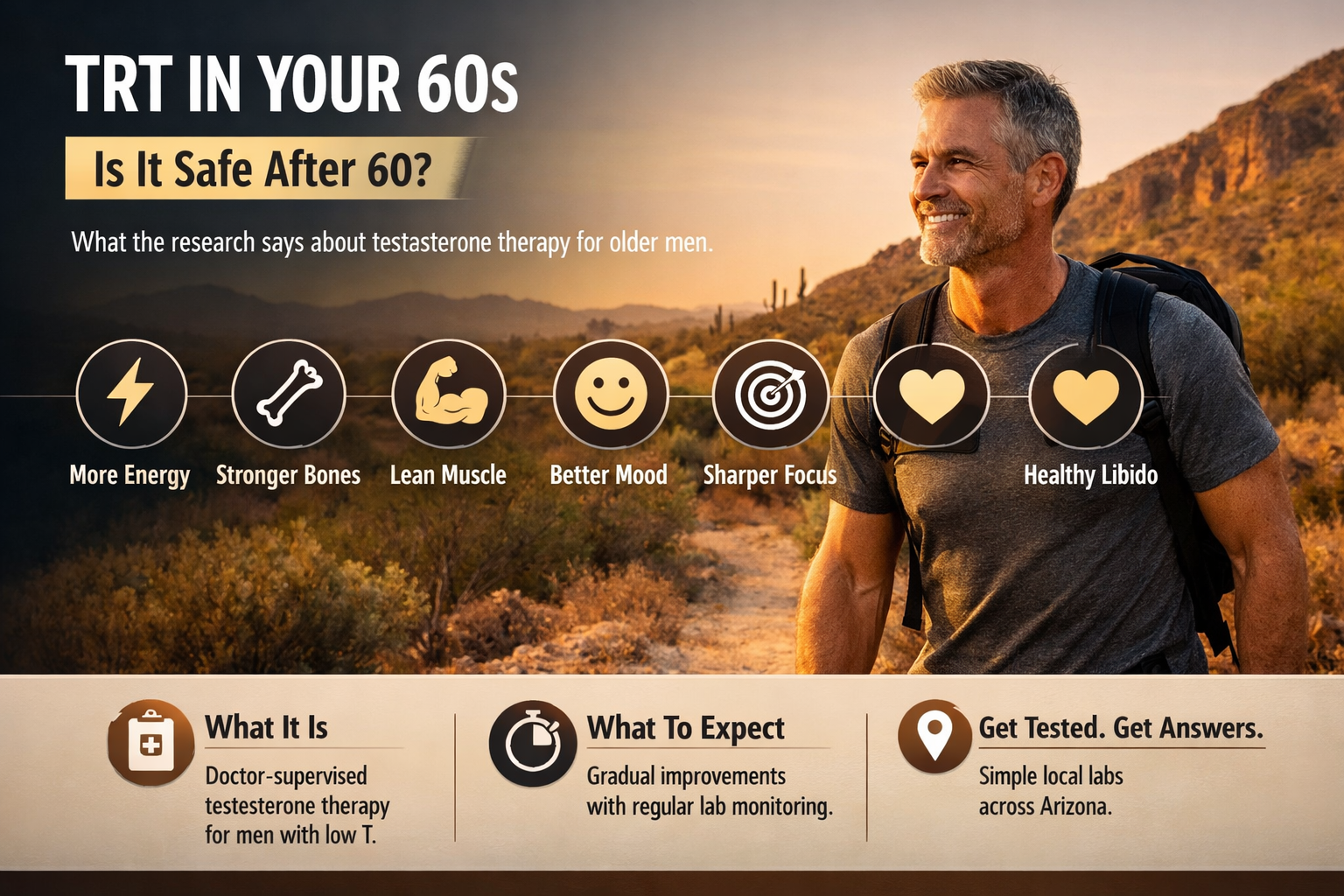
TRT in Your 60s: Is It Safe? What Arizona Men Should Know
Wondering about TRT in your 60s? You're in good company. Testosterone replacement therapy is one of the most common treatments Arizona men in their 60s ask about — and one of the most misunderstood. Some men worry they're "too old" to start; others have heard decades-old warnings about heart or prostate risks that newer research has largely put to rest. This guide walks through what the current evidence actually says about starting testosterone therapy after 60, the real risks to monitor, and how the process works for men across Phoenix, Scottsdale, Mesa, Tucson, and the rest of Arizona.
Why testosterone matters after 60
Testosterone doesn't fall off a cliff at any single birthday — it declines gradually, roughly 1% per year after age 30. By your 60s, that slow drift adds up. Research on aging men suggests roughly one in five men over 60 meets criteria for hypogonadism (clinically low testosterone). That's not a niche problem — it's a sizable share of the men hiking Camelback, playing pickleball in Sun City, or still putting in full work weeks across the Valley.
Low testosterone in your 60s can show up as fatigue, low libido, erectile changes, loss of muscle despite staying active, more belly fat, brittle motivation, and low mood. Because "normal" shifts with age, it helps to understand normal testosterone levels by age before assuming your symptoms are just "getting older."
What the research says about TRT safety after 60
The biggest safety question men in their 60s ask is about the heart. For years, conflicting headlines left even physicians unsure. That changed with the TRAVERSE study — a randomized trial of more than 5,000 middle-aged and older men (average age 63, nearly half over 65) with low testosterone and elevated cardiovascular risk. The result: testosterone therapy did not increase major adverse cardiovascular events compared with placebo, even in a population deliberately chosen for high heart risk.
Beyond the heart, a recent review of TRT in men aged 50 and above found consistent improvements in sexual desire, erectile function, lean body mass, bone mineral density, and vitality — with no increased risk of prostate cancer when treatment follows guideline-based screening and monitoring. The most common dose-related side effect was erythrocytosis (thickened blood), which is exactly why ongoing lab work is non-negotiable.
What benefits can a man in his 60s realistically expect?
- Energy and vitality: less of the 3 p.m. crash, more capacity for work, grandkids, and Arizona's outdoor life.
- Body composition: easier retention of lean muscle and gradual reduction in fat mass — especially paired with resistance training.
- Bone density: particularly relevant after 60, when fracture risk starts climbing.
- Libido and sexual function: among the most consistently documented improvements in older men.
- Mood and mental sharpness: many men report steadier mood and clearer thinking as levels normalize.
Expectations matter: TRT restores your physiology; it doesn't make you 25 again. Improvements build gradually over weeks to months.
Over 60 and feeling it? Find out if low T is the reason.
Doctor-supervised • Arizona-based • Telehealth available
Get Started — Free Assessment →The real risks after 60 — and how monitoring manages them
Safe TRT in your 60s isn't about avoiding treatment; it's about treating correctly. Reputable sources like Harvard Health urge men to confirm genuinely low levels and commit to follow-up testing before starting — advice we fully endorse. Here's what a good protocol watches:
Heart health
With TRAVERSE largely settling the major-event question, the focus shifts to individual factors: blood pressure, existing cardiac conditions, and lifestyle. If you have a cardiac history, your provider should know it and tailor your plan. We cover the full evidence in our guide to TRT and heart health.
Prostate and PSA
Men in their 60s need baseline PSA testing before starting and periodic checks after. Current evidence does not show TRT causes prostate cancer, but monitoring remains standard of care — here's a deeper look at TRT and prostate safety, including PSA monitoring.
Red blood cell count (hematocrit)
Testosterone stimulates red blood cell production, and older men can be more prone to elevated hematocrit. It's the most common TRT side effect and very manageable with dose adjustments — which is why hematocrit monitoring matters on TRT.
Sleep apnea and other considerations
Untreated severe sleep apnea, active prostate or breast cancer, and plans for fertility are reasons to pause or modify treatment. A thorough intake catches these before you ever start.
Is starting TRT in your 60s different from starting younger?
The fundamentals are identical — confirmed low levels on morning labs, symptoms, physician supervision. What changes is the monitoring emphasis: more attention to PSA, hematocrit, and cardiovascular factors, and dosing that's titrated conservatively at the start. Men who began therapy earlier often just continue seamlessly into their 60s; if you're a decade behind them, you haven't missed the window. (If you're reading this a bit early, see our companion guide to TRT in your 50s.)
How TRT works for Arizona men in their 60s
At AZTRT, the process is built for men who don't want to spend retirement (or their last working years) in waiting rooms:
- Labs near you: a comprehensive morning blood panel at a lab close to home — Phoenix, Scottsdale, Mesa, Tempe, Chandler, Gilbert, Tucson, and beyond.
- Telehealth consult: an Arizona-licensed provider reviews your labs, symptoms, and health history — including heart and prostate factors specific to your age group.
- Personalized protocol: if you qualify, medication ships to your door with clear instructions.
- Ongoing monitoring: follow-up labs track testosterone, estradiol, PSA, and hematocrit so your protocol stays safe and effective.
Your 60s can be strong ones. Start with a simple blood test.
Doctor-supervised • Arizona-based • Telehealth available
Get Started — Free Assessment →Frequently asked questions
Is 65 too old to start TRT?
No. There is no upper age cutoff in current guidelines. The TRAVERSE safety trial included men up to age 80, and nearly half of participants were over 65. What matters is confirmed low testosterone, symptoms, appropriate screening (PSA, hematocrit, cardiac history), and ongoing physician monitoring — not the number on your birth certificate.
What testosterone level is considered low for a man in his 60s?
Most guidelines use roughly 300 ng/dL total testosterone as the threshold for low, confirmed on two separate morning blood draws. Age doesn't change the cutoff much — a 64-year-old with a level of 220 ng/dL and symptoms has low T, not "normal for his age." Free testosterone and other labs help complete the picture.
How long does it take to feel results from TRT in your 60s?
Timelines in your 60s mirror younger men: libido and mood often improve within 3–6 weeks, energy and mental clarity over 1–3 months, and body composition and bone density changes over 3–12 months. Consistency with your protocol and follow-up labs is what drives results.
Sources
- The TRAVERSE Trial: Cardiovascular Safety of Testosterone Therapy for Older Men — PubMed / NIH
- Testosterone Replacement Therapy in Men Aged 50 and Above: A Narrative Review — PMC / NIH
- Hypogonadism in the Aging Male: Diagnosis, Potential Benefits, and Risks of Testosterone Replacement Therapy — PMC / NIH
- Is Testosterone Therapy Safe? — Harvard Health Publishing
