
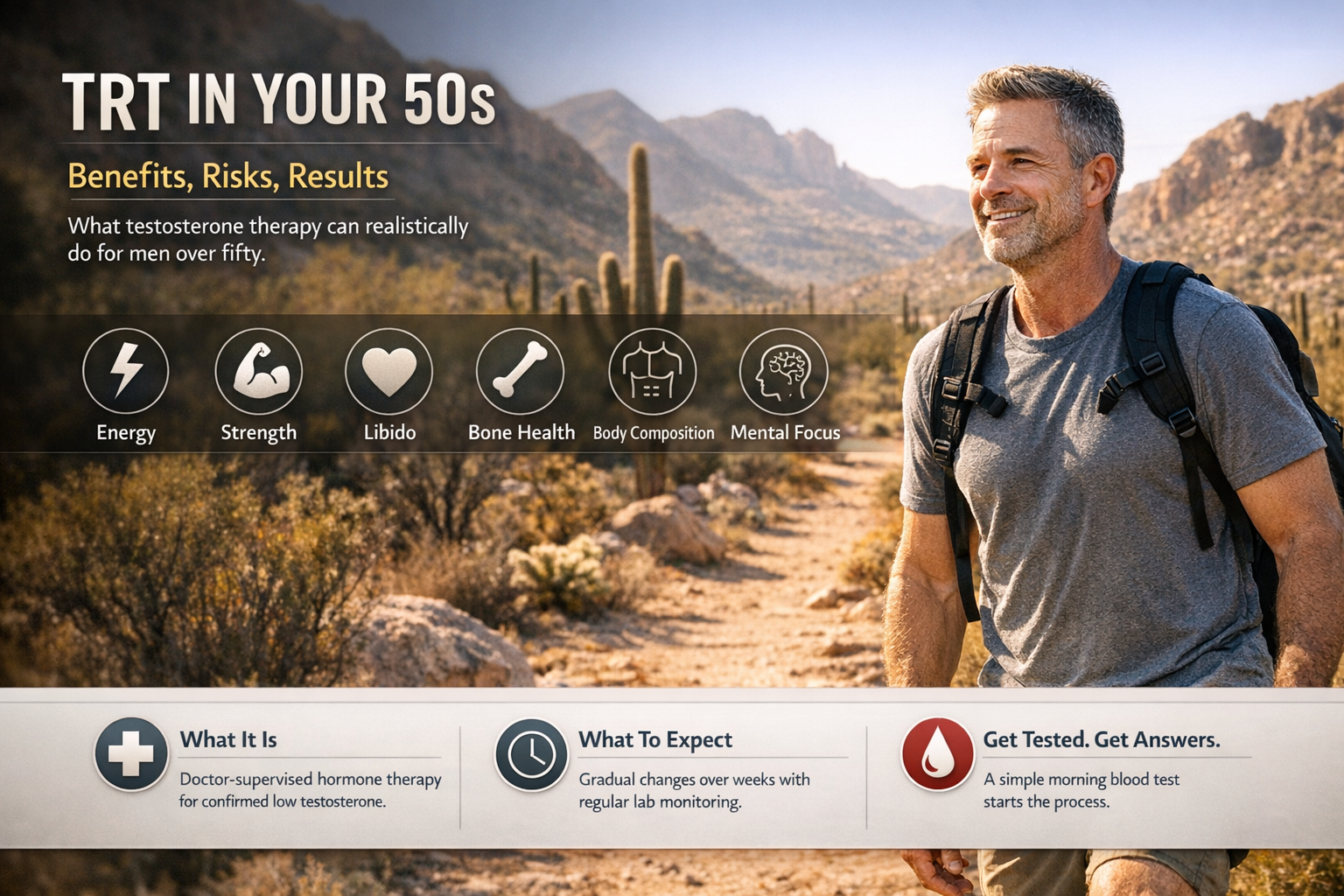
TRT in Your 50s: Is It Safe? Benefits, Risks & Results
If you are a man in your 50s living in Phoenix, Scottsdale or anywhere in Arizona and you are wondering whether TRT in your 50s is a smart move or a risky one, you are asking exactly the right question at exactly the right decade. This is the age when age-related testosterone decline stops being a statistic and starts being something you feel — in the gym, in the bedroom, and in how sharp you feel by 3 p.m.
Here is the honest version, without the hype: testosterone replacement therapy can be genuinely life-changing for a man in his 50s who has clinically low testosterone. It can also be a waste of money and an unnecessary medical commitment for a man whose fatigue is coming from poor sleep, untreated sleep apnea, alcohol, or a thyroid problem. The difference between those two men is bloodwork and a real clinical evaluation — not a guess.
Why testosterone drops in your 50s
Testosterone production peaks in your late teens and early twenties, then begins a slow, steady decline. Most research puts that decline at roughly 1% per year beginning somewhere in your late 30s or early 40s. By your 50s, that compounding drop has added up, which is why the prevalence of clinically low testosterone rises sharply with each decade of life.
But age is only part of the story. In men in their 50s, several other factors accelerate the decline:
- Visceral body fat. Abdominal fat converts testosterone into estrogen, which lowers total testosterone and creates a self-reinforcing cycle.
- Poor or fragmented sleep. Most testosterone is produced during deep sleep. Untreated sleep apnea — common in men over 50 — can meaningfully suppress levels.
- Chronic stress. Sustained cortisol elevation suppresses the hormonal signals that tell your testes to produce testosterone.
- Medications and chronic conditions. Opioids, corticosteroids, type 2 diabetes and metabolic syndrome all drag levels down.
This is exactly why a legitimate clinic will not simply hand you a prescription because you turned 50. The evaluation matters. If you have not read up on it yet, our guide to how low testosterone is actually diagnosed walks through the process step by step, and our breakdown of what a normal testosterone level looks like by age gives you the reference ranges to compare against.
What "low" actually means at 50-plus
Most guideline bodies use a total testosterone level below roughly 300 ng/dL, measured on two separate early-morning blood draws, as the biochemical threshold for hypogonadism. That number matters less than the combination: low labs plus real symptoms. A man at 310 ng/dL with crushing fatigue, no libido and shrinking muscle may be a better candidate than a man at 280 ng/dL who feels fine.
Symptoms that most often bring Arizona men in their 50s to our clinic:
- Fatigue that sleep does not fix
- Loss of morning erections and declining libido
- Losing strength and muscle despite consistent training
- Stubborn belly fat that will not respond to diet
- Low mood, irritability, or a flat, unmotivated feeling
- Brain fog and poor concentration
Find out if low testosterone is behind how you feel
Doctor-supervised • Arizona-based • Telehealth available
Get Started — Free Assessment →What TRT can realistically do for a man in his 50s
A 2025 narrative review focused specifically on men aged 50 and above found that testosterone therapy consistently improved sexual desire, erectile function, lean body mass, bone mineral density and insulin sensitivity, with the largest benefits seen in men whose starting levels were below 300 ng/dL. That last detail is the whole ballgame: the men who benefit most are the men who were genuinely deficient to begin with.
Sexual function and libido
Usually the first thing to shift, often within three to six weeks. Testosterone drives desire directly; its effect on erectile function is more variable, especially if vascular disease or diabetes is also in play.
Body composition
Expect a gradual increase in lean mass and a reduction in fat mass over three to six months — and note that TRT amplifies training, it does not replace it. A 55-year-old who lifts three times a week and eats adequate protein will see dramatically different results than one who does neither.
Energy, mood and mental clarity
Most men describe this as the ceiling lifting rather than a stimulant-like jolt. It builds over weeks. Our realistic TRT timeline of what changes and when lays out the expected sequence so you are not judging results at week two.
Bone density
Often overlooked, and arguably one of the most important long-term benefits for men in their 50s. Male osteoporosis is real and under-diagnosed, and testosterone plays a direct role in maintaining bone mineral density.
The risks and safety picture — what the evidence says
For years, the two big worries about testosterone therapy in older men were heart attacks and prostate cancer. The evidence base has matured considerably.
On cardiovascular safety, the TRAVERSE trial randomized more than 5,000 men aged 45 to 80 who had low testosterone plus existing cardiovascular disease or high cardiovascular risk. Testosterone therapy did not increase the rate of major adverse cardiac events compared with placebo — reassuring, though the trial did note an increase in fractures in the treatment group, and its findings apply to men who actually had an indication for treatment, not to men with normal levels.
On the prostate, current guideline-level thinking has moved away from the old assumption that testosterone causes prostate cancer, but monitoring is still non-negotiable. Baseline and follow-up PSA testing is standard. Our detailed look at TRT, PSA and prostate safety covers what the monitoring schedule should look like.
The side effects that actually come up in day-to-day practice are more mundane and, importantly, manageable: rising hematocrit (thickened blood, which is why we check a CBC regularly), estrogen elevation, acne or oily skin, fluid retention, testicular shrinkage, and suppressed fertility. Mayo Clinic notes that testosterone therapy can also worsen sleep apnea and stimulate red blood cell production, both of which are reasons monitoring exists. Our full guide to TRT side effects and how they are managed goes deeper on each.
Ready to get real answers instead of guessing?
Doctor-supervised • Arizona-based • Telehealth available
Get Started — Free Assessment →Who should be cautious — or wait
TRT is not right for every man in his 50s. Situations that call for caution or a hard stop include untreated or severe sleep apnea, an elevated or rapidly rising PSA, active prostate or breast cancer, a hematocrit already above the normal range, uncontrolled heart failure, or a desire to father children in the near future, since testosterone therapy suppresses sperm production.
There is also the honest conversation about commitment. Testosterone therapy is generally a long-term treatment. Your body reduces its own production while you are on it, and if you stop, levels typically drop back toward — and often temporarily below — your baseline. Going in with that expectation is far better than being surprised by it two years later.
How TRT works for men in Arizona
Arizona telehealth rules make this straightforward for men across the Phoenix metro — Scottsdale, Mesa, Tempe, Chandler, Gilbert — as well as Tucson, Flagstaff and Prescott. The typical path looks like this:
- Early-morning bloodwork at a local Arizona lab, usually before 10 a.m. when levels peak. Total and free testosterone, LH, FSH, estradiol, PSA, CBC, and a metabolic panel.
- A provider consultation by video to review results, symptoms, medical history and goals.
- A treatment plan if you qualify — most often weekly or twice-weekly testosterone cypionate injections you do at home, with ancillary medications if indicated.
- Follow-up labs at roughly six to eight weeks, then periodically, to fine-tune the dose and catch anything that needs adjusting.
One practical Arizona note: our summers matter clinically. Dehydration in 110-degree heat can push hematocrit higher, so staying genuinely hydrated is part of safe therapy here in a way it is not in milder climates.
Frequently asked questions
Is 50 too old to start TRT?
No. Men in their 50s are among the most common candidates for testosterone therapy, and the research base for this age group is substantial. What determines whether you should start is not your age but your bloodwork, your symptoms, and your overall health profile — particularly your prostate, blood counts and cardiovascular status.
How long does TRT take to work in your 50s?
Libido and mood often improve within three to six weeks. Energy and mental clarity typically build over six to twelve weeks. Changes in muscle mass, body fat and strength usually become clear between three and six months. Bone density changes take a year or more. Age slows the timeline somewhat but does not prevent results.
Does TRT cause heart problems in older men?
The largest randomized trial to date, TRAVERSE, found no increase in major adverse cardiac events among men aged 45 to 80 with low testosterone and elevated cardiovascular risk. That said, testosterone therapy still requires a cardiovascular risk assessment before starting and ongoing monitoring afterward, and the reassuring data applies to men who genuinely have low testosterone — not to men using it without an indication.
The bottom line
Your 50s are the decade where the gap between how old you are and how old you feel becomes negotiable. For men with genuinely low testosterone, TRT can close a meaningful part of that gap — more energy, better body composition, restored libido, sharper focus, stronger bones. For men whose levels are normal, it will not, and the honest answer is to look elsewhere for the cause.
The only way to know which man you are is a proper morning blood panel and a real conversation with a provider who monitors you over time. That is a low-cost, low-risk first step — and in Arizona, it can be done almost entirely from home.
Sources
- Testosterone Replacement Therapy in Men Aged 50 and Above: A Narrative Review of Evidence-Based Benefits, Safety Considerations, and Clinical Recommendations — PubMed Central (NIH)
- The TRAVERSE trial: cardiovascular safety of testosterone therapy for older men — PubMed (NIH)
- Testosterone therapy: Potential benefits and risks as you age — Mayo Clinic
- Low Testosterone (Male Hypogonadism): Symptoms, Causes & Treatment — Cleveland Clinic
