
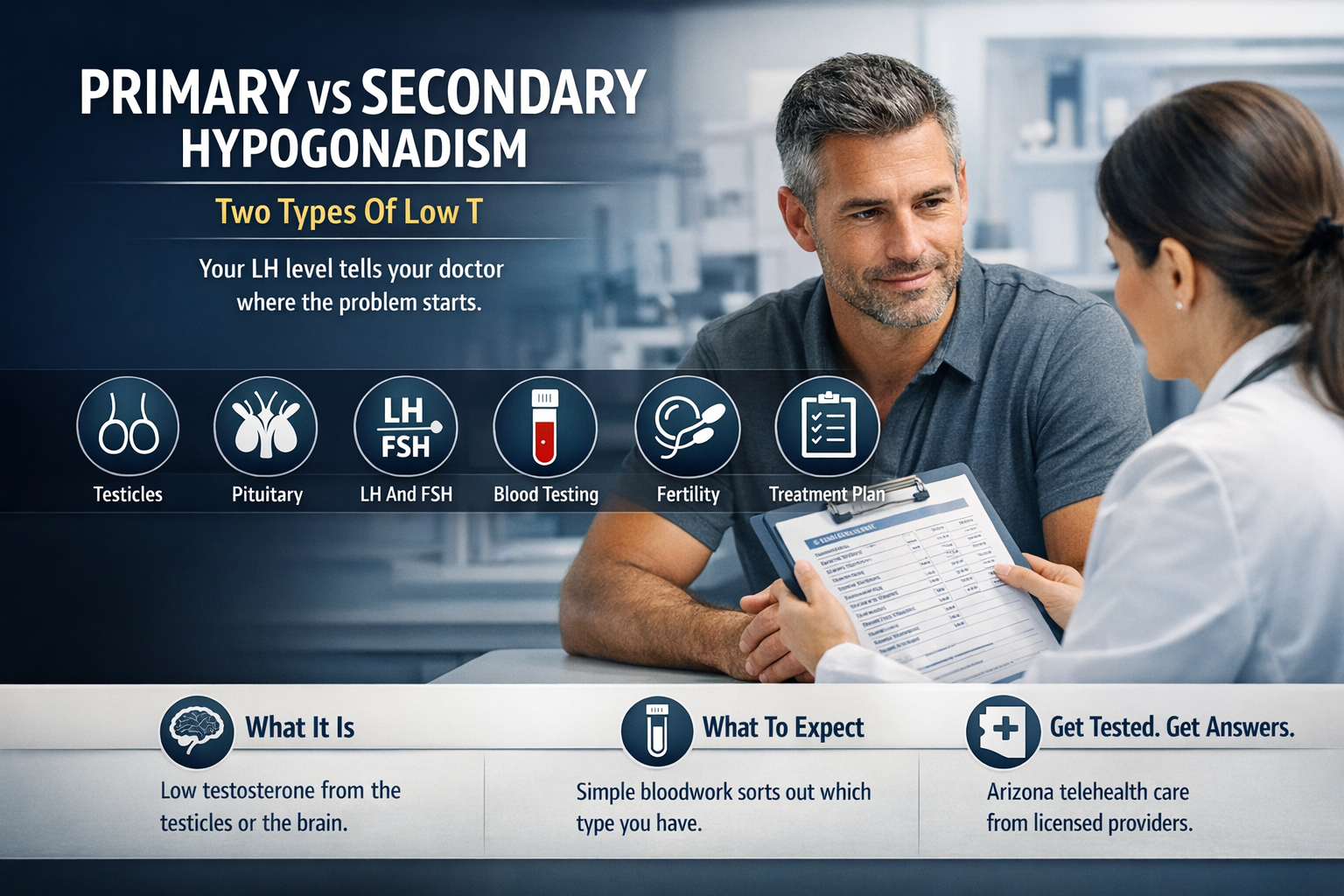
Primary vs. Secondary Hypogonadism: What's the Difference?
If you've been told you have low testosterone, the next question your provider should be answering is where the problem is coming from. Primary vs. secondary hypogonadism is the fork in the road — and it's the difference between "your testicles need help" and "your brain isn't sending the memo." Most Arizona men who come to us with fatigue, low drive, and a testosterone number under 300 ng/dL have never had that question asked, let alone answered.
It's not an academic distinction. It determines whether you're a candidate for treatments that preserve your own production, whether you need additional imaging or genetic testing, and whether there's a reversible cause sitting underneath the number. Here's how the two types differ, and how they're sorted out.
The basic wiring: how your body makes testosterone
Testosterone production runs on a three-part chain of command called the hypothalamic-pituitary-gonadal axis:
- The hypothalamus (in your brain) releases GnRH in pulses.
- The pituitary gland responds by releasing LH (luteinizing hormone) and FSH (follicle-stimulating hormone).
- The testicles receive LH and produce testosterone; FSH drives sperm production.
Testosterone then feeds back to the brain to keep the whole loop balanced. Break the chain at the bottom and you get primary hypogonadism. Break it at the top and you get secondary. This is why understanding how low testosterone is diagnosed requires more than one number — a testosterone level alone tells you something is wrong, not where.
Primary hypogonadism: the problem is in the testicles
In primary hypogonadism (also called hypergonadotropic hypogonadism), the brain is working fine. It sends plenty of LH. The testicles simply can't respond adequately. Because testosterone stays low, the negative feedback loop never shuts off, so the pituitary keeps pushing harder — which is why LH and FSH come back elevated.
Common causes include:
- Klinefelter syndrome and other genetic conditions affecting testicular development
- Undescended testicles in childhood
- Mumps orchitis or other testicular infection
- Testicular injury, torsion, or surgical removal
- Prior chemotherapy or radiation to the pelvis
- Heavy long-term alcohol use
- Aging — testicular function does decline gradually with age
Primary hypogonadism can result from testicular injury, infection, genetic conditions, or cancer treatment. In most of these cases the damage is structural and permanent, which shapes the treatment conversation: testosterone replacement therapy is usually the appropriate path, because there's no upstream signal to restore.
Secondary hypogonadism: the problem is in the brain
In secondary hypogonadism (hypogonadotropic hypogonadism), the testicles are structurally capable of producing testosterone but aren't being told to. The pituitary or hypothalamus is underperforming, so LH and FSH are low, or sitting in the normal range when they should clearly be high given how low the testosterone is. That "inappropriately normal" pattern is one of the most commonly missed findings on a basic lab panel.
Causes are much more varied — and importantly, many of them are reversible:
- Obesity — by far the most common contributor in men under 50, and a major driver of the overlap between low testosterone and metabolic disease
- Pituitary adenoma — usually benign, but it can suppress LH output
- Elevated prolactin from a prolactinoma or certain medications
- Opioid use — chronic opioids suppress the axis significantly
- Anabolic steroid use, past or present
- Obstructive sleep apnea, chronic illness, or severe stress
- Corticosteroids, head injury, or Kallmann syndrome
The reversible list is the reason this distinction matters so much. A 38-year-old in Chandler with a testosterone of 240 ng/dL, a low LH, untreated sleep apnea and 40 extra pounds has a very different set of options than a man with primary testicular failure — and in many cases, treating the underlying cause moves the number meaningfully on its own.
Find out which type of low T you actually have
Doctor-supervised • Arizona-based • Telehealth available
Get Started — Free Assessment →How the two are told apart: LH and FSH
The separating test is simple and inexpensive. After a confirmed low morning total testosterone — drawn before 10 a.m., on two separate occasions — your provider adds LH and FSH to the panel. Per the American Urological Association, a low or low-normal LH points to a central hypothalamic-pituitary problem, while an elevated LH indicates a primary testicular defect.
From there, the workup branches:
- High LH/FSH (primary): your provider may consider karyotype testing if the picture suggests a genetic cause, and will discuss testosterone replacement directly.
- Low or low-normal LH/FSH (secondary): prolactin should be checked to screen for hyperprolactinemia. Guidelines also advise that men with total testosterone below roughly 150 ng/dL alongside a low or low-normal LH undergo pituitary MRI — non-secreting adenomas can hide behind a normal prolactin.
Additional labs typically round out the picture: SHBG, free testosterone, estradiol, a metabolic panel, thyroid function, and iron studies. That's why the bloodwork you need before starting TRT is more extensive than a single testosterone draw — the panel is doing diagnostic work, not just confirming a symptom.
A practical caveat worth knowing: acute illness, poor sleep, and recent stress can all temporarily suppress testosterone and gonadotropins, which is exactly why a single abnormal result shouldn't drive a lifelong treatment decision. In Arizona, where summer training loads, shift work, and heat stress are real variables, retesting on a normal week matters.
Why the distinction changes your treatment
Here's where it becomes practical rather than theoretical.
If you have primary hypogonadism
The testicles can't respond to a stronger signal, so medications that boost LH won't accomplish much. Testosterone replacement therapy is generally the appropriate treatment, with standard monitoring of hematocrit, PSA, and estradiol. Fertility is often already affected by the underlying condition, and a reproductive specialist referral is worth discussing early if you want children.
If you have secondary hypogonadism
You have more options, because the testicles still work. That opens the door to therapies that stimulate your own production rather than replacing it — which is why so many men in this category ask about enclomiphene compared with TRT. Enclomiphene and clomiphene raise LH and FSH, prompting your own testicles to produce more testosterone while preserving testicular size and sperm production. Similarly, hCG used alongside TRT mimics LH directly, which is one strategy for men who want to protect fertility while on therapy.
This is also the group where lifestyle intervention genuinely moves the needle. Weight loss, treating sleep apnea, tapering opioids under medical supervision, and correcting a prolactin problem can all raise testosterone without any hormone prescription at all.
Mixed pictures are common
Plenty of men — especially over 50 — show features of both: modest testicular decline plus an aging or suppressed central signal. This combined pattern is well described in the clinical literature on male hypogonadism, and it's one reason treatment plans should be individualized rather than pulled off a template.
Fertility: the most important practical difference
If you want children now or later, this conversation should happen before your first injection. Exogenous testosterone suppresses LH and FSH, which suppresses sperm production — regardless of which type of hypogonadism you have. For men with secondary hypogonadism, that's a meaningful trade-off, because their fertility is often intact to begin with and there are protocols specifically designed to preserve it. Our full breakdown of TRT and fertility covers how those protocols work and what recovery typically looks like.
Getting this sorted out in Arizona
At AZTRT, every new patient's workup includes LH and FSH alongside total and free testosterone, so the primary-vs-secondary question is answered at the outset rather than after the fact. Lab draws happen at Quest and Labcorp locations across Phoenix, Scottsdale, Mesa, Tempe, Gilbert, Chandler, and Tucson, and consults are handled by telehealth — so the only in-person step is the blood draw itself.
If the panel points to secondary hypogonadism with a reversible cause, we'll tell you that plainly, even when it means you don't need testosterone at all. If it points to primary testicular failure, replacement therapy with proper monitoring is the straightforward answer.
Get a complete hormone panel — not just a testosterone number
Doctor-supervised • Arizona-based • Telehealth available
Get Started — Free Assessment →Frequently asked questions
Can secondary hypogonadism be reversed?
Often, yes — and that's the main reason the distinction matters. When the cause is obesity, untreated sleep apnea, chronic opioid use, high prolactin, or prior anabolic steroid use, addressing that cause can raise testosterone on its own. Structural causes like a pituitary adenoma need their own treatment. Primary hypogonadism, by contrast, usually reflects permanent testicular damage and is not reversible.
What blood test tells you if hypogonadism is primary or secondary?
LH and FSH, drawn alongside a confirmed low morning total testosterone. High LH and FSH with low testosterone indicates primary (testicular) hypogonadism. Low or inappropriately normal LH and FSH with low testosterone indicates secondary (central) hypogonadism, which typically prompts a prolactin check and, at very low testosterone levels, a pituitary MRI.
Does the type of hypogonadism change which TRT I should take?
It changes the options more than the injection itself. Men with secondary hypogonadism may be candidates for enclomiphene, clomiphene, or hCG-based protocols that stimulate their own testosterone production and help preserve fertility. Men with primary hypogonadism generally need direct testosterone replacement, since those medications rely on testicles that can still respond to an LH signal.
Sources
- Evaluation and Management of Testosterone Deficiency: Guideline — American Urological Association
- Male Hypogonadism: Symptoms & Causes — Mayo Clinic
- Male Hypogonadism (StatPearls) — NCBI Bookshelf, National Library of Medicine
- A Practical Guide to Male Hypogonadism in the Primary Care Setting — PMC, National Library of Medicine
