
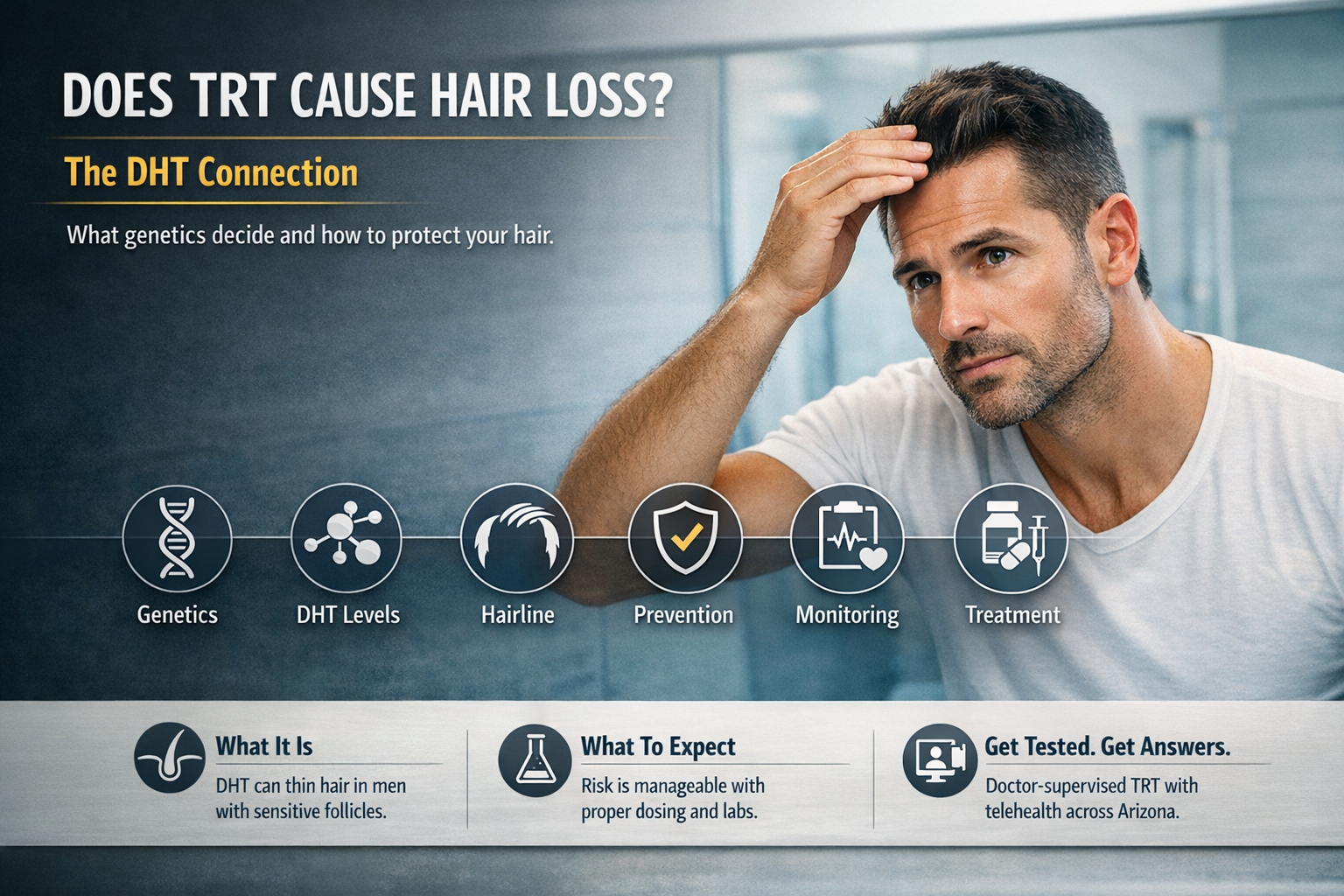
Does TRT Cause Hair Loss? What Arizona Men Should Know
"Does TRT cause hair loss?" is one of the first questions men in Phoenix, Scottsdale, and across Arizona ask before starting testosterone replacement therapy — and it deserves a straight answer. The short version: testosterone therapy doesn't make hair fall out on its own. What it can do is raise levels of dihydrotestosterone (DHT), and in men whose hair follicles are genetically sensitive to DHT, that can speed up a process that was already underway. This guide explains the science, who's actually at risk, and how a provider-supervised TRT program in Arizona keeps your hair — and your health — monitored.
The real culprit: DHT, not testosterone
Your body converts a portion of its testosterone into dihydrotestosterone (DHT) using an enzyme called 5-alpha reductase. DHT is a powerful androgen that's essential during male development, but in adulthood, high DHT levels can shrink hair follicles and shorten the hair growth cycle, gradually miniaturizing the hairs on top of your scalp until they stop growing back.
When you start TRT, your total testosterone rises — and since DHT is made from testosterone, DHT typically rises with it. That's the mechanical link between TRT and hair. But here's the part most men miss: the amount of DHT in your blood matters far less than how your follicles respond to it.
Genetics decide whether DHT affects your hairline
Male pattern baldness — androgenetic alopecia — is fundamentally a genetic condition. Men who develop it have hair follicles with more androgen receptors and heightened 5-alpha-reductase activity in the balding areas of the scalp, which is why the same DHT level thins hair in one man and does nothing in another. The condition is common — it affects a large share of men and becomes more likely with age — and it typically starts with a receding hairline at the temples followed by thinning at the crown.
Practical translation for Arizona men considering TRT:
- If baldness runs in your family (father, grandfathers, uncles) or you've already noticed a receding hairline, TRT may accelerate thinning that was genetically scheduled to happen anyway.
- If you have no family history and a full head of hair in your 40s or 50s, your follicles are likely not DHT-sensitive, and TRT is unlikely to cause meaningful hair loss.
- TRT doesn't create baldness genes. It can only turn up the volume on a predisposition you already have.
It's also worth remembering why men consider TRT in the first place. Untreated low testosterone comes with its own costs — fatigue, low drive, and the other common signs of low testosterone in men — that affect daily life far more than a hairline for most men. The decision is about weighing real benefits against a manageable, monitorable risk.
Worried About Low T? Find Out Where You Stand
Arizona-licensed providers • Arizona-based • Telehealth available
Get Started — Free Assessment →How likely is hair loss on TRT?
There's no fixed percentage that applies to everyone, because risk tracks your genetics, your dose, and your baseline DHT sensitivity. What clinical experience consistently shows:
- Men already thinning before TRT are the most likely to notice faster progression, usually in the classic pattern — temples first, then the crown.
- Higher-than-physiologic doses raise risk. Restoring testosterone to a normal range is a different animal than the supraphysiologic doses seen in steroid abuse. This is one reason proper dosing and lab monitoring — not "more is better" — matter so much. A responsible program reviews TRT's risks and side effects with you up front and tracks your labs on a schedule.
- Shedding isn't always permanent loss. Some men notice temporary shedding as hormone levels shift in the first months of therapy, which can stabilize as levels level off.
How to protect your hair on TRT
If you're predisposed to male pattern baldness and still want the benefits of optimized testosterone, you have real options — and they work best when started early, before follicles are lost for good.
1. Start with proper baseline labs
A quality Arizona TRT clinic checks your hormones before you start — including testosterone, estradiol, and related markers — so changes can be tracked over time. Here's the bloodwork you need before starting TRT. Labs are easy to complete locally at draw sites across the Phoenix metro, Tucson, and most Arizona towns.
2. Use the lowest effective dose
The goal of TRT is restoring your levels to a healthy physiologic range — not maximizing them. Staying in range keeps DHT conversion proportionate and reduces unnecessary follicle exposure.
3. Consider a 5-alpha-reductase inhibitor if appropriate
Finasteride blocks the enzyme that converts testosterone to DHT, and in a large two-year controlled trial, finasteride significantly improved scalp hair growth in men with male pattern hair loss compared to placebo. It's not right for everyone — it can affect libido in a small percentage of men and should only be used under medical guidance — but for genetically predisposed men on TRT, it's the most evidence-backed hair-protection tool available. Topical minoxidil is another option that works on the follicle directly, independent of hormones.
4. Pick the right delivery method with your provider
Injections, gels, creams, and pellets each produce different hormone curves, and some topical applications may influence local DHT conversion in the skin. Your provider can walk you through how TRT injections, gels, pellets, and creams compare and match the method to your goals.
5. Monitor and adjust
Hair changes happen over months, not days. Ongoing follow-up labs and honest check-ins let your provider adjust dose or add hair-protective treatment early — long before a temporary shed becomes permanent thinning.
The Arizona angle: monitored TRT via telehealth
For men in Phoenix, Scottsdale, Mesa, Chandler, Gilbert, Tempe, and Tucson, provider-supervised TRT no longer requires monthly clinic visits. AZTRT operates telehealth-first across Arizona: your consults happen online, your labs are drawn at a location near you, and your medication ships to your door — with the same structured monitoring (testosterone, estradiol, hematocrit, PSA) that responsible hair-risk management requires. If you're new to the process, this step-by-step guide to getting started with TRT covers exactly what to expect.
Get Your Testosterone Tested in Arizona
Arizona-licensed providers • Arizona-based • Telehealth available
Get Started — Free Assessment →The bottom line
TRT doesn't cause hair loss in men who aren't genetically predisposed to it. In men who are, it can accelerate male pattern baldness by raising DHT — but that risk is visible, measurable, and manageable with proper dosing, monitoring, and (when appropriate) proven treatments like finasteride and minoxidil. The worst approach is getting testosterone from an unmonitored source with no labs and no follow-up. The best approach is a doctor-supervised program that watches your numbers and your hairline with you.
Frequently asked questions
Will I go bald if I start TRT?
Only if you're genetically predisposed to male pattern baldness — and even then, TRT accelerates rather than creates the process. Men with no family history of baldness and no thinning by their 40s are unlikely to see meaningful hair loss from properly dosed TRT. If you are predisposed, options like finasteride and minoxidil can protect your hair while you stay on therapy.
Can I take finasteride with TRT?
Many men do, under medical supervision. Finasteride blocks the conversion of testosterone to DHT, protecting DHT-sensitive follicles while leaving your testosterone benefits largely intact. It carries a small risk of sexual side effects in some men, so the decision should be made with your provider based on your goals and risk tolerance.
Does hair grow back if I stop TRT?
Hair lost to true follicle miniaturization generally does not grow back on its own, whether the loss happened on or off TRT. Temporary shedding during hormone shifts can recover, but established male pattern baldness is progressive. That's why early monitoring and early treatment matter more than waiting to see how bad it gets.
Sources
- DHT (Dihydrotestosterone): What It Is, Side Effects & Levels — Cleveland Clinic
- Androgenetic Alopecia — StatPearls, NCBI Bookshelf (NIH)
- Androgenetic Alopecia — MedlinePlus Genetics (NIH)
- Finasteride in the Treatment of Men with Androgenetic Alopecia — PubMed (Journal of the American Academy of Dermatology)
