
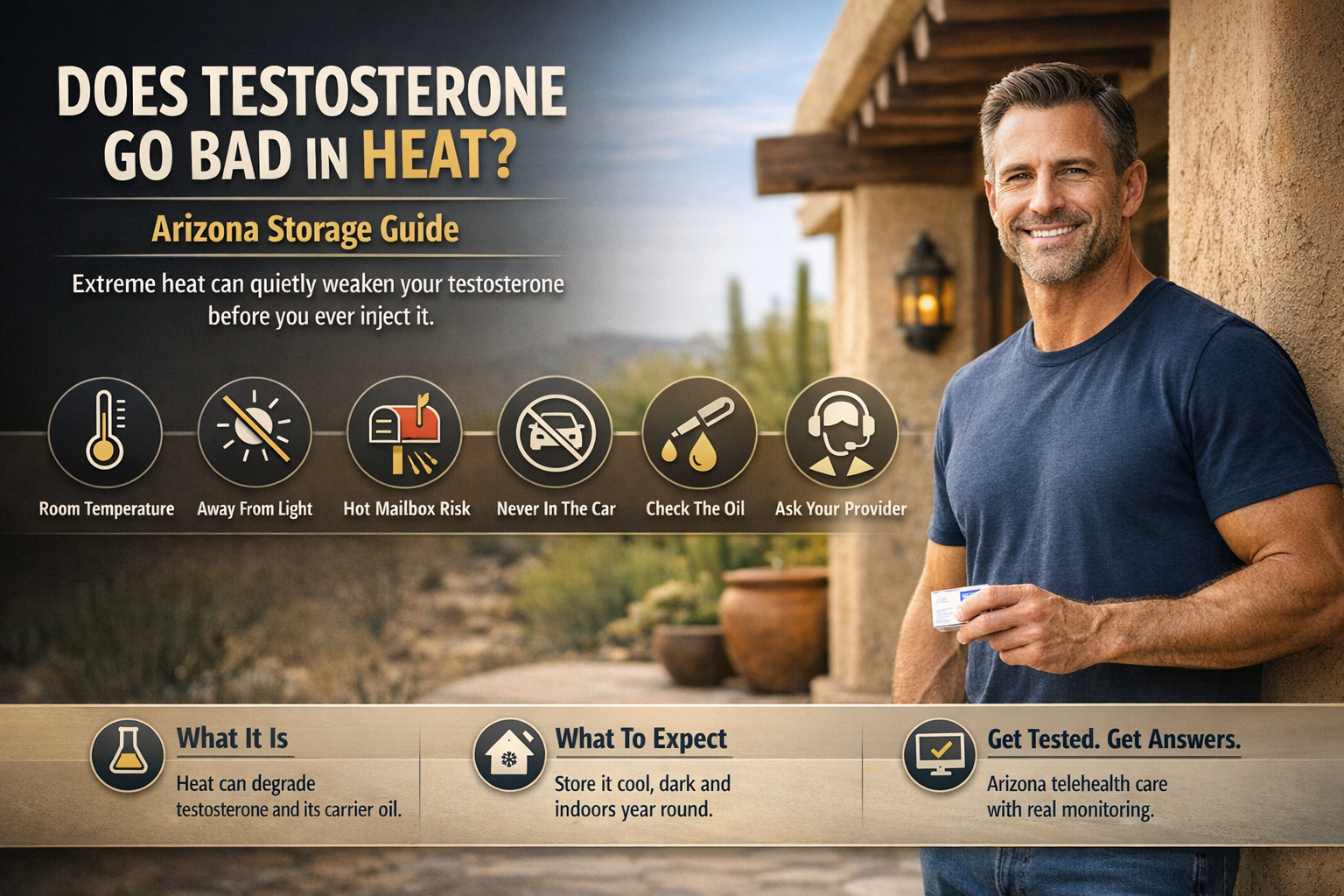
Does Testosterone Go Bad in Heat? Storing TRT in Arizona
If you're on testosterone replacement therapy in Arizona, heat isn't a minor detail — it's a storage problem you have to plan around from May through September. Phoenix routinely runs above 110°F, a parked car interior can climb well past 140°F within an hour, and a metal mailbox in full sun is one of the hottest places on your property. So the question “does testosterone go bad in heat?” isn't paranoid. It's the right question for anyone doing TRT in the desert, especially if your medication arrives by mail.
Here's what the labeling actually says, what heat does to an oil-based hormone, and how Arizona men can keep every vial working the way it should.
What temperature should testosterone be stored at?
Injectable testosterone is not a refrigerated medication. According to the FDA prescribing information for testosterone cypionate, the product is stored at 20° to 25°C (68° to 77°F) — what pharmacists call USP Controlled Room Temperature — and protected from light.
Two practical things follow from that:
- Don't refrigerate it. Cold makes the carrier oil thick and cloudy and can cause the testosterone to crystallize out of solution, which makes drawing and injecting harder.
- Don't cook it. Sustained temperatures well above that range are exactly what Arizona delivers for four months a year.
The same range applies whether you're prescribed testosterone cypionate or testosterone enanthate — both are oil-based intramuscular or subcutaneous preparations with essentially the same storage requirements.
What heat actually does to a testosterone vial
A vial of testosterone is a steroid hormone dissolved in a sterile carrier oil (usually cottonseed, sesame, or grapeseed oil) with benzyl alcohol or benzyl benzoate as a preservative. Extreme, prolonged heat can affect all three parts:
- The hormone and its ester. Chemical stability is defined at the labeled storage range. Push far outside it for long enough and degradation becomes a real possibility — meaning less active drug than the label claims.
- The carrier oil. Oils oxidize with heat and light exposure. Rancid or oxidized oil is more likely to sting or cause a post-injection reaction.
- The seal and container. Repeated heating and cooling stresses the rubber stopper and can compromise the sterile barrier over time.
The frustrating part is that heat damage is usually invisible. A vial that lost potency in a hot mailbox looks identical to one stored perfectly in a bedroom closet. That's why the FDA's guidance on medications exposed to extreme conditions is conservative: drugs exposed to excessive heat should be replaced rather than assumed safe, even when they look normal.
Warning signs your testosterone may be compromised
Always inspect the vial before you draw. Do not use it, and call your provider or pharmacy, if you see:
- Cloudiness, haziness, or a color shift (fresh testosterone is clear and pale yellow to light amber)
- Visible particles, floaters, or crystals that don't dissolve after gently warming the vial in your hands
- A bulging, cracked, loose, or leaking stopper
- A strong, sharp, or rancid smell
- A vial that is hot to the touch after sitting in delivery, sun, or a car
One more clue is clinical rather than visual: if your symptoms unexpectedly return mid-cycle on a stable dose — energy dropping, libido fading, workouts getting flat — and nothing else has changed, degraded medication is one possibility worth raising with your provider. It's not the most likely explanation, but it belongs on the list alongside dosing and lab follow-up, and it's a reason to review how often you take your TRT injections and whether the schedule is being followed as prescribed.
Not sure if your TRT is working the way it should?
Arizona-licensed providers • Arizona-based • Telehealth available
Get Started — Free Assessment →The four Arizona heat traps for TRT
1. The mailbox
This is the biggest risk for anyone using mail-order or telehealth pharmacy delivery. A closed metal mailbox in Phoenix, Mesa, or Gilbert in July is essentially a small oven, and a package can sit there for hours. If you can't retrieve deliveries the same day, arrange for a signature, a hold at the carrier facility, a locked shaded parcel box, or delivery to a workplace where someone brings it inside immediately.
2. Your car
A vehicle interior can exceed 140°F on a 105°F Arizona afternoon. Don't leave testosterone, syringes, or a travel kit in a car, glovebox, or trunk — not for an errand, not for a workday, not overnight. The FDA's general medication guidance is blunt about this: store medicines in a cool, dry place and avoid leaving them in a car in summer or winter.
3. The bathroom and the garage
The two most common storage spots in an Arizona home are two of the worst. Bathrooms swing through heat and humidity with every shower; an uncooled Arizona garage can hold 110°F+ air for months. A bedroom closet, a dresser drawer, or a kitchen cabinet away from the oven and dishwasher is better on every count.
4. Travel and the summer road trip
Flying or driving with testosterone means keeping it in your carry-on or the air-conditioned cabin — never in a checked bag that may sit on hot tarmac, and never in a trunk. Bring the pharmacy label so the prescription is clearly yours, and pack an insulated pouch with a cool pack (not directly touching the vial, so it doesn't get too cold).
How to store testosterone correctly in Arizona
- Pick one cool, dark, indoor spot in the conditioned part of your home — a bedroom closet shelf or dresser drawer is ideal.
- Keep it in the original carton to protect against light exposure.
- Bring deliveries inside the same day. Set a phone reminder on shipment day if needed.
- Don't refrigerate or freeze unless your pharmacy specifically instructs it.
- Keep it out of reach of children and pets, and away from vents, windows, and heat-producing appliances.
- Inspect every time before drawing, and follow proper technique when you self-inject testosterone at home.
If a vial has been badly heat-exposed, the safest move is replacement, not improvisation. Never try to “fix” a suspect vial by refrigerating it, filtering it, or transferring the oil to another container — that introduces contamination risk on top of the original problem.
Why this matters more for telehealth patients
Most Arizona men now start therapy through a virtual clinic, and that's a genuine advantage — but it moves one link of the supply chain to your front door. Understanding how online TRT in Arizona works through telehealth includes knowing how your medication ships, how fast it arrives, and what happens if a package is delayed in August.
Storage is only one part of a well-run protocol. Consistent dosing, scheduled bloodwork, and periodic dose adjustments are what actually drive results, and reputable clinics build all of that into the plan. The American Urological Association guideline on testosterone deficiency emphasizes on-treatment monitoring of levels and symptoms rather than a set-and-forget prescription. If you're early in the process, it also helps to have realistic expectations about how long TRT takes to work so you can tell a normal timeline from a genuine problem.
Frequently asked questions
Can I still use testosterone that was left in a hot car?
Don't assume it's fine. A brief trip home in an air-conditioned car is very different from hours in a parked vehicle in Arizona summer heat. If the vial was exposed to extreme heat for an extended period, or if it's cloudy, discolored, or hot to the touch, contact your provider or pharmacy about a replacement instead of injecting it.
Should testosterone be refrigerated?
No. Injectable testosterone is stored at controlled room temperature, roughly 68°F to 77°F, protected from light. Refrigeration can thicken the carrier oil and cause crystallization, making the medication difficult to draw and inject. Follow the storage instructions on your pharmacy label.
How do I keep my TRT delivery safe in the Arizona summer?
Track the shipment and bring it inside the same day it arrives. If that's not possible, ask about signature-required delivery, a carrier hold for pickup, a shaded or locked parcel box, or shipping to a workplace address. Once inside, store the vial in its carton in a cool, dark, air-conditioned room.
The bottom line for Arizona men
Testosterone is a stable medication when it's stored the way it's meant to be — cool, dark, indoors, at room temperature. Arizona simply makes that harder for a third of the year. Bring deliveries in the same day, keep vials out of cars, garages, and bathrooms, inspect before every injection, and replace anything that's been badly heat-exposed. Those habits cost you nothing and protect every dose you paid for.
And if you've been storing your medication well but still aren't feeling the results you expected, that's a conversation to have with a provider who will actually look at your labs, your dose, and your protocol — not just refill the prescription.
Get TRT done right — from Phoenix to Tucson
Arizona-licensed providers • Arizona-based • Telehealth available
Get Started — Free Assessment →Sources
- Depo-Testosterone (testosterone cypionate injection) Prescribing Information — U.S. Food and Drug Administration
- Safe Drug Use After a Natural Disaster — U.S. Food and Drug Administration
- 5 Medication Safety Tips for Older Adults — U.S. Food and Drug Administration
- Testosterone Deficiency Guideline — American Urological Association
