
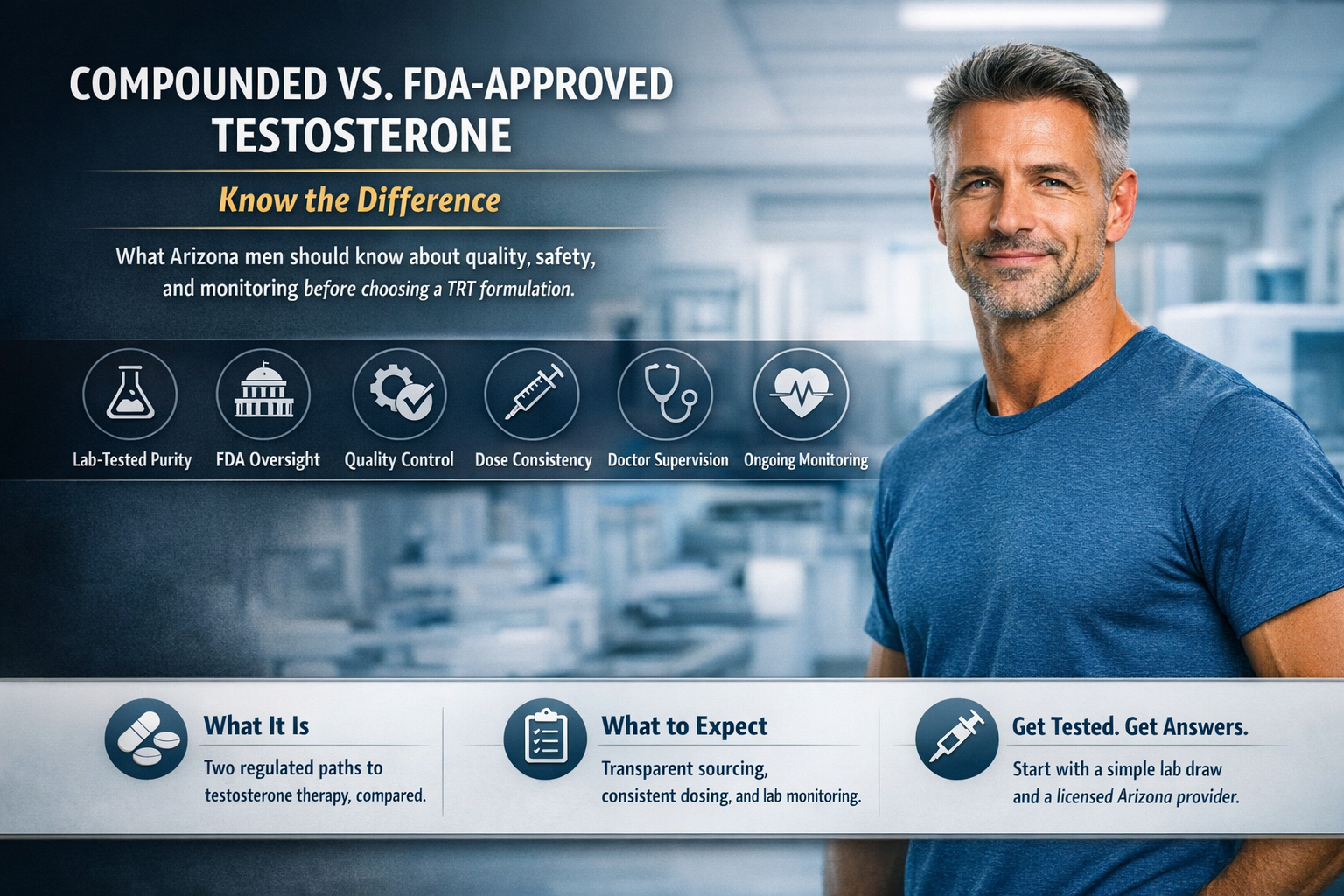
Compounded vs. FDA-Approved Testosterone: An Arizona Guide
If you've started shopping for testosterone replacement therapy in Arizona, you've probably noticed that not every clinic prescribes the same kind of testosterone. Some use FDA-approved cypionate or enanthate from a licensed pharmaceutical manufacturer. Others rely on compounded testosterone — custom blends mixed in-house by a compounding pharmacy, often at a lower price. The compounded testosterone vs. FDA-approved testosterone question matters more than most men realize, because it affects how consistent your dose actually is, what quality checks the product has passed, and how safely your treatment can be monitored over time.
What's the Difference Between Compounded and FDA-Approved Testosterone?
FDA-approved testosterone products — the injectable esters, transdermal gels, patches, and pellets sold under a manufacturer's name — go through a formal approval process before they're allowed on the market. the FDA restricts these products to men with confirmed low testosterone tied to a diagnosed medical condition, and each batch has to meet strict, reproducible manufacturing standards.
Compounded testosterone is different. A compounding pharmacist combines the active ingredient with a base to create a custom formulation — sometimes a specific dose strength, a cream instead of a gel, or a combination product not sold commercially. Compounding has a legitimate role in medicine (allergy-friendly formulations, discontinued dose strengths, pediatric dosing), but it operates under a separate, lighter regulatory framework than an FDA-approved drug.
How FDA-Approved Testosterone Is Regulated
Before an FDA-approved testosterone product reaches a pharmacy, the manufacturer has to demonstrate that every batch stays within a tight potency range — typically within about 10% of the labeled dose — and that the active ingredient is pure, stable, and free of contamination. The product also carries FDA-mandated labeling, including boxed warnings and dosing instructions, so both the prescriber and the patient know exactly what they're working with. This is the same regulatory bar that applies to the injections, gels, pellets, and creams most Arizona TRT clinics prescribe as first-line therapy.
What "Compounded" Testosterone Means — and Why Some Pharmacies Use It
Compounding pharmacies fall into two regulatory categories. A "503A" pharmacy compounds in smaller batches for individual patients under a state pharmacy board's oversight; a "503B" outsourcing facility compounds in larger batches under closer FDA-adjacent oversight, similar in spirit — though not identical — to drug manufacturing standards. The key difference from an FDA-approved product: compounded preparations are not required to prove safety and effectiveness in clinical trials before they're dispensed, and standard 503A pharmacies aren't required to test the purity of their raw ingredients before mixing them.
Clinics sometimes turn to compounding when a patient needs a dose strength or delivery method that isn't commercially available, or to manage cost. That can be reasonable in specific cases, but it's worth asking your provider directly which category your testosterone falls into — a legitimate TRT clinic worth choosing should be transparent about it rather than leaving it unmentioned.
Want Testosterone You Can Trust the Dose Of?
Doctor-supervised • Arizona-based • Telehealth available
Get Started — Free Assessment →The Real Risks: Potency Variability and Contamination
The concern with compounded hormone products isn't theoretical. A National Academies review of compounded bioidentical hormone therapy found that tested compounded hormone preparations varied meaningfully from their labeled potency — in some documented cases by double-digit percentages in either direction — while FDA-approved products are required to stay within a roughly ±10% range. The same review noted that standard compounding pharmacies aren't required to run confirmatory purity testing on their raw ingredients or prove that the active hormone stays stable for the life of the product, the way FDA-approved manufacturers must.
For a man on testosterone therapy, potency swings aren't just an inconvenience. A dose that's stronger than labeled can push estradiol and hematocrit higher than expected; a dose that's weaker can leave symptoms unresolved while your provider assumes the treatment plan itself isn't working. Either way, it muddies the picture your baseline and follow-up bloodwork is supposed to give you.
Is Compounded Testosterone Ever the Right Choice?
Compounding isn't inherently unsafe, and reputable 503B outsourcing facilities do undergo more rigorous testing than a small 503A pharmacy mixing a one-off prescription. But for standard testosterone replacement — where FDA-approved cypionate, enanthate, gels, and patches already cover the vast majority of dosing needs — most Arizona men don't need to take on the added variability of a compounded product. It's a reasonable option to discuss with your provider only when a specific medical circumstance calls for it, not as a default cost-saving substitute.
This also affects your wallet: compounded testosterone is often marketed as cheaper, but when you factor in more frequent lab checks to catch dosing inconsistencies, the real difference in what TRT actually costs in Arizona can be smaller than it first appears.
What This Means for Monitoring and Safety on TRT
Regardless of which formulation you're on, testosterone therapy isn't a "set it and forget it" prescription. A 2026 Endocrine Society statement on testosterone replacement reinforces that diagnosis and dosing decisions should rest on accurately measured, standardized lab testing, not symptoms alone, and that ongoing monitoring matters because large randomized trial data has shown real safety signals — including a measurable increase in blood clot risk — that make follow-up bloodwork non-negotiable. Product consistency only makes that monitoring more reliable; it doesn't replace it. That's also why understanding the full picture of TRT's risks and side effects matters before you start, whatever formulation you land on.
How AZTRT Approaches Your Testosterone Prescription
AZTRT prescribes FDA-approved testosterone formulations — the same injectable cypionate and enanthate, gels, and patches that meet manufacturer-level potency and purity standards — and pairs that with the lab monitoring schedule current guidelines call for. You'll know exactly what's in your prescription, what it costs, and when your next set of labs is due. If a clinic can't answer clearly whether your testosterone is FDA-approved or compounded, that's worth asking about before you commit.
Get FDA-Approved Testosterone, Monitored Right
Doctor-supervised • Arizona-based • Telehealth available
Get Started — Free Assessment →Frequently asked questions
Is compounded testosterone illegal?
No. Compounding is legal and regulated by state pharmacy boards (and, for 503B facilities, the FDA), but compounded products are not FDA-approved drugs and don't go through the same clinical trial and batch-testing requirements.
Why do some TRT clinics use compounded testosterone instead of FDA-approved brands?
Usually cost or the ability to offer a custom dose strength or delivery format that isn't commercially available. It's a legitimate option in specific cases, but it shifts more of the quality-control burden onto the individual pharmacy rather than a regulated manufacturer.
Does insurance cover FDA-approved testosterone in Arizona?
Many insurance plans cover FDA-approved testosterone formulations when medical necessity is documented, while compounded products are more often cash-pay. Coverage varies by plan, so it's worth confirming directly with your provider or insurer.
Sources
