
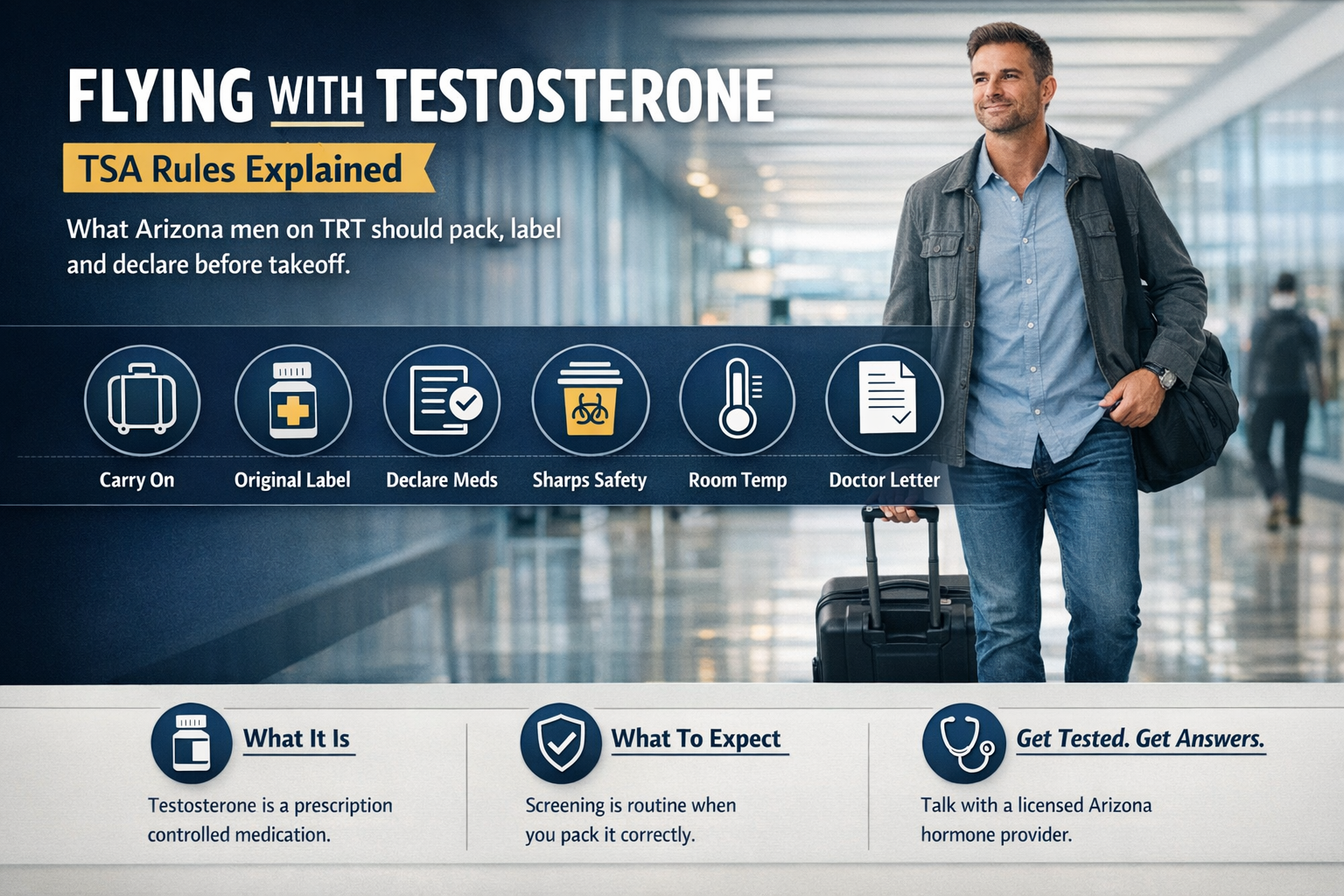
Can You Fly With Testosterone? TSA Rules for Men on TRT
If you're an Arizona man on testosterone replacement therapy who travels for work, chases warm-weather golf, or spends part of the year out of state, sooner or later you'll ask the obvious question: can you fly with testosterone? The short answer is yes. Flying with TRT is routine, legal, and — with a small amount of preparation — genuinely uneventful. Thousands of men move through Phoenix Sky Harbor, Tucson International, and Mesa Gateway every week with a vial and a few syringes in their bag.
What trips men up isn't the security line. It's the details: what to pack, what to label, whether the desert heat in a parked car ruins a vial, and what happens when the trip crosses a border. Here's a practical, Arizona-specific walkthrough.
Is testosterone legal to carry on a plane?
Testosterone is a legal prescription medication in the United States — and it is also a Schedule III controlled substance under the Controlled Substances Act, a status noted directly on the FDA prescribing information for testosterone cypionate. That combination is the entire reason travel questions come up at all. It is not contraband. But it is regulated, which means the burden of showing that your supply is legitimately prescribed sits with you.
In practice that's easy to satisfy. A vial that still carries the pharmacy label — your name, the prescribing clinician, the drug, the strength, the fill date — answers the question before anyone has to ask it. Men who run into friction are almost always the ones carrying unlabeled vials, decanted "travel" containers, or product obtained outside a legitimate prescribing relationship. If you're unsure where your supply sits on that spectrum, it's worth understanding whether it's legal to buy testosterone online in Arizona before you pack it.
What TSA actually allows
For domestic U.S. flights, the working rules are straightforward:
- Medications are allowed in both carry-on and checked bags. Carry-on is strongly preferred — checked luggage gets lost, delayed, and exposed to unpredictable temperatures in cargo holds.
- Syringes and needles are permitted when accompanied by the injectable medication they're used with. Pack them together, in the same pouch, so the relationship is obvious.
- Medically necessary liquids are exempt from the 3.4-ounce limit in reasonable quantities. A 10 mL vial is well inside "reasonable." You should declare medical liquids at the checkpoint.
- A doctor's note is not required for domestic travel. It is, however, cheap insurance — and it becomes genuinely important internationally.
Screening officers see injectable medications constantly. Insulin, biologics, fertility drugs, testosterone — none of it is unusual. Your vial may get a swab test for explosive residue. That's normal and takes seconds.
How to pack TRT for a flight
A clean setup takes about five minutes:
- Keep the original box and pharmacy label. Don't transfer testosterone into an unmarked container. The label is your documentation.
- Use one clear pouch for the vial, syringes, needles, and alcohol swabs. One pouch means one conversation instead of four.
- Bring a travel sharps container or a rigid, puncture-resistant alternative. Used needles cannot go loose into a hotel trash can or your bag. Many hotels and pharmacies will accept a small sharps container for disposal.
- Pack a few extra doses. Delays and cancellations happen. An extra syringe weighs nothing.
- Carry a short letter from your provider listing the medication, dose, and diagnosis. Optional domestically, valuable abroad.
If you're newer to therapy and still building the routine, our step-by-step guide on how to self-inject testosterone at home covers the technique that makes injecting in an unfamiliar hotel room feel like a non-event.
Travel a lot? Get a TRT plan that travels with you.
Arizona-licensed providers • Arizona-based • Telehealth available
Get Started — Free Assessment →Storage, heat, and the Arizona problem
Injectable testosterone is an oil-based solution stored at controlled room temperature — roughly 68°F to 77°F, protected from light, per the FDA label. It does not need refrigeration or an ice pack, which makes it far easier to travel with than insulin.
What it does not tolerate well is a car in a Phoenix parking lot in July, where interior temperatures routinely blow past anything the label contemplates. The same applies to a checked bag sitting on a hot tarmac. This is the single most Arizona-specific reason to keep your vial in your carry-on rather than your luggage or your center console. We go deeper on this in our guide to whether testosterone goes bad in heat and how to store TRT in Arizona.
One practical note: if a vial has been somewhere cold and you see crystals, gentle warming and shaking typically redissolves them. If a vial has been badly overheated, has changed color, or looks cloudy, don't guess — call your clinic.
Do you need to change your injection schedule when you travel?
Usually, no. Testosterone cypionate has a half-life of roughly eight days after intramuscular injection, which is why most protocols are built around weekly or twice-weekly dosing rather than daily timing. Shifting an injection by a few hours, or even a day, to accommodate a flight is not a clinical crisis.
Consistency across weeks and months, though, is what actually drives outcomes — clinical guidance on androgen replacement emphasizes steady, monitored dosing rather than improvised schedules, and professional guidelines have converged on regular follow-up labs to keep levels in range. The risk of travel isn't the one shifted dose. It's the two-week trip where doses get skipped entirely. If you want the reasoning behind your specific cadence, see our breakdown of how often you take TRT injections.
Crossing time zones? Pick the local day of the week you'll inject and stick to it. Don't try to recreate your Phoenix clock in Boston.
International travel: check before you go
This is where flying with testosterone stops being routine. Anabolic agents are restricted or outright prohibited in some countries, and many nations cap the personal supply a traveler may bring — commonly 30 to 90 days' worth. Penalties in a handful of destinations are serious.
Before an international trip:
- Check the destination country's embassy or consulate guidance on controlled medications.
- Carry a signed letter from your prescribing provider with the medication name, dose, and medical indication.
- Keep everything in original labeled packaging, in your carry-on.
- Bring only what the trip requires, plus a small buffer — not your entire supply.
- Never carry someone else's prescription, and never accept a request to carry medication for another traveler.
Refills, lost doses, and staying covered on the road
Two travel failures are common. The first is running out mid-trip. The second is a lost bag with the only vial in it. Both are solved the same way: request refills before you leave, split your supply between two bags if you're carrying more than one, and make sure your clinic can reach you.
Telehealth is a real advantage here. If you're managing therapy through an online TRT program in Arizona, a delayed refill or a question from a hotel room in Denver is a message away rather than a rescheduled office visit. Just keep in mind that prescribing is licensed state by state, so an Arizona clinic manages your Arizona prescription — plan refills around your trip rather than expecting to fill on the road.
Frequently asked questions
Can I bring syringes and needles through TSA?
Yes. Syringes and needles are allowed through security when they accompany the injectable medication they're used with. Pack them in the same clear pouch as your labeled vial, and bring a rigid travel sharps container for used needles. Declare the medication at the checkpoint if you're asked about liquids.
Do I need a doctor's note to fly with testosterone?
Not for domestic U.S. flights — TSA does not require a prescription or a physician letter. But because testosterone is a Schedule III controlled substance, keeping the original pharmacy label on the vial is strongly recommended, and a short provider letter is genuinely worth carrying for any international trip.
Should testosterone go in my carry-on or checked bag?
Carry-on, essentially always. Checked bags get lost or delayed, and cargo holds and hot tarmacs expose your vial to temperatures outside the labeled room-temperature storage range — a real concern flying out of Phoenix in summer. Keeping it on you also means it's available if your trip gets extended.
The bottom line
Flying with testosterone is legal, common, and simple when you pack it properly: original labeled packaging, carry-on, syringes with the vial, a sharps container, and a couple of spare doses. Domestic travel needs almost no extra effort. International travel needs about fifteen minutes of research and a letter from your provider. And in Arizona specifically, the heat — not the checkpoint — is the thing most likely to cost you a vial.
Start TRT with an Arizona clinic that keeps up with your schedule.
Arizona-licensed providers • Arizona-based • Telehealth available
Get Started — Free Assessment →Sources
