
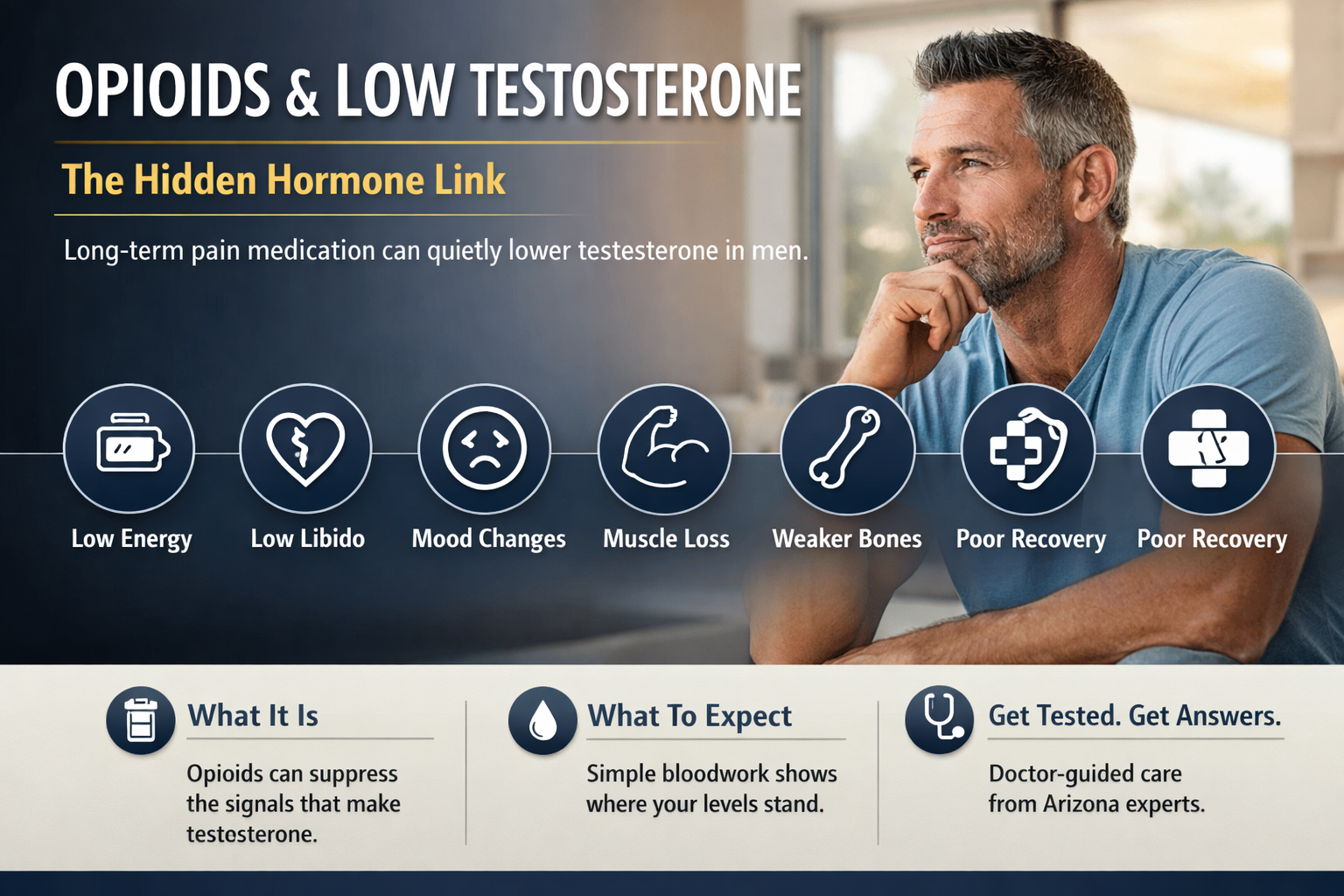
Can Opioids Cause Low Testosterone? What Arizona Men Should Know
If you have been on prescription pain medication for months and feel drained, flat, or uninterested in sex, you may be wondering: can opioids cause low testosterone? The short answer is yes. It is one of the most common medication-related causes of low T in men, and one of the most overlooked. This guide explains how opioids affect your hormones, which symptoms to watch for, how the condition is diagnosed, and what treatment options Arizona men have, including doctor-supervised testosterone therapy available by telehealth across Phoenix, Scottsdale, Mesa, Tucson and the rest of the state.
How opioids lower testosterone
Testosterone production starts in the brain, not the testes. The hypothalamus releases gonadotropin-releasing hormone (GnRH), which tells the pituitary gland to release luteinizing hormone (LH). LH then signals the testes to produce testosterone. This chain is called the hypothalamic-pituitary-gonadal (HPG) axis.
Opioids interfere with the very top of that chain. A 2025 review in the journal Andrology explains that opioids suppress the gonadal axis mainly by inhibiting GnRH. With less GnRH, the pituitary sends a weaker signal, and the testes make less testosterone, even though they are perfectly healthy.
Because the problem originates in the brain rather than the testes, doctors classify this as secondary (central) hypogonadism. If you want to understand why that distinction matters for treatment, see our guide to primary vs. secondary hypogonadism.
What doctors call it: OPIAD
Clinicians often use the term opioid-induced androgen deficiency (OPIAD). Researchers note that it remains underdiagnosed, partly because many men on long-term pain management are never offered a hormone test, and partly because the symptoms overlap with chronic pain itself.
Which opioids and doses matter most?
Almost any opioid taken regularly over time can affect testosterone. That includes common prescriptions such as oxycodone, hydrocodone, morphine, tramadol, fentanyl patches, and the long-acting medications used in opioid treatment programs, such as methadone. Research suggests the risk tends to rise with:
- Daily, long-term use rather than a few days after a surgery or injury
- Higher doses and stronger medications
- Long-acting or extended-release formulas that keep blood levels elevated around the clock
- Older age, since natural testosterone already declines with time
How common is it? Estimates vary widely depending on the medication, dose and how "low" is defined, but studies of men taking opioids for non-cancer pain consistently find high rates of testosterone deficiency. A short course after a dental procedure or a broken bone is unlikely to cause lasting problems. The concern is sustained, everyday use.
Symptoms of opioid-induced low testosterone
The symptoms look much like low T from any other cause, which is why they are easy to blame on pain, stress or age. Common signs include:
- Low sex drive and erectile difficulties (our article on when low libido in men is a hormone problem covers this in depth)
- Persistent fatigue and low energy
- Depressed mood, irritability or loss of motivation
- Loss of muscle mass and strength, and increased body fat
- Hot flashes or night sweats
- Reduced body and facial hair
- Mild anemia
- Thinning bones (osteopenia or osteoporosis)
The bone effect deserves special attention. Men on chronic pain medication may already be at higher risk of falls, and low testosterone adds to fracture risk. Learn more in our guide to low testosterone and bone density in men.
The pain connection
There is an interesting twist. Low testosterone may make pain feel worse. Early evidence suggests testosterone may have pain-reducing (anti-nociceptive) properties, which raises the possibility of a cycle: opioids lower testosterone, lower testosterone may heighten pain sensitivity, and higher pain can lead to higher opioid doses. Research here is still developing, so treat this as a promising area rather than a settled fact.
On Long-Term Pain Medication? Check Your Testosterone.
Doctor-supervised • Arizona-based • Telehealth available
Get Started — Free Assessment →How opioid-related low T is diagnosed
Diagnosis follows the same careful standard used for any man with suspected low testosterone. The Endocrine Society's clinical practice guideline recommends diagnosing hypogonadism only when a man has consistent symptoms and unequivocally low testosterone on repeat morning blood tests. A typical workup includes:
- Two early-morning total testosterone tests on separate days
- Free testosterone and SHBG, especially if total testosterone is borderline
- LH and FSH to confirm the pattern. With opioid-related low T, these are usually low or "inappropriately normal" despite low testosterone
- Prolactin, CBC, PSA and a metabolic panel as a baseline and to rule out other causes
A full walkthrough of the process is in our article on how low testosterone is diagnosed. In the Phoenix metro and Tucson, these labs can be drawn at widely available national lab locations, often the same week.
Treatment options for opioid-induced low testosterone
The right plan depends on your pain needs, your goals (including fertility) and your lab results. Any changes to opioid therapy must be made with your prescribing physician, never on your own, because stopping suddenly can cause withdrawal and uncontrolled pain.
1. Review the pain medication plan
Reviews of OPIAD management note that reducing or tapering opioids, when medically appropriate, can allow testosterone to recover because the effect is largely reversible. Some men work with their pain specialist on non-opioid options, physical therapy, or a supervised dose reduction. For others, ongoing opioid therapy is necessary, and hormone treatment becomes the main tool.
2. Testosterone replacement therapy (TRT)
For men who remain on opioids and have confirmed low T with symptoms, TRT is a reasonable, evidence-based option. Limited clinical trial data show testosterone therapy can improve libido, body composition and aspects of quality of life in men with opioid-induced deficiency. TRT still requires routine monitoring of testosterone levels, PSA and red blood cell counts; our guide to TRT and hematocrit monitoring explains why that last one matters.
3. Fertility-preserving alternatives
TRT can lower sperm production, so men who want children may be better suited to therapies that stimulate the body's own production. Because opioid-related low T originates in the brain, medications that boost LH and FSH may be an option for some men. Learn how one of these works in what enclomiphene is and how it works. A provider can help decide whether this approach fits your situation.
Who should get tested?
Consider asking for a testosterone check if you:
- Have taken opioid medication daily for more than a few months
- Are in a methadone or buprenorphine treatment program and feel persistently fatigued or low
- Have noticed a drop in sex drive, strength or mood since starting pain medication
- Have had a fracture from a minor fall
Being on opioids is nothing to be embarrassed about, and a hormone evaluation is simply part of treating the whole person. A good clinic will coordinate with your pain doctor rather than work around them.
Frequently asked questions
Does testosterone come back after stopping opioids?
In many men, yes. Because opioids suppress hormone signals from the brain rather than damaging the testes, testosterone often recovers after opioids are tapered or stopped. Recovery time varies, and any taper should be supervised by your prescribing doctor.
Can I take TRT while on opioids?
Often, yes. Men who need ongoing opioid therapy and have confirmed low testosterone with symptoms may be candidates for TRT. A licensed provider will review your labs, medications and health history, and monitor you regularly once treatment starts.
Does tramadol or methadone lower testosterone?
Both can. Long-term use of most opioids, including tramadol and long-acting medications like methadone, has been linked to lower testosterone. The risk is generally greater with daily use, higher doses and longer duration.
The bottom line: if you rely on opioid pain medication and feel worn down in ways that pain alone does not explain, low testosterone may be part of the picture. It is common, testable and treatable, and addressing it may improve your energy, mood, bones and quality of life.
Find Out If Low T Is Holding You Back
Doctor-supervised • Arizona-based • Telehealth available
Get Started — Free Assessment →Sources
- Opioid-induced androgen deficiency in men: Prevalence, pathophysiology, and efficacy of testosterone therapy (Andrology, 2025) — PubMed
- Testosterone deficiency in non-cancer opioid-treated patients — PubMed Central (NIH)
- Testosterone Therapy in Men With Hypogonadism: An Endocrine Society Clinical Practice Guideline — PubMed
- Opioid-Induced Androgen Deficiency (OPIAD): Diagnosis, Management, and Literature Review — PubMed
