
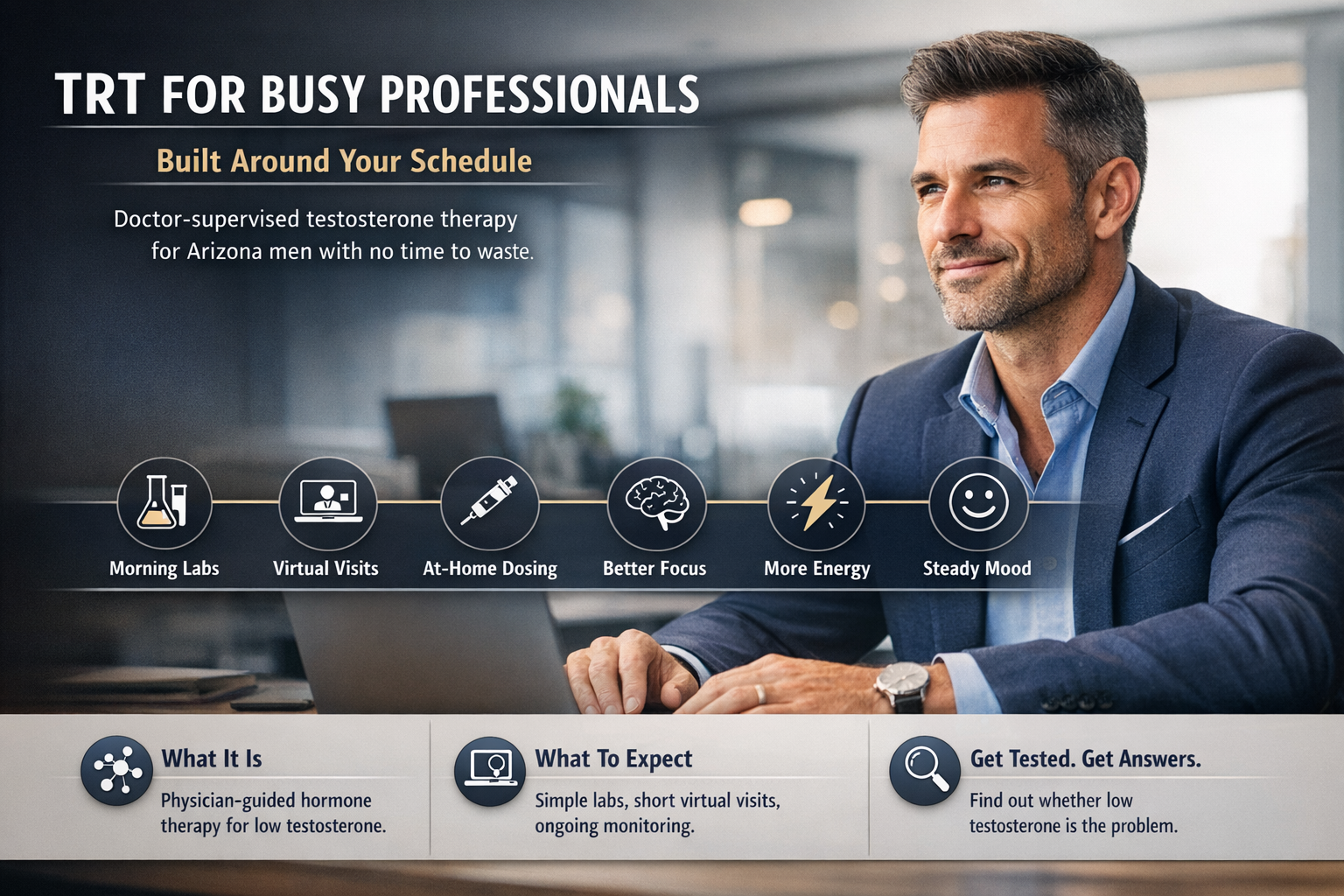
TRT for Busy Professionals: How Arizona Men Fit It In
If you are an Arizona professional running on five hours of sleep, back-to-back meetings and a gym membership you barely use, the question is rarely whether you want to feel better. It is whether TRT for busy professionals is actually practical — or one more appointment you will end up cancelling. The honest answer: testosterone replacement therapy is one of the lower-maintenance chronic treatments in men's health once you are past the diagnostic phase. The heavy lifting is front-loaded into the first month, and most of it happens on your schedule, not a clinic's.
Why demanding careers and low testosterone overlap so often
The lifestyle that comes with a high-pressure job is, unfortunately, close to a recipe for suppressed hormone production. Chronic short sleep, elevated stress, weight gain around the midsection, heavy travel and inconsistent training all pull in the same direction. A systematic review and meta-analysis found that total sleep deprivation reduces serum testosterone in healthy men, and epidemiological work has repeatedly tied lower sleep duration to lower daytime testosterone. If you have been sleeping badly for years, that is not a neutral input.
Weight is the other big one. Excess body fat — particularly visceral fat — increases the conversion of testosterone to estradiol and is recognized as a contributor to hypogonadism at any age. Untreated obstructive sleep apnea, common in men who snore and carry extra weight, compounds it further. None of this means every stressed executive has low testosterone. It does mean the men least likely to make time for a blood test are often the ones most likely to have something worth finding. If you have been wondering whether your sleep quality is part of the picture, our breakdown of the link between low testosterone and poor sleep is a useful place to start.
The symptoms that show up at work first
Men in their late 30s through 50s rarely walk in describing textbook hypogonadism. They describe performance problems. The most common early complaints we hear from Phoenix, Scottsdale and Chandler professionals:
- Afternoon collapse. You are functional until 2 p.m., then you are running on caffeine and willpower.
- Slower thinking. Word-finding pauses, rereading the same email, a sense that recall is not what it was. This overlaps heavily with brain fog and its connection to low testosterone.
- Flat motivation. Not depression exactly — more an absence of drive to start things you used to attack.
- Shorter fuse. Irritability with staff, family, traffic on the 101.
- Training that stops paying off. Same effort in the gym, less muscle, more midsection.
The Cleveland Clinic lists fatigue, reduced muscle mass, low libido and depressed mood among the hallmark symptoms of low testosterone. The catch is that every one of those is also explainable by "I work too much," which is exactly why so many men go a decade without ever testing.
What TRT actually asks of your calendar
Here is the realistic time cost, step by step.
1. Baseline labs — about 20 minutes
Testosterone must be drawn in the early morning, and diagnosis is not made on a single number. The American Urological Association recommends two separate early-morning total testosterone measurements below 300 ng/dL, interpreted alongside symptoms, before diagnosing testosterone deficiency. Practically, that means two short stops at a lab before work. Arizona has draw sites in nearly every commercial corridor — Phoenix, Tempe, Mesa, Gilbert, Scottsdale, Tucson — so this is usually a detour, not a day off. Our step-by-step guide to getting your testosterone tested in Arizona covers what to ask for and how to prepare.
2. The consultation — 20 to 30 minutes, from wherever you are
This is the visit that historically killed the process: a half-day off work to sit in a waiting room. It no longer has to be. Arizona permits established telehealth care for this category of treatment, so the intake visit, results review and treatment discussion can happen from your office, your car between meetings, or a hotel room in another state. If you want the mechanics, we walk through how telehealth testosterone therapy works in Arizona in detail.
3. Treatment itself — roughly five minutes a week
Most men on injectable testosterone cypionate self-administer at home on a weekly or twice-weekly schedule. Once you are past the first couple of attempts, the whole process — draw, swab, inject, dispose — takes a few minutes. Medication is shipped to you. There is no pharmacy line, no recurring appointment. Men who prefer creams or gels trade the needle for a daily application and a caution about skin-to-skin transfer with partners and children. If you are weighing frequency, see how often TRT injections are typically taken.
4. Monitoring — a few morning lab stops a year
This is the part you cannot skip, and it is the single biggest difference between supervised care and buying testosterone off the internet. Expect follow-up bloodwork at roughly the 6–8 week mark, again around six months, then periodically. Your provider is tracking total and free testosterone, hematocrit, estradiol and PSA, among others, and adjusting the dose accordingly. Skipping monitoring is how avoidable problems — thickened blood, unmanaged estrogen, missed prostate signals — turn into real ones.
No time for a clinic waiting room? Start online.
Arizona-licensed providers • Arizona-based • Telehealth available
Get Started — Free Assessment →A realistic first-90-days time budget
Added up, the first three months of TRT for a working professional in Arizona typically look like this: two early-morning lab visits, one telehealth consult, one follow-up telehealth check-in, one repeat lab draw, and about five minutes a week at home. That is somewhere in the range of three to four hours total across an entire quarter — less than a single afternoon.
The tradeoff is that the results are not instant. Libido and mood often shift within the first three to six weeks. Energy and mental clarity tend to follow. Body composition changes take months and only materialize if training and nutrition come along for the ride. Men expecting a switch to flip in week two are the ones most likely to quit before the therapy has had a fair chance.
Travel, time zones and staying consistent
Frequent travel is the most common reason men worry TRT will not work for them. In practice it is manageable with a few habits:
- Pick a fixed injection day and tie it to something that does not move — Sunday evening, for example. Consistency of interval matters more than time of day.
- Carry medication in your original labeled packaging with the prescription documentation for air travel, in your carry-on rather than checked baggage.
- Schedule lab draws around your travel calendar, not the other way around; a week's flexibility is usually fine.
- Do not double up after a missed dose. Contact your provider and resume the normal schedule.
What TRT will not do for a busy professional
Being straight about this matters. Testosterone therapy is not a productivity drug and it is not a substitute for sleep. If you are chronically sleeping five hours, drinking most nights and carrying 40 excess pounds, TRT alone will underdeliver — and in some cases the underlying cause, like untreated sleep apnea, needs addressing first. It is also a prescription therapy with real considerations: hematocrit elevation, fertility suppression, acne and possible worsening of sleep apnea are all documented and all monitored for. Men who want children in the near term should raise fertility with their provider before starting, because standard TRT suppresses sperm production.
Used properly, though, it treats a specific, measurable, clinically diagnosed problem — and if that problem is why your last three years have felt like wading through wet sand, finding out takes one morning.
Frequently asked questions
How much time does TRT actually take each week?
After the initial workup, most men on weekly injectable testosterone spend about five minutes a week on treatment at home, plus follow-up bloodwork a few times a year. The bulk of the time commitment is concentrated in the first month, when baseline labs and the initial consultation happen.
Can I do TRT without taking time off work in Arizona?
In most cases, yes. Lab draws are early-morning and take about 20 minutes at a local Arizona draw site, and consultations and follow-ups can be handled by telehealth from your office or while traveling. The main scheduling constraint is that testosterone must be measured in the morning.
Is my fatigue from low testosterone or just from overwork?
It can be either, and often both. Overwork, chronic short sleep and weight gain can all suppress testosterone, and their symptoms overlap. The only way to separate them is bloodwork — two early-morning total testosterone measurements interpreted alongside your symptoms by a licensed provider.
Find out in one morning whether low T is the problem.
Arizona-licensed providers • Arizona-based • Telehealth available
Get Started — Free Assessment →Sources
- Evaluation and Management of Testosterone Deficiency: Guideline — American Urological Association
- Effect of partial and total sleep deprivation on serum testosterone in healthy males: a systematic review and meta-analysis — PubMed
- Low Testosterone (Male Hypogonadism): Symptoms and Treatment — Cleveland Clinic
- Male Hypogonadism: Symptoms and Causes — Mayo Clinic
