
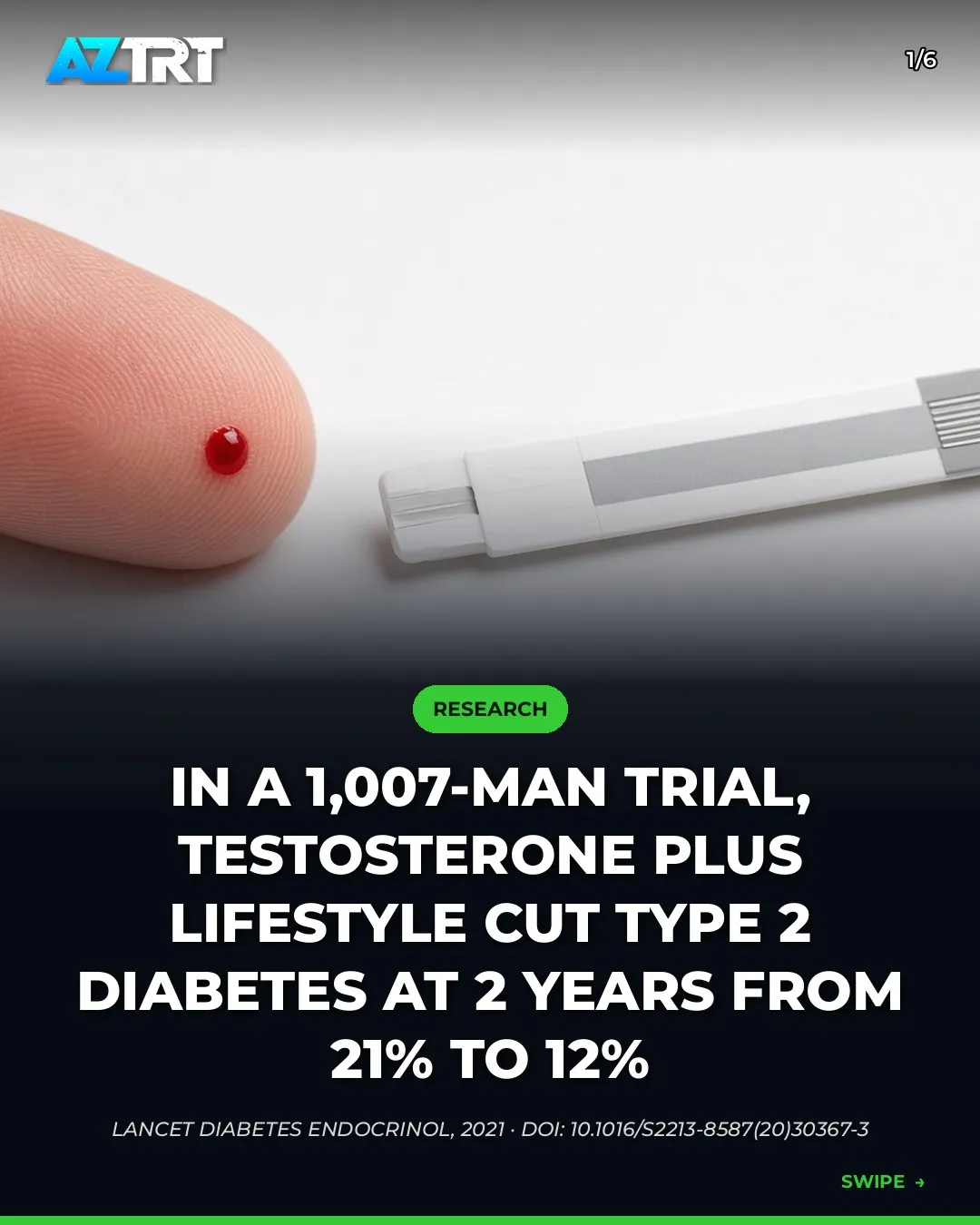
T4DM Trial: Testosterone and Type 2 Diabetes Risk in Men on a Lifestyle Program
Added to a lifestyle program, testosterone cut the share of men with type 2 diabetes at 2 years by about 41% vs placebo.
This article walks through the Lancet Diabetes Endocrinol (2021)30367-3) paper in plain English: what was studied, what changed, what the limits are, and what it does not prove. Full citation and DOI link30367-3) are at the end, with a PubMed record.
What the study found
T4DM was a two-year, randomized, double-blind, placebo-controlled phase 3b trial at six Australian centers. It enrolled 1,007 men aged 50 to 74 with a waist of at least 95 cm, testosterone at or below 14 nmol/L, and impaired glucose tolerance or newly diagnosed type 2 diabetes. All men joined a lifestyle program and received testosterone undecanoate injections or placebo.
At two years, 12% of the testosterone group met the glucose threshold for type 2 diabetes vs 21% of the placebo group (relative risk 0.59). Hematocrit rose above 54% in 22% of men on testosterone, and the larger TRAVERSE substudy later found no significant diabetes prevention, so the evidence is mixed.
Key finding (from the study record): Type 2 diabetes at 2 years: 12% testosterone vs 21% placebo (RR 0.59, 95% CI 0.43-0.80; P=.0007); 2-h glucose -1.70 vs -0.95 mmol/L.
How the study was done
- Design: Randomised double-blind placebo-controlled 2-year phase 3b RCT (T4DM)
- Who was studied: 1,007 men 50-74, waist >=95 cm, T <=14 nmol/L, prediabetes or new T2D, all in a lifestyle program
- Journal / year: Lancet Diabetes Endocrinol (2021)
- First author: Wittert G et al.
From the abstract: BACKGROUND: Men who are overweight or obese frequently have low serum testosterone concentrations, which are associated with increased risk of type 2 diabetes. We aimed to determine whether testosterone treatment prevents progression to or reverses early type 2 diabetes, beyond the effects of a community-based lifestyle programme. METHODS: T4DM was a randomised, double-blind, placebo-controlled, 2-year, phase 3b trial done at six Australian tertiary care centres.
What it means — and what it does not
Useful takeaway: Added to a lifestyle program, testosterone cut the share of men with type 2 diabetes at 2 years by about 41% vs placebo.
Limits and caveats: Hematocrit >54% in 22% on testosterone vs 1% placebo. Men were not pathologically hypogonadal. Injectable testosterone undecanoate. The later TRAVERSE substudy found NO significant diabetes prevention - must mention.
This evidence can inform a conversation with a licensed provider. It is not a guarantee of similar results for you, and it is not a recommendation to start, stop, or change any medication on your own.
Related research we cite
- Cardiovascular Safety of Testosterone-Replacement Therapy — N Engl J Med (2023); also on PubMed. Takeaway: In a 5,246-man randomized trial, men with low T on testosterone had no more heart attacks, strokes or cardiac deaths than men on placebo.
How this connects to care
AZTRT serves men in Arizona with telehealth evaluation, labs, and provider-guided plans when appropriate. Plans start at $149/month or $357/quarter and include initial labs only. Medication ships three months at a time when prescribed.
Relevant pages on this site:
- Tirzepatide (weight loss) (branded trial drugs are not the same as compounded products, which are not FDA-approved)
- Tirzepatide page (branded trial drugs are not the same as compounded products, which are not FDA-approved)
- TRT program
FAQ
What did this study actually find?
Added to a lifestyle program, testosterone cut the share of men with type 2 diabetes at 2 years by about 41% vs placebo. The design was: Randomised double-blind placebo-controlled 2-year phase 3b RCT (T4DM). Population: 1,007 men 50-74, waist >=95 cm, T <=14 nmol/L, prediabetes or new T2D, all in a lifestyle program.
Does this mean I should start treatment?
No. Research informs care; it does not prescribe it. A licensed provider reviews your symptoms, labs, and history before any decision. Results vary.
What are the main limits of this evidence?
Hematocrit >54% in 22% on testosterone vs 1% placebo. Men were not pathologically hypogonadal. Injectable testosterone undecanoate. The later TRAVERSE substudy found NO significant diabetes prevention - must mention.
Keep reading
- TTrials Anemia Study: How Testosterone Raised Hemoglobin in Older Men
- Fitness vs Smoking for Longevity: Lessons From 122,007 Treadmill Tests
- Benefits of Testosterone Replacement Therapy for Men
- Best Foods for Testosterone: Nutrition for Hormone Health
Reference
Wittert G et al. Testosterone treatment to prevent or revert type 2 diabetes in men enrolled in a lifestyle programme (T4DM): a randomised, double-blind, placebo-controlled, 2-year, phase 3b trial. Lancet Diabetes Endocrinol. 2021. https://doi.org/10.1016/S2213-8587(20)30367-330367-3) · PubMed 33338415.
Next step
Book a free consult with an Arizona-licensed provider. Bring your questions — including anything this study raised for you.
Plans start at $149/month or $357/quarter and include initial labs only. Medication ships three months at a time when prescribed.
Talk to a licensed provider. Results vary. Not medical advice.
Talk to a licensed provider. Results vary. Not medical advice.
