
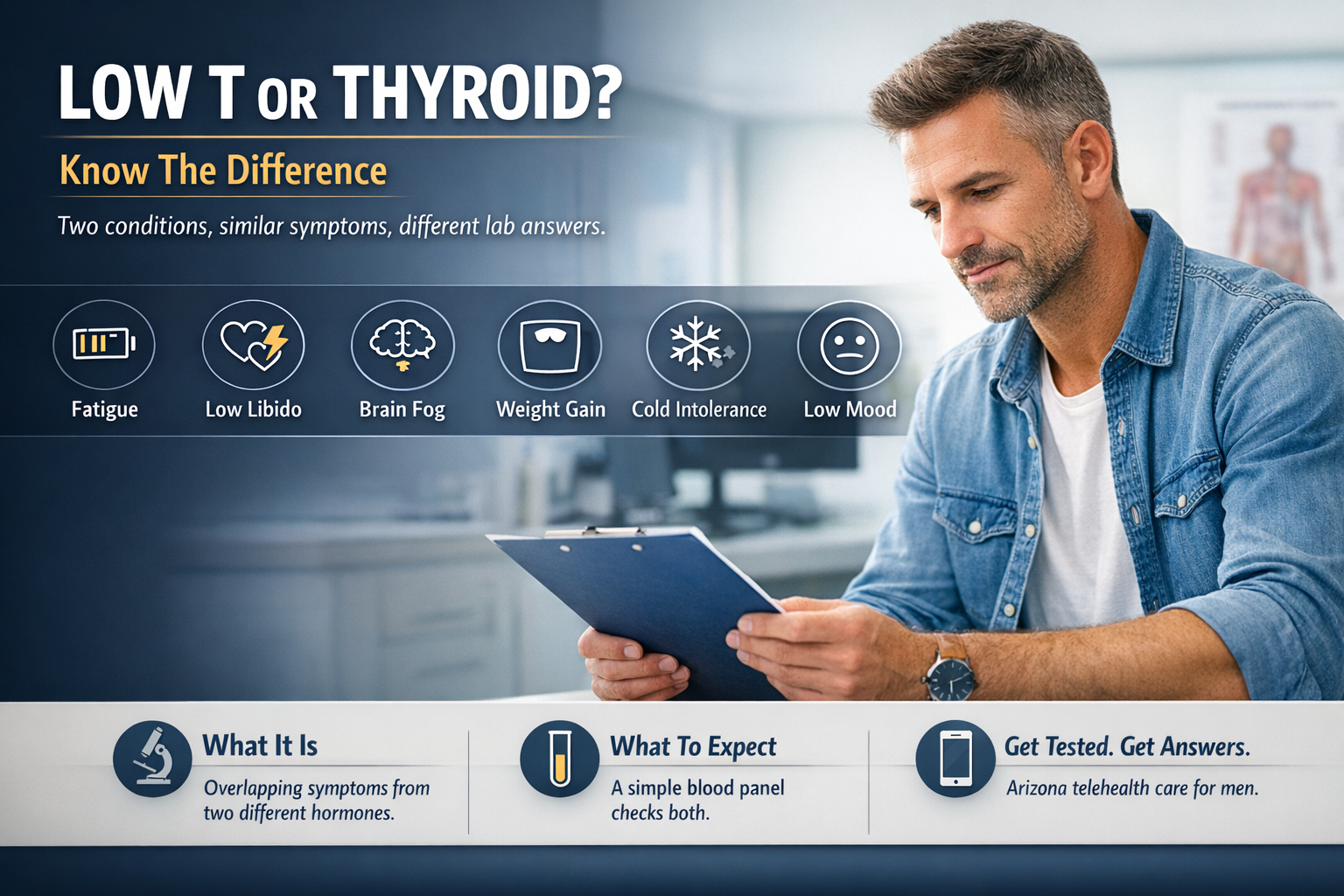
Low Testosterone or Thyroid Problem? How to Tell Them Apart
If you have been dragging for months, gaining weight around the middle and losing interest in the gym and the bedroom, you have probably wondered whether it is low testosterone or a thyroid problem. It is one of the most common questions we hear from men across Phoenix, Scottsdale and Mesa — and it is a smart question, because these two conditions overlap almost perfectly on symptoms and separate cleanly only on labs. Guessing wrong costs you months. Testing both at once costs you one blood draw.
Why low testosterone and thyroid problems get confused
Testosterone and thyroid hormone do very different jobs, but they influence a lot of the same systems: energy production, body composition, mood, cognition and sexual function. When either one drops, the downstream complaints look remarkably similar from the outside.
The confusion is common enough that endocrinology guidance treats it as a standard part of the workup. Published recommendations on diagnosing hypogonadism in men note that thyroid dysfunction should be excluded because its symptoms can mimic testosterone deficiency. In other words: a good clinician does not choose between the two up front — they check both.
There is also a practical reason men land here. The symptoms build slowly. Most guys do not wake up one day feeling different; they look back over two or three years and realize the version of themselves who had energy is gone. That slow slide is typical of both conditions, which is why so many men reading about chronic fatigue and low testosterone also end up wondering about their thyroid.
The symptoms that overlap
These complaints show up with either condition and are essentially useless for telling them apart on their own:
- Persistent fatigue that sleep does not fix
- Weight gain, especially around the abdomen
- Low mood, flat affect or mild depression
- Brain fog, poor concentration and word-finding trouble
- Reduced libido and erectile difficulties
- Muscle weakness, aches or slower recovery from training
- Hair thinning and dry skin
Sexual symptoms in particular cut both ways. Hypothyroidism in men can reduce libido, contribute to erectile dysfunction and lower sperm count — the exact profile most men associate with low T. If you have been quietly assuming your bedroom symptoms prove it is testosterone, that assumption is not safe.
Clues that lean thyroid
Certain symptoms are more characteristic of an underactive thyroid, though none of them are proof:
- Cold intolerance — feeling cold when nobody else does, even in an Arizona summer office
- Constipation and sluggish digestion
- A slow resting heart rate
- Puffiness around the face and eyes
- Coarse, brittle hair or noticeable dry, flaky skin
- Hoarseness or a deepening, gravelly voice change
- Neck swelling or a visible goiter
Autoimmune thyroiditis is the most common driver in the U.S. Hashimoto's disease damages the thyroid gland gradually and often produces no symptoms for years before fatigue and weight gain appear.
Clues that lean low testosterone
- Loss of morning erections and reduced spontaneous arousal
- Measurable loss of muscle mass or strength despite consistent training
- Reduced body and facial hair growth
- Testicular shrinkage or reduced ejaculate volume
- Irritability and a specific loss of drive — competitiveness, ambition, motivation
- Declining bone density on a DEXA scan
Even here, the overlap is real. Cognitive complaints are a good example: men researching brain fog and low testosterone are often describing something a thyroid panel would explain just as well. The honest answer is that symptom lists narrow the odds; they do not settle the question.
Stop guessing which hormone it is
Arizona-licensed providers • Arizona-based • Telehealth available
Get Started — Free Assessment →The labs that actually tell them apart
This is where the question gets answered. A comprehensive men's hormone panel should include both sets of markers, drawn on the same morning.
Thyroid markers
- TSH — thyroid stimulating hormone. This is the screening test. A high TSH means the pituitary is shouting at an underperforming thyroid, which points to hypothyroidism.
- Free T4 — the circulating hormone the thyroid produces. Low free T4 alongside high TSH confirms overt hypothyroidism.
- Free T3 and thyroid antibodies (TPO) — added when the picture is unclear or autoimmune disease is suspected.
Testosterone markers
- Total testosterone — drawn fasting, in the morning, and confirmed on a second separate day. Major urology guidance requires two low morning readings before diagnosing testosterone deficiency, not a single number.
- Free testosterone and SHBG — because a normal-looking total can still leave you with too little usable hormone.
- LH and FSH — these separate a testicular problem from a pituitary or hypothalamic one.
- Estradiol and prolactin — to round out the hormonal picture.
If you want the full walkthrough of what a proper diagnostic sequence looks like, we cover how low testosterone is diagnosed step by step, and the complete list of bloodwork you need before starting TRT in a separate guide.
Can you have both at once?
Yes — and it is not rare. Chronic illness and endocrine dysfunction tend to travel together, and thyroid disease appears on the standard list of conditions associated with lower testosterone in men. Untreated hypothyroidism can also suppress testosterone production indirectly, which means some men see their testosterone improve once thyroid hormone is replaced and their metabolism normalizes.
That is a genuinely important point: in a subset of men, correcting the thyroid is enough. They never needed testosterone therapy at all. In others, both need treating. You cannot know which group you are in without both sets of numbers.
What goes wrong when you treat the wrong one
Two failure modes are common, and both waste time.
Treating low T while a thyroid problem goes unchecked. The man starts testosterone, feels some improvement, but never gets back to normal. Energy stays flat, weight will not move, and everyone blames the dose. The real answer was an untreated TSH of 9.
Blaming the thyroid when testosterone is the problem. Levothyroxine gets started for a borderline TSH, nothing changes, and the man concludes hormones are a dead end — while a total testosterone of 240 ng/dL sits unaddressed in his chart.
Neither situation reflects a bad drug. Both reflect an incomplete workup. This is also why a clinic that runs a narrow, testosterone-only panel is a poor fit for a first-time evaluation: it can only find what it looks for.
How Arizona men get both checked
The logistics are straightforward. In Arizona, hormone panels are drawn at standard patient service centers — Quest and Labcorp locations across Phoenix, Scottsdale, Mesa, Tempe, Chandler, Gilbert and Tucson — and results typically return within a few business days.
A few practical notes specific to getting an accurate result here:
- Go early. Testosterone peaks in the morning; guidelines assume a morning draw. Aim for before 10 a.m.
- Fast. Food can transiently lower testosterone readings.
- Hydrate. In Arizona heat, mild dehydration is common and can skew several blood markers. Drink water the night before and that morning.
- Report your supplements. High-dose biotin, common in hair and nail products, interferes with many thyroid immunoassays and can produce falsely abnormal TSH results.
- Bring your history. A family history of thyroid disease matters, as does any past head injury, opioid use or steroid use.
Telehealth handles the rest. An Arizona-licensed provider can order both panels, review the results with you by video and build a plan — whether that means thyroid replacement, testosterone therapy, both, or neither. Our guide to getting your testosterone tested in Arizona walks through the full process.
Get both hormones checked in one draw
Arizona-licensed providers • Arizona-based • Telehealth available
Get Started — Free Assessment →Frequently asked questions
Can a thyroid problem cause low testosterone?
It can contribute. Untreated hypothyroidism slows metabolism and can indirectly suppress the hormonal signaling that drives testosterone production. Thyroid dysfunction is listed among the chronic conditions associated with lower testosterone in men. In some cases, treating the thyroid raises testosterone enough that no further hormone therapy is needed — which is exactly why both should be tested before any treatment starts.
What blood test tells the difference between low T and thyroid problems?
There is no single test — you need two panels drawn at the same visit. TSH and free T4 assess thyroid function, while morning total testosterone, free testosterone, SHBG, LH and FSH assess testosterone status. Testosterone should be confirmed with a second morning draw on a different day before a diagnosis is made.
Should I start TRT if my thyroid has not been checked?
No. Starting testosterone therapy without a thyroid panel risks treating the wrong condition and leaves you unable to tell whether an incomplete response is a dosing issue or an untreated thyroid problem. A reputable clinic will run thyroid markers as part of the baseline workup before writing any prescription.
Sources
- Hypothyroidism (Underactive Thyroid): Symptoms & Treatment — Cleveland Clinic
- Hashimoto's Disease: Symptoms & Causes — Mayo Clinic
- Recommendations on the Diagnosis, Treatment and Monitoring of Hypogonadism in Men — PMC, National Library of Medicine
- Testosterone Deficiency Guideline — American Urological Association
