
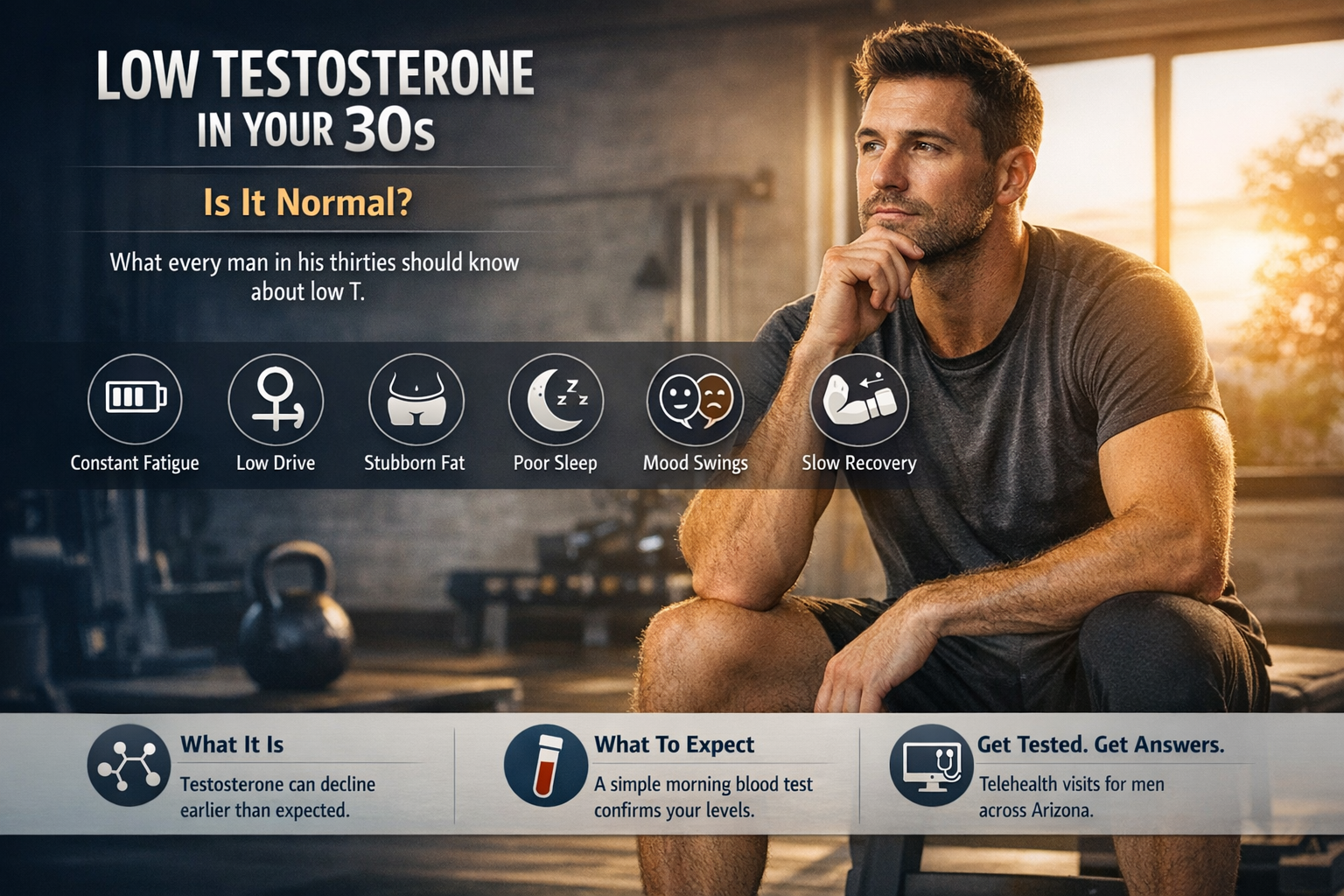
Low Testosterone in Your 30s: Is It Normal? What to Know
Low testosterone in your 30s catches a lot of men off guard. You expect to hear about low T at 50 or 60 — not at 32, when you're building a career, maybe raising kids, and supposedly in your physical prime. Yet more men in their 30s across Phoenix, Scottsdale, and the rest of Arizona are getting tested and discovering their testosterone is well below where it should be. So is low testosterone in your 30s normal? Here's what the evidence says, why it happens, and what you can do about it.
Is low testosterone in your 30s normal?
Short answer: it happens more than most men think, but it always deserves a proper workup. Testosterone does decline with age — levels typically fall about 1% per year starting in your late 30s, according to the Cleveland Clinic. But that slow drift is very different from having clearly low levels at 31 or 35. When a man in his 30s has both low lab values and real symptoms, age alone is rarely the explanation — and that's actually good news, because it means there's usually a cause you can identify and address.
It's also worth knowing that research suggests roughly 20% of men under 40 have testosterone below the typical reference range. That doesn't mean all of them need treatment — but it does mean that if you're in your 30s and feel off, you're far from alone, and testing is a reasonable next step rather than an overreaction.
Signs of low T in your 30s
Low testosterone in younger men tends to show up as a cluster of symptoms rather than one dramatic change. The most common signs of low testosterone in men include:
- Constant fatigue — tired by mid-afternoon no matter how much you sleep.
- Low sex drive — a noticeable drop in libido or weaker erections.
- Stubborn body fat — especially around the midsection, despite eating well.
- Trouble building or keeping muscle — workouts that used to produce results no longer do.
- Mood changes — irritability, low motivation, flat mood, or a shorter fuse than usual.
- Poor sleep and slow recovery — restless nights and lingering soreness after training.
Any one of these can have other causes. But when several show up together in your 30s and persist for months, your hormones belong on the list of suspects.
Think Your Levels Might Be Low? Find Out This Week.
Doctor-supervised • Arizona-based • Telehealth available
Get Started — Free Assessment →What causes low testosterone in your 30s?
In your 30s, low T is usually driven by identifiable factors rather than aging itself. Clinical reviews show that acquired conditions such as obesity, diabetes, and anabolic steroid use are strongly associated with low testosterone in younger men. The most common culprits include:
- Excess body fat. Fat tissue converts testosterone into estrogen, and carrying extra weight — common with desk jobs and long Phoenix commutes — steadily suppresses levels.
- Poor sleep. Most testosterone is produced during deep sleep. Chronic short sleep, shift work, or untreated sleep apnea can measurably lower levels.
- Chronic stress. Elevated cortisol works against testosterone production — a real issue for men grinding through demanding careers.
- Past anabolic steroid or "prohormone" use. Even years later, prior use can leave natural production suppressed.
- Medical conditions. Type 2 diabetes, thyroid problems, pituitary issues, varicocele, or prior testicular injury or infection.
- Medications. Opioids, some antidepressants, and long-term corticosteroids can all lower testosterone.
This is why a proper evaluation matters: treating the underlying cause is sometimes enough to restore levels in younger men, and it changes which treatment path makes sense.
What's a "low" number for a man in his 30s?
The American Urological Association defines low testosterone as a total level below 300 ng/dL, confirmed on two separate early-morning blood draws, interpreted alongside symptoms. But that cutoff was largely derived from studies of older men. Newer research has examined what a normal testosterone level actually looks like for men aged 20–44, and many clinicians argue that a man in his 30s sitting at 320 ng/dL with clear symptoms shouldn't automatically be told he's "fine."
Context matters: a healthy man in his early 30s typically runs meaningfully higher than a man in his 60s. If you want the full breakdown of healthy ranges by decade, see our guide to normal testosterone levels by age. And because total testosterone doesn't tell the whole story, free testosterone and SHBG often need to be measured too.
How to find out for sure in Arizona
Guesswork is useless here — symptoms overlap with a dozen other conditions, so the only way to know is bloodwork. The process is simple: an early-morning blood draw (testosterone peaks before ~10 a.m.), repeated once to confirm, plus a broader panel to rule out other causes. We've covered exactly how low testosterone is diagnosed and what bloodwork you need before starting TRT in detail.
For Arizona men, this is easier than it used to be. With a telehealth clinic like AZTRT, you complete a quick online visit with a licensed provider, then stop by a local lab near you in Phoenix, Scottsdale, Mesa, Tempe, Gilbert, or Tucson — usually a 15-minute errand before work. Results are reviewed with you virtually, so there's no waiting room and no awkward conversation with a doctor who brushes off your symptoms because "you're too young for low T."
Treatment in your 30s: why age changes the conversation
If testing confirms low testosterone, being in your 30s shapes the plan in two important ways.
First, lifestyle and underlying causes get real attention. In younger men, weight loss, sleep fixes, stress management, and treating conditions like sleep apnea can meaningfully raise levels — sometimes enough on their own.
Second, fertility matters. Traditional TRT suppresses sperm production, which is a major consideration if you're planning to have kids. That's why younger men are often better candidates for fertility-preserving approaches like enclomiphene, or TRT protocols paired with medications that maintain natural function. A good clinic will walk through these trade-offs before writing any prescription — being told about them after starting is a red flag.
Left unaddressed, low testosterone doesn't just cost you energy today; it's linked with declining muscle mass, bone density, and metabolic health over time. Men who catch it in their 30s tend to have more options than those who wait — as we've seen with the men we've written about facing low testosterone in their 40s, symptoms rarely improve by ignoring them.
Get Your Testosterone Tested Without Leaving Home.
Doctor-supervised • Arizona-based • Telehealth available
Get Started — Free Assessment →Frequently asked questions
Is it normal to have low testosterone at 35?
It's common but not something to dismiss. Testosterone declines slowly starting in the mid-to-late 30s, but clearly low levels at 35 — especially with symptoms like fatigue, low libido, and stubborn weight gain — usually have an identifiable cause such as excess body fat, poor sleep, chronic stress, or a medical condition. A morning blood test is the only way to know.
What testosterone level is low for a man in his 30s?
Most guidelines define low testosterone as a total level under 300 ng/dL on two separate morning blood draws, combined with symptoms. However, healthy men in their 30s typically run well above that floor, so a symptomatic man in the low 300s may still warrant a full evaluation including free testosterone and SHBG.
Can low testosterone in your 30s be reversed naturally?
Sometimes. In younger men, losing excess body fat, fixing sleep (including treating sleep apnea), managing stress, and stopping medications or substances that suppress testosterone can raise levels meaningfully. When natural production is genuinely impaired, medical options like enclomiphene or TRT are considered — with fertility preserved as a priority for men who want kids.
Sources
- Evaluation and Management of Testosterone Deficiency: AUA Guideline — The Journal of Urology (American Urological Association)
- What Is a Normal Testosterone Level for Young Men? Rethinking the 300 ng/dL Cutoff in Men 20–44 Years Old — The Journal of Urology
- Low Testosterone in Adolescents & Young Adults — PMC / National Library of Medicine
- Low Testosterone (Male Hypogonadism): Symptoms & Treatment — Cleveland Clinic
