
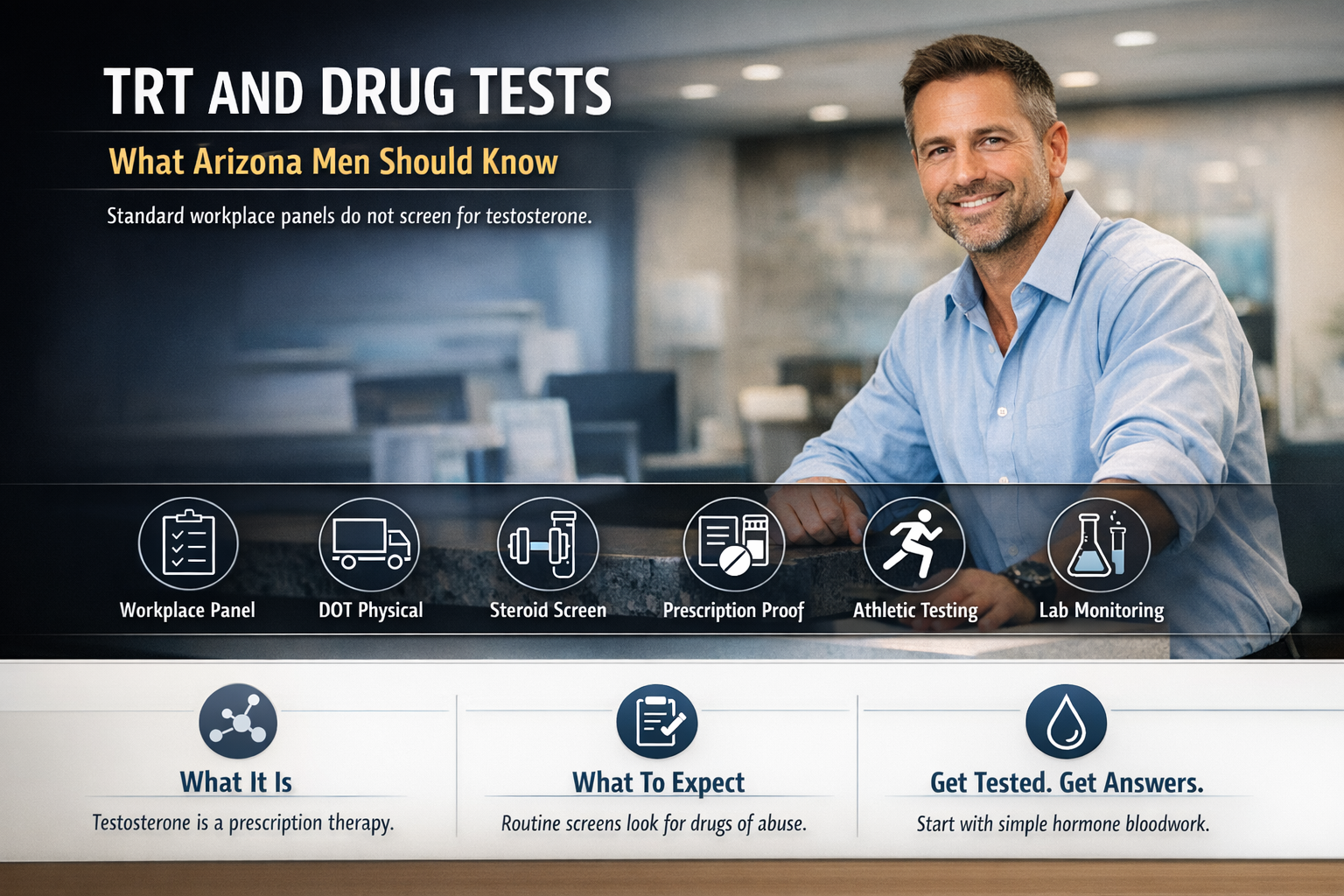
Does TRT Show Up on a Drug Test? An Arizona Men's Guide
If you are considering testosterone replacement therapy in Phoenix, Mesa or Tucson and your job involves a pre-employment screen, a DOT physical or random testing, the question comes up fast: does TRT show up on a drug test? It is one of the most common concerns men raise before starting treatment — and the answer is reassuring, but worth understanding in detail.
Below is a plain-English breakdown of what routine drug tests actually look for, when testosterone can be detected, what your prescription protects, and how Arizona men typically handle disclosure.
What standard drug tests actually screen for
Almost every workplace drug screen in the United States is an immunoassay panel built around federally recognized drugs of abuse. The two most common versions are:
- 5-panel (the DOT standard): marijuana (THC), cocaine, amphetamines, opioids and PCP.
- 10-panel (common for private employers): the above plus benzodiazepines, barbiturates, methadone, propoxyphene and methaqualone.
Notice what is missing from both lists: anabolic steroids. Testosterone is not part of a standard panel, and it is not something a routine lab is even looking for. The chemistry is different, the equipment required is different, and the cost is significantly higher — which is exactly why employers do not include it by default.
When testosterone can be detected
Testosterone is detectable, but only if someone specifically orders a test designed to find it. That generally means one of two scenarios:
1. A dedicated anabolic steroid panel
These use gas or liquid chromatography paired with mass spectrometry (GC-MS or LC-MS) to identify synthetic anabolic agents. They are ordered occasionally by law enforcement agencies, some fire departments, certain professional sports organizations and a small number of safety-sensitive employers — not by the typical Arizona employer.
2. Athletic and anti-doping testing
Sanctioned competition is a different world entirely. Anti-doping labs measure the ratio of testosterone to epitestosterone in urine, and an elevated T/E ratio triggers further confirmatory analysis using carbon isotope ratio mass spectrometry to distinguish testosterone your body made from testosterone you were prescribed. If you compete in a tested sport, TRT is a meaningful consideration — and one we cover in more depth in our guide to TRT for athletes and active men, including how Therapeutic Use Exemptions work.
For the overwhelming majority of men — contractors, nurses, pilots, truck drivers, engineers, sales professionals — neither scenario applies to a routine employment screen.
Wondering if low testosterone is behind how you feel?
Arizona-licensed providers • Arizona-based • Telehealth available
Get Started — Free Assessment →Prescribed TRT is legal — and that matters
Testosterone is a Schedule III controlled substance under the Controlled Substances Act, which means it is legal to possess and use when prescribed by a licensed clinician, and illegal to obtain without one. FDA-approved testosterone cypionate labeling carries the CIII designation for exactly this reason.
Practically speaking, that Schedule III status is your protection. If a specialized panel ever did detect testosterone, the follow-up conversation is with a Medical Review Officer (MRO) — the licensed physician who reviews non-negative results before they reach your employer. You provide your prescription and clinic documentation, the MRO verifies it, and the result is reported as a legitimate medical use rather than a violation. That is the same process that protects men prescribed stimulants for ADHD or opioids after surgery.
This is also one of many reasons to work with a licensed Arizona clinic rather than a gray-market source. Product ordered from overseas or from a fitness-forum seller comes with no prescription, no documentation and no legal standing — we break down the specifics in our article on whether it is legal to buy testosterone online in Arizona.
DOT physicals and Arizona safety-sensitive jobs
Arizona has a large population of commercial drivers, aviation workers and trade professionals who undergo DOT or employer-mandated exams. Two points worth knowing:
- The DOT drug panel does not test for testosterone. It is the federal 5-panel, full stop.
- The DOT physical exam is separate from the drug screen. A certified medical examiner reviews your medications and health history. Disclosing prescribed TRT here is straightforward and, on its own, is not disqualifying. What examiners care about is whether you are medically stable and monitored — which is the whole point of supervised therapy with regular bloodwork.
Men on TRT who fly, drive commercially or work in public safety roles generally find that consistent monitoring — hematocrit, PSA, estradiol and testosterone levels — makes these conversations easier, not harder, because there is a documented clinical record behind the treatment.
How to handle disclosure without overthinking it
A few practical habits used by our Phoenix-area patients:
- Keep documentation accessible. A photo of your prescription label and your clinic's contact information on your phone covers nearly every situation.
- List TRT on medical intake forms. Omitting a prescribed medication creates far more trouble than disclosing it.
- Ask before you assume. If you are unsure whether your employer runs a steroid panel, HR or your occupational health provider can tell you what is on the panel.
- Do not stop therapy before a screen. Abruptly discontinuing testosterone can cause symptoms to return and is medically unnecessary given the above.
Getting evaluated the right way
The confidence to answer questions about your treatment starts with being properly evaluated in the first place. Legitimate care means confirmed lab results before any prescription is written — typically two early-morning total testosterone measurements plus supporting hormones. Our walkthrough of how low testosterone is diagnosed explains the specific labs and thresholds clinicians use, and testosterone replacement therapy is prescribed only after low levels are confirmed alongside symptoms.
For men across the Valley, that process no longer requires taking time off work. Bloodwork is done at a local Phoenix, Scottsdale, Chandler or Tucson lab, and visits happen by video — see how telehealth testosterone therapy works in Arizona, or read our step-by-step guide to getting started with TRT.
Frequently asked questions
Will TRT make me fail a pre-employment drug test?
No. Standard pre-employment panels do not include testosterone or other anabolic steroids, so prescribed TRT will not produce a positive result on a typical 5-panel or 10-panel screen.
Does testosterone show up on a DOT drug test?
No. The DOT drug panel is a federal 5-panel screen covering marijuana, cocaine, amphetamines, opioids and PCP. Testosterone is not included. You should still disclose prescribed TRT during the separate DOT medical examination.
How long does testosterone stay in your system?
It depends on the ester. Testosterone cypionate and enanthate have half-lives of roughly seven to eight days, and specialized anti-doping tests can detect markers of use for weeks to months afterward. This matters only for sanctioned athletic testing, not routine employment screens.
Start with real answers — and real bloodwork
Arizona-licensed providers • Arizona-based • Telehealth available
Get Started — Free Assessment →Sources
