
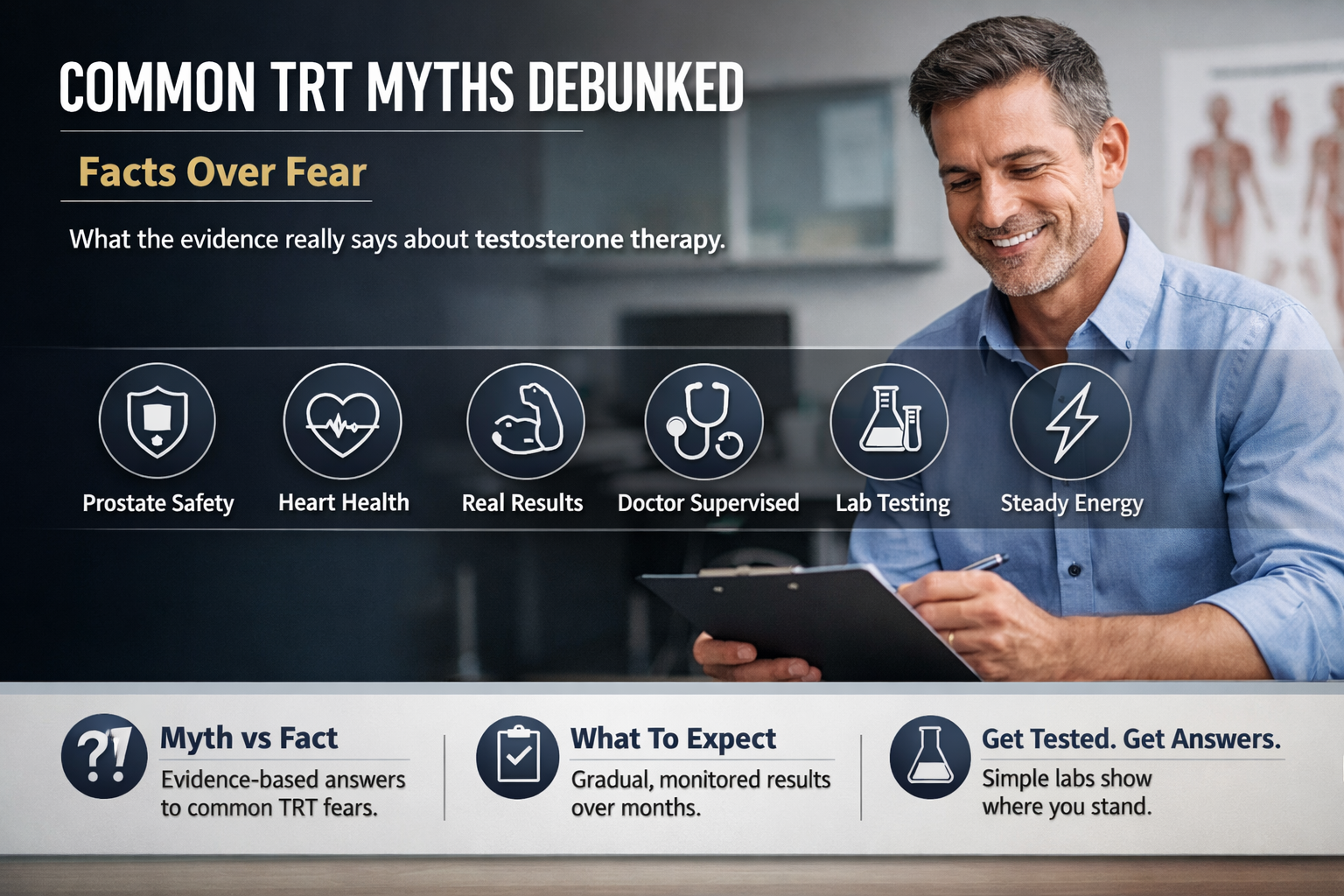
Common TRT Myths Debunked: What Arizona Men Should Know
If you've been researching TRT myths, you've probably run into contradictory claims: it causes cancer, it wrecks your heart, it turns you into a rage monster, or a supplement from the gas station works just as well. For Arizona men weighing testosterone replacement therapy, this noise makes it hard to make a clear-headed decision. This guide walks through the most common TRT myths one by one and compares each against what current medical evidence and urology guidelines actually say.
Why TRT myths persist
Much of the fear around testosterone therapy traces back to older, lower-quality studies, headlines that outran the data, and confusion between medically supervised TRT and illicit steroid abuse. Research has advanced considerably — including large randomized safety trials — but the myths have a long half-life. Let's break down the big ones.
Myth #1: "TRT causes prostate cancer"
This is the most persistent TRT myth, and it dates back to small studies from the 1940s. Modern evidence tells a different story. The American Urological Association's testosterone deficiency guideline advises clinicians to inform patients that current evidence does not support a link between testosterone therapy and the development of prostate cancer in appropriately screened and monitored men.
That said, "no established causal link" is not the same as "ignore your prostate." A responsible clinic checks PSA before treatment and monitors it on a schedule. We cover the screening details in our full guide to TRT and prostate safety, including PSA monitoring.
Myth #2: "TRT will give you a heart attack"
In 2013-2014, a pair of widely criticized studies triggered an FDA warning and years of alarming headlines. The question was finally put to a rigorous test in the TRAVERSE trial — a randomized, placebo-controlled study of roughly 5,200 middle-aged and older men with low testosterone who already had, or were at high risk for, cardiovascular disease. The result: testosterone therapy was not associated with a higher rate of major cardiac events than placebo.
Following TRAVERSE, a European expert panel position statement concluded that testosterone therapy, prescribed to appropriately selected men and monitored regularly, is considered safe from a cardiovascular standpoint. Monitoring still matters — hematocrit and blood pressure should be tracked — and men with recent cardiac events need individualized evaluation. For a deeper look at the data, see our article on testosterone therapy and heart health.
Tired of guessing? Get real answers from real labs.
Doctor-supervised • Arizona-based • Telehealth available
Get Started — Free Assessment →Myth #3: "TRT is the same as steroid abuse"
Anabolic steroid abuse means taking supraphysiologic doses — often many times what the body produces — without medical oversight, frequently stacking multiple compounds. TRT is the opposite: restoring testosterone to a normal physiologic range under a physician's care, with dosing guided by bloodwork.
The "roid rage" trope comes from abuse-level dosing, not replacement therapy. Men on properly dosed TRT typically report steadier mood, not aggression — irritability is actually a common symptom of low testosterone. Side effects at replacement doses do exist, but they're generally manageable with monitoring; our overview of TRT's real risks and side effects walks through each one and how clinics mitigate them.
Myth #4: "Natural testosterone boosters work just as well"
Over-the-counter "T-boosters" are one of the most heavily marketed supplement categories — and one of the least supported. Most contain herbal blends with little or no high-quality human evidence of meaningful testosterone increases, and supplements aren't FDA-reviewed for efficacy before sale. Lifestyle factors like sleep, resistance training, and weight loss genuinely help, but they typically can't correct clinically low levels caused by testicular or pituitary dysfunction. We compared the evidence in detail in our breakdown of natural testosterone boosters vs. TRT.
Myth #5: "TRT works overnight"
On the flip side of the fear-based myths is the hype-based one. TRT is not an instant fix. Libido and mood often improve within 3-6 weeks, energy and body composition changes build over 3-6 months, and full benefits can take a year. Anyone promising a transformation in days is selling something. Here's a realistic TRT results timeline so you know what to expect month by month.
Myth #6: "Low testosterone only affects older men"
Testosterone does decline gradually with age, but low T is not exclusively a retiree's problem. According to the Urology Care Foundation, roughly 2 out of 10 men over age 60 have low testosterone — but the condition also affects younger men, and obesity, diabetes, sleep apnea, and certain medications can drive levels down at any age. Men in their 30s and 40s with real symptoms and confirmed low labs are legitimate candidates for evaluation.
Myth #7: "If you feel fine — or your labs look 'normal' — there's nothing to discuss"
Diagnosis myths cut both ways. Some men self-diagnose from symptoms alone; others get dismissed despite textbook symptoms because a single afternoon blood draw came back borderline. Proper diagnosis requires two early-morning total testosterone measurements on separate days, interpreted alongside symptoms — testosterone peaks in the morning and swings throughout the day, so timing matters. A single random lab, in either direction, is not an answer.
How Arizona men can separate fact from fiction
The antidote to TRT myths is data — your own. In Arizona, that's easier than most states: telehealth TRT is fully legal, and men in Phoenix, Scottsdale, Mesa, Chandler, Tucson, and everywhere in between can complete morning lab draws at a nearby Labcorp or Sonora Quest location, then review results with a licensed provider by video. No waiting rooms, no guesswork — just numbers, symptoms, and a medically sound plan.
- Get real labs: two morning draws, including total and free testosterone.
- Demand supervision: a legitimate clinic monitors PSA, hematocrit, and estradiol on a schedule.
- Ignore the hype: both the fear-based myths and the miracle-cure promises.
Skip the myths. Start with your own numbers.
Doctor-supervised • Arizona-based • Telehealth available
Get Started — Free Assessment →Frequently asked questions
Is TRT safe for long-term use?
For appropriately diagnosed men under medical supervision, current evidence supports the safety of long-term TRT. The large randomized TRAVERSE trial found no increase in major cardiovascular events versus placebo, and guidelines do not link supervised therapy to prostate cancer. Long-term safety depends on ongoing monitoring of PSA, hematocrit, and symptoms — which is why unsupervised use is where problems arise.
Does TRT cause prostate cancer?
No established causal link exists. The American Urological Association advises that evidence does not support a connection between testosterone therapy and prostate cancer development in screened, monitored men. Clinics still check PSA before and during treatment as a standard precaution.
Is TRT just legal steroids?
No. Steroid abuse involves supraphysiologic doses taken without oversight to push levels far above normal. TRT restores testosterone to the normal range a healthy man would naturally produce, with dosing set and adjusted by a physician based on bloodwork and symptoms.
Sources
- Evaluation and Management of Testosterone Deficiency Guideline — American Urological Association
- The TRAVERSE Trial: Cardiovascular Safety of Testosterone Therapy for Older Men — PubMed (NIH)
- Cardiovascular Safety of Testosterone Therapy — Insights from the TRAVERSE Trial and Beyond — PMC (NIH)
- Low Testosterone: Symptoms, Diagnosis & Treatment — Urology Care Foundation
