
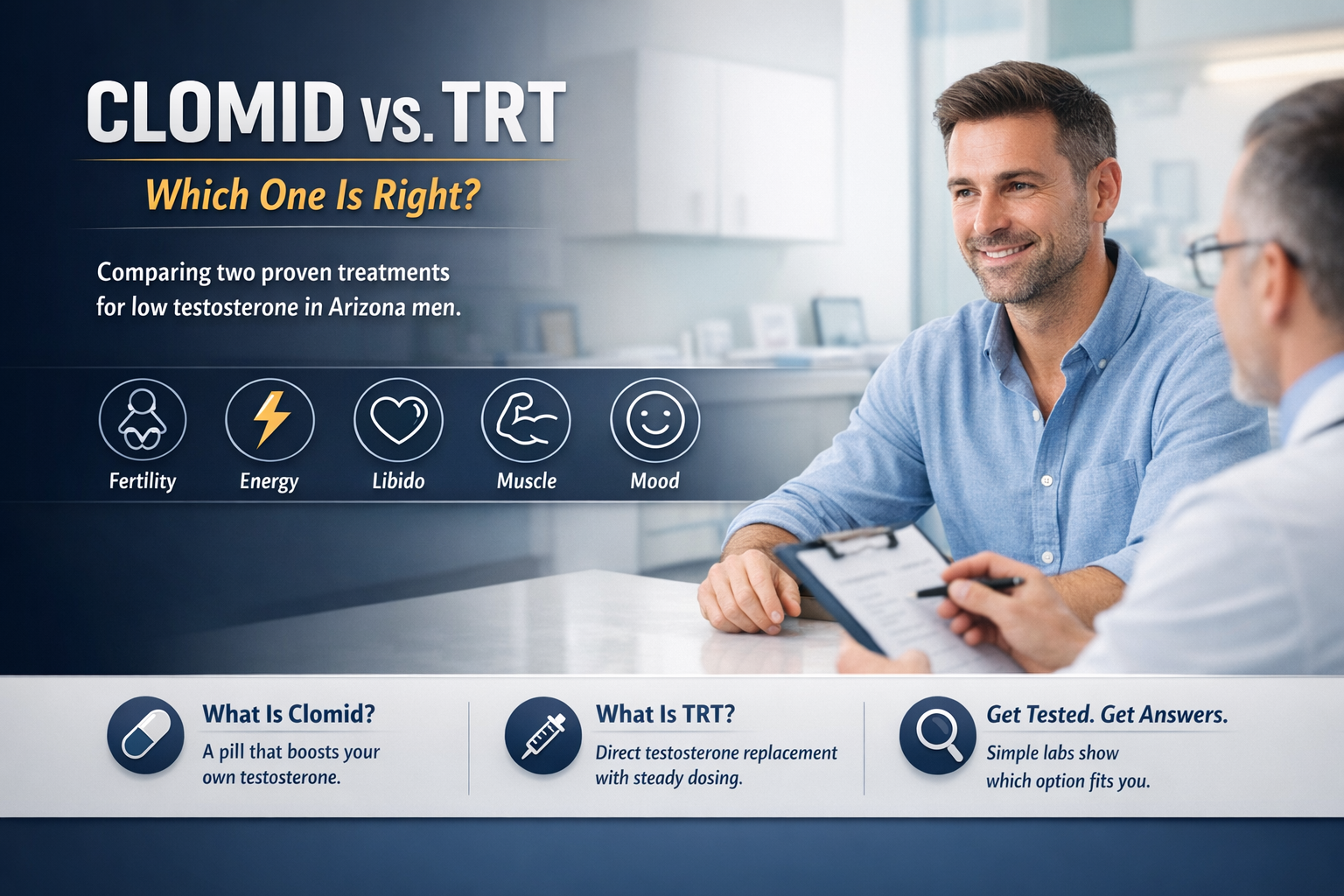
Clomid vs. TRT: Which Is Better for Low Testosterone?
If you're comparing Clomid vs. TRT for low testosterone, you're already asking the right question. Both treatments can raise testosterone levels in Arizona men — but they work in completely different ways, and the better choice depends on your age, your labs, and whether you want to have children. This guide breaks down how each works, what the research shows, and how men in Phoenix, Scottsdale, Mesa, and across Arizona can get evaluated for either option through telehealth.
What is Clomid (clomiphene citrate)?
Clomid is the brand name for clomiphene citrate, an oral medication originally developed for female infertility that has been used off-label for decades to treat low testosterone in men. It belongs to a class of drugs called selective estrogen receptor modulators (SERMs). By blocking estrogen's negative feedback signal at the hypothalamus and pituitary gland, clomiphene stimulates the brain to release more LH and FSH, prompting the testes to produce more testosterone naturally.
Because your testes keep doing the work, they don't shrink or shut down — sperm production continues. Clomid is a mixture of two isomers, enclomiphene and zuclomiphene. If you've heard of the newer, purified version, we've covered how enclomiphene works and how it compares to TRT in a separate guide.
What is TRT?
Testosterone replacement therapy (TRT) supplies testosterone directly — most commonly through weekly injections of testosterone cypionate, though gels and pellets exist. Instead of nudging your body to make more, TRT bypasses the signaling system entirely and delivers a steady, controllable dose. That's why it tends to produce the most reliable symptom improvement: energy, libido, mood, and body composition.
The tradeoff is that your brain senses plenty of testosterone and stops sending LH and FSH signals to the testes. Natural production pauses, and sperm counts fall — often dramatically. This is why fertility planning matters before starting, something we explain in depth in our guide to TRT and fertility.
Clomid vs. TRT: head-to-head
Testosterone levels and symptom relief
Both treatments raise testosterone meaningfully. In an age-matched comparison study, men on clomiphene roughly doubled their testosterone (from about 247 to 504 ng/dL) and reported symptom improvement, though satisfaction scores were somewhat higher among men on injectable testosterone. In practice, TRT generally achieves higher peak levels and more predictable dosing, while Clomid responses vary from man to man depending on how well the pituitary and testes respond.
Fertility
This is the biggest dividing line. The American Urological Association's guideline is direct: clinicians should not prescribe exogenous testosterone to men interested in current or future fertility, and SERMs like clomiphene are an appropriate alternative for those men. Clomid maintains — and often improves — sperm production. TRT suppresses it. Men who need TRT but still want to protect fertility sometimes add other medications; our article on why hCG is used alongside TRT covers that approach.
Convenience and administration
Clomid is a simple oral tablet, typically taken daily or every other day — no needles, no refrigeration. TRT injections are usually done once or twice weekly at home with a small insulin-style syringe. Most men find either routine easy after the first few weeks.
Side effects and monitoring
Clomid is generally well tolerated. In a long-term study, 88% of men on clomiphene for three or more years reached normal testosterone levels while only about 8% reported side effects — most commonly mood changes, visual disturbances (rare but a reason to stop), or headaches. Some men feel less symptom relief than their lab numbers suggest, possibly due to the zuclomiphene isomer's estrogenic activity. TRT's side effects — acne, elevated hematocrit, estrogen fluctuations, testicular shrinkage — are well understood and manageable with proper oversight; see our full breakdown of TRT safety, risks, and side effects. Either way, ongoing bloodwork is non-negotiable.
Cost
Generic clomiphene is inexpensive, though it's often compounded for men's dosing. TRT costs more in medication and supplies but is still affordable at most Arizona men's health clinics. For both, the real cost driver is quality monitoring — labs, follow-ups, and dose adjustments.
Not Sure Which Path Fits You? Start With Labs.
Doctor-supervised • Arizona-based • Telehealth available
Get Started — Free Assessment →Which one is right for you?
There's no universal winner — the right answer comes from your goals and your labs. As a general framework used by hormone clinics in Phoenix and across Arizona:
- Clomid tends to fit younger men (20s–30s), men who want children now or soon, men with secondary hypogonadism (low LH signaling with healthy testes), and men who simply prefer to avoid injections or lifelong replacement.
- TRT tends to fit men who are done having kids or not planning any, men with primary hypogonadism (testes that can't respond to stimulation), men who tried Clomid and didn't feel better despite improved numbers, and men who want the most consistent symptom relief.
One key caveat: Clomid only works if your testes can respond to the increased signaling. That's why a proper diagnosis — total and free testosterone, LH, FSH, estradiol, and related markers — comes first. Our guide to the bloodwork you need before starting TRT walks through exactly what gets tested and why.
How it works in Arizona
For men in Phoenix, Scottsdale, Mesa, Tempe, Chandler, Gilbert, and Tucson, the process is straightforward: a telehealth consultation, a lab order you can complete at a local draw site (Sonora Quest and Labcorp locations are all over the Valley), and a physician review of your results. If your labs and symptoms point to low testosterone, your provider discusses whether Clomid-style stimulation therapy, enclomiphene, or TRT best matches your situation — and monitors your levels either way. AZTRT treats men across the entire state of Arizona via telehealth, so there's no need to sit in a waiting room to get real answers.
Frequently asked questions
Does Clomid raise testosterone as much as TRT?
Usually not quite. Clomid can roughly double testosterone in responsive men, which is enough for many to feel significantly better. TRT typically reaches higher, more predictable levels because the dose is controlled directly. Some men on Clomid see good lab numbers but incomplete symptom relief, in which case switching to TRT is common.
Can you have kids while taking Clomid for low T?
Yes — that's Clomid's biggest advantage. Because it stimulates your own testicular function rather than replacing testosterone, sperm production continues and often improves. TRT, by contrast, suppresses sperm production, which is why guidelines recommend against it for men actively pursuing fatherhood.
Do you need a prescription for Clomid in Arizona?
Yes. Clomiphene is a prescription medication, and its use for male low testosterone is off-label, so it requires bloodwork, a physician evaluation, and ongoing monitoring. Arizona men can complete the entire process — consult, lab order, and prescription — through a licensed telehealth clinic like AZTRT.
The bottom line
Clomid and TRT are both legitimate, evidence-backed treatments for low testosterone — they just solve the problem from opposite directions. Clomid restarts your own production and protects fertility; TRT replaces testosterone outright and delivers the most consistent results. The only way to know which is right for you is a proper hormone panel reviewed by a physician who treats men's hormones every day.
Find Out Where Your Levels Stand — From Anywhere in Arizona
Doctor-supervised • Arizona-based • Telehealth available
Get Started — Free Assessment →Sources
- Evaluation and Management of Testosterone Deficiency: AUA Guideline — American Urological Association
- Testosterone supplementation versus clomiphene citrate for hypogonadism: an age matched comparison of satisfaction and efficacy — PubMed / The Journal of Urology
- Long-Term Safety and Efficacy of Clomiphene Citrate for the Treatment of Hypogonadism — PubMed / The Journal of Urology
- Clomiphene Citrate Treatment as an Alternative Therapeutic Approach for Male Hypogonadism: Mechanisms and Clinical Implications — PMC / NCBI
