
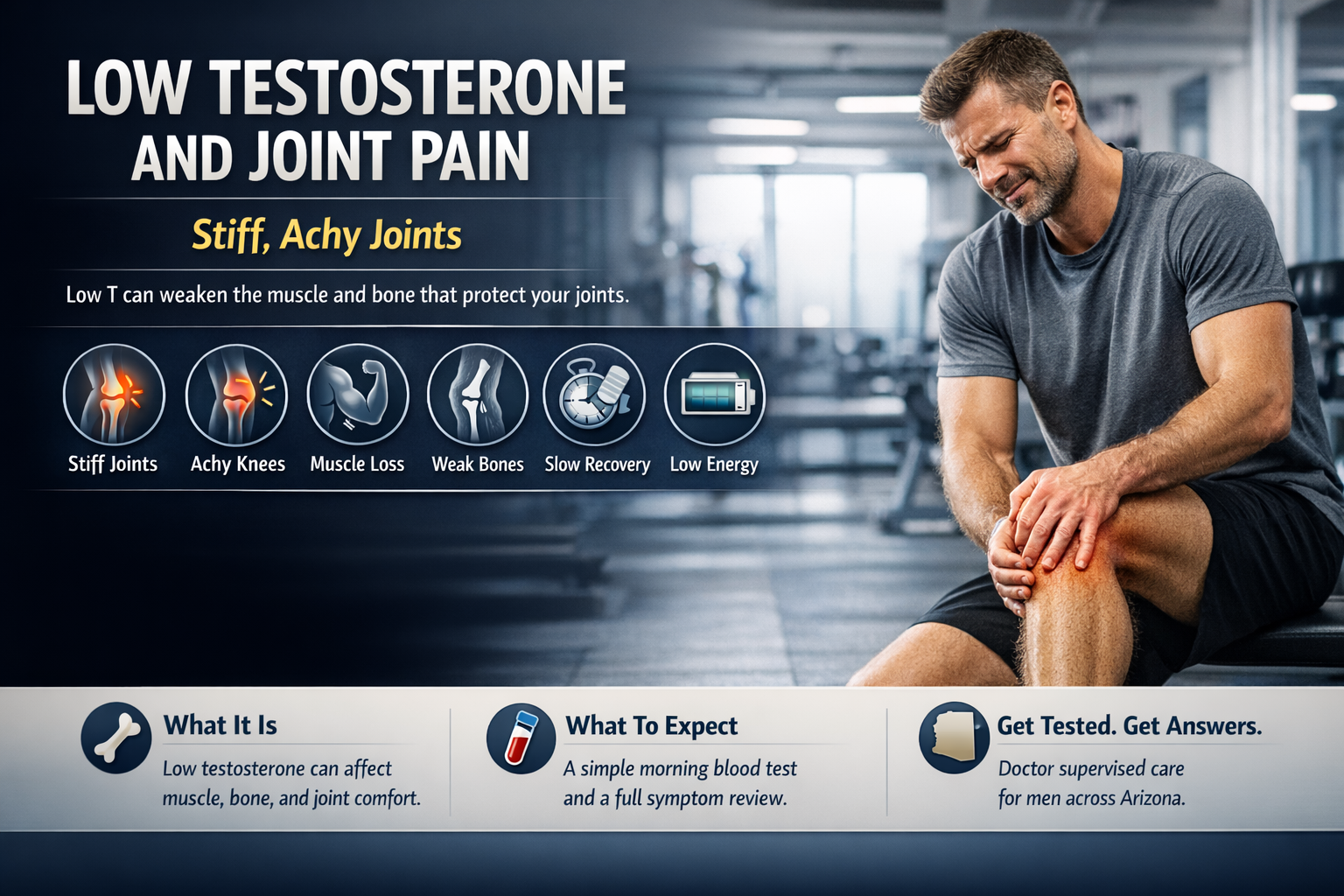
Can Low Testosterone Cause Joint Pain? What Men Should Know
If you're a man in your 30s, 40s, or 50s wondering whether low testosterone can cause joint pain, you're asking a smarter question than most. Achy knees, stiff shoulders, and mornings that start with a five-minute warm-up before you feel human are usually blamed on age, old sports injuries, or "just wear and tear." Sometimes that's exactly what it is. But testosterone plays a real role in the tissues that surround and protect your joints — muscle, bone, and connective tissue — and men across Phoenix, Scottsdale, and Mesa regularly tell us their joint discomfort showed up in the same season as their energy crash.
Here's what the evidence actually supports, what it doesn't, and how to figure out which one you're dealing with.
How testosterone connects to your joints
Your joints don't work in isolation. They're held together and protected by muscle, tendon, ligament, and bone — and testosterone influences most of that supporting cast.
1. Muscle mass is your joint's shock absorber
Strong muscle around a joint absorbs force before that force reaches cartilage. Testosterone is a primary driver of lean muscle maintenance in men, and the Mayo Clinic lists decreased muscle mass as a recognized symptom of male hypogonadism. When quadriceps strength drops, the knee carries a bigger share of every step. When rotator cuff and upper-back muscle thins out, the shoulder joint gets less support overhead. The pain shows up in the joint, but the deficit is in the muscle around it.
This is one reason men often notice the change in the gym first. If you're losing muscle despite working out consistently, that's worth investigating — not just for how you look, but for how your joints hold up.
2. Bone density supports the whole structure
Testosterone is central to male bone health. Research on male hypogonadism and bone shows testosterone deficiency is a well-established contributor to low bone mass and osteoporosis in men — a condition most men assume only affects women. Weaker bone doesn't usually hurt on its own, but it changes how load transfers through a joint and raises fracture risk during the exact activities (lifting, pickleball, hiking Camelback) that Arizona men don't want to give up.
3. Inflammation and recovery speed
Androgens appear to have anti-inflammatory effects in joint tissue, and low-testosterone states are commonly accompanied by higher body fat — itself an inflammatory driver. Practically, that combination often shows up as longer recovery between hard efforts and soreness that lingers a day or two longer than it used to.
4. The autoimmune connection
There's also a documented association with inflammatory joint disease. In a population-based case-control study, lower testosterone levels preceded and predicted a higher risk of future rheumatoid arthritis in men. Association isn't causation, and most men with low T never develop RA — but it reinforces that testosterone and joint health share more biology than people expect.
Stiff joints and no energy? Find out if it's your hormones.
Doctor-supervised • Arizona-based • Telehealth available
Get Started — Free Assessment →Where the evidence gets more complicated
Honest answer: the research on testosterone and osteoarthritis specifically is not one-directional, and any clinic telling you TRT is a treatment for arthritis is overselling. A bidirectional Mendelian randomization analysis actually found higher bioavailable testosterone associated with increased osteoarthritis risk, which cuts against the simple "low T causes bad joints" story. Other observational work points the opposite way.
What that mixed picture means for you is straightforward:
- Low testosterone is a plausible contributor to joint discomfort, mostly through muscle and bone, not a proven direct cause of joint disease.
- Testosterone therapy is prescribed to treat diagnosed testosterone deficiency — not to treat arthritis or joint pain on its own.
- Joint pain always deserves its own evaluation. Low T and a torn meniscus can coexist, and treating one doesn't fix the other.
Symptoms that suggest hormones are part of the story
Joint pain by itself rarely points to low testosterone. Joint pain plus a cluster of other symptoms is a different conversation. Watch for:
- Persistent fatigue that sleep doesn't fix — the kind of chronic fatigue commonly linked with low testosterone
- Strength plateaus or losses despite consistent training
- Increasing midsection body fat
- Low libido or erectile changes
- Irritability, low motivation, or mental fog
- Longer recovery after workouts and more frequent nagging tweaks
If several of those overlap with your achy joints, it's worth reviewing the full list of signs of low testosterone in men before assuming it's just age.
How to find out — the Arizona version
Getting an answer is simpler than most men expect. Testosterone is diagnosed with blood work, not symptoms alone.
- Morning labs, drawn twice. Testosterone peaks in the morning and fluctuates day to day, so a single afternoon reading isn't enough. Standard practice is two separate early-morning draws, typically before 10 a.m.
- A complete panel, not just total T. Total testosterone, free testosterone, SHBG, LH/FSH, estradiol, CBC, and PSA where age-appropriate. This is the same panel that determines whether treatment is appropriate at all — the details are covered in our guide to how low testosterone is diagnosed.
- A real clinical review. Numbers without symptoms — and symptoms without numbers — don't equal a diagnosis. A licensed provider should connect both, and rule out thyroid issues, sleep apnea, vitamin D deficiency, and medication effects that can mimic low T.
Arizona men have it easy here: labs are available through Quest and LabCorp draw sites across Phoenix, Scottsdale, Tempe, Chandler, Gilbert, Mesa, and Tucson, and Arizona telehealth rules allow the consult to happen from your kitchen table. Our step-by-step walkthrough of how to get your testosterone tested in Arizona covers exactly what to expect and what it costs.
What to do about achy joints while you're figuring it out
Whether or not hormones turn out to be involved, these help almost every man with joint discomfort:
- Keep training, but change the loading. Rest rarely fixes joints; smarter load usually does. Swap deep barbell squats for split squats or leg press, overhead press for landmine press.
- Prioritize strength around the painful joint. Building the surrounding musculature is the most reliable non-drug intervention for chronic joint pain.
- Protein and vitamin D. Both underpin muscle and bone maintenance — and vitamin D deficiency is surprisingly common even in sunny Arizona, where most people work indoors and avoid the summer sun.
- Fix sleep. Most daily testosterone production happens during sleep, and poor sleep raises pain sensitivity.
- Get an orthopedic opinion for a specific, single joint. One knee that swells and catches is a structural problem, not a hormonal one.
If testing does show a deficiency and you and your provider decide treatment makes sense, set expectations realistically. Strength and body composition changes typically build over months, not weeks — see what's reasonable in our overview of TRT and muscle growth.
Get real answers from an Arizona men's health provider.
Doctor-supervised • Arizona-based • Telehealth available
Get Started — Free Assessment →Frequently asked questions
Does TRT help with joint pain?
TRT is prescribed to treat diagnosed testosterone deficiency, not joint pain. That said, some men with confirmed low testosterone report less stiffness and better recovery as muscle mass and training capacity improve. It is not a treatment for arthritis, and any clinic promising joint pain relief from testosterone is going beyond the evidence.
Can low testosterone cause stiffness in the morning?
Indirectly, yes. Low testosterone is associated with reduced muscle mass, poorer sleep quality, and higher body fat — all of which contribute to morning stiffness and slower recovery. Morning stiffness lasting more than an hour, however, is a classic sign of inflammatory arthritis and should be evaluated by a physician.
What testosterone level is low enough to explain symptoms?
Most guidelines flag total testosterone below roughly 300 ng/dL on two separate morning draws as low, but symptoms matter as much as the number. Some men feel poorly in the 300s, especially when free testosterone is low or SHBG is high. Diagnosis requires both lab confirmation and a symptom review with a licensed provider.
The bottom line for Arizona men
Low testosterone doesn't erode your cartilage directly, but it can quietly remove the muscle and bone that protect your joints — and that shows up as stiffness, slower recovery, and aches you didn't have five years ago. Joint pain alone isn't a reason to assume low T. Joint pain alongside fatigue, muscle loss, weight gain, and flat drive is a reason to get tested and find out for certain.
AZTRT works with men across Phoenix, Scottsdale, Mesa, Tempe, Chandler, Gilbert, and Tucson through licensed telehealth — real labs, real providers, and an honest answer about whether hormones are actually your problem.
Sources
- Male hypogonadism: Symptoms and causes — Mayo Clinic
- Male Hypogonadism and Osteoporosis: The Effects, Clinical Consequences, and Treatment of Testosterone Deficiency in Bone Health — PMC, National Library of Medicine
- Association between testosterone levels and risk of future rheumatoid arthritis in men: a population-based case-control study — PubMed
- The causal impact of bioavailable testosterone levels on osteoarthritis: a bidirectional Mendelian randomized study — PMC, National Library of Medicine
