
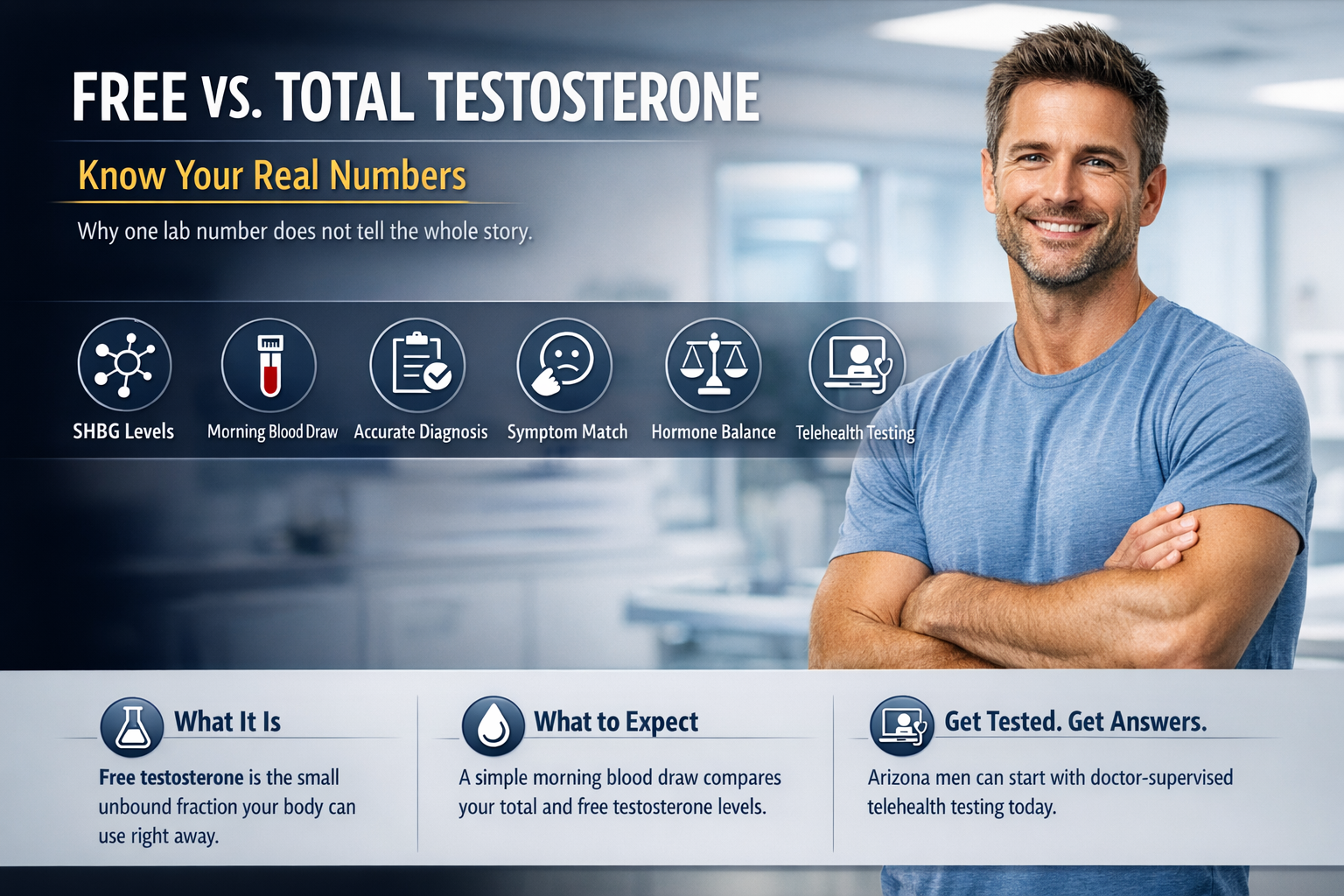
Free vs. Total Testosterone Explained for Arizona Men
If you've had bloodwork done for low testosterone symptoms, you've probably seen two different numbers on the lab report: total testosterone and free testosterone. They sound similar, but they measure different things, and mixing them up can lead to a missed diagnosis or unnecessary worry. For Arizona men trying to make sense of a lab report — whether it came from a Scottsdale urgent care, a Phoenix telehealth visit, or a walk-in Sonora Quest draw — understanding the difference between free and total testosterone is the first step to knowing whether your levels are actually low.
What Is Total Testosterone?
Total testosterone is exactly what it sounds like: the complete amount of testosterone circulating in your bloodstream, measured in nanograms per deciliter (ng/dL). It includes testosterone in three states:
- Bound to SHBG (sex hormone-binding globulin): roughly 40-60% of your testosterone is tightly attached to this protein and is not readily available to tissues.
- Bound to albumin: another large share is loosely attached to albumin, a protein that releases testosterone fairly easily when tissues need it.
- Free (unbound): a small remainder, typically 1-2% of the total, floats freely and is immediately available to bind to receptors in muscle, brain, and other tissue.
Total testosterone is the standard first-line test because it's inexpensive, well-standardized across labs, and correlates with symptoms in most men. It's the number most Arizona TRT clinics use to start the diagnostic conversation.
What Is Free Testosterone?
Free testosterone isolates just the unbound portion — the fraction your body can use on demand. Some labs also report "bioavailable testosterone," which adds back the albumin-bound portion since it releases so easily. Free and bioavailable testosterone are considered better reflections of what your tissues are actually experiencing, especially when SHBG levels are unusually high or low.
The catch: free testosterone assays are less standardized than total testosterone tests, and results can vary meaningfully between labs and testing methods (direct immunoassay versus equilibrium dialysis, for example). That's part of why a full hormone workup, not a single number, is usually needed to confirm a diagnosis.
Why the Difference Matters for Diagnosis
Here's where it gets practical. According to American Urological Association guidance recommending a total testosterone level below 300 ng/dL as a reasonable cut-off for diagnosing low testosterone, most clinicians start with total testosterone, confirmed on two separate early-morning draws, before combining it with a patient's symptoms to make a diagnosis. Testosterone naturally peaks in the morning, which is why AZTRT and most Arizona clinics ask patients to get labs drawn before 10 a.m.
But total testosterone alone can be misleading in specific situations. If your SHBG is abnormally high or low, your total number can look normal (or low) while your actual usable testosterone tells a different story. That's the scenario where free testosterone becomes the tiebreaker.
Not Sure If Your Levels Are Actually Low?
Doctor-supervised • Arizona-based • Telehealth available
Get Started — Free Assessment →When Doctors Order a Free Testosterone Test
Free testosterone testing typically gets added to the picture in a few common situations:
- Obesity. Cleveland Clinic notes that in men with obesity, low total testosterone often reflects lower SHBG rather than a true hormone deficiency, and free testosterone may still be normal — which changes the diagnosis and treatment decision entirely.
- Symptoms that don't match the total number. If a man has clear low-T symptoms but a borderline-normal total testosterone, or normal symptoms with a borderline-low number, free testosterone can clarify the picture.
- Conditions that shift SHBG. Thyroid disorders, liver disease, and certain medications can push SHBG up or down, distorting the total testosterone reading. This is one reason a broader workup — including the age-related patterns covered in how much testosterone decline is actually normal with age — matters more than a single lab value.
- Older age. SHBG tends to rise gradually as men get older, which can make total testosterone look lower than the biologically active testosterone actually is.
Free Testosterone and Ongoing TRT Monitoring
The Endocrine Society's clinical practice guideline emphasizes diagnosing hypogonadism only when symptoms accompany consistently low, confirmed morning testosterone levels — not from a single lab draw taken at the wrong time of day or interpreted in isolation. That same principle carries into treatment: once you start therapy, your provider tracks more than just one number.
Arizona men on TRT typically get testosterone rechecked alongside the other labs that get monitored during treatment — hematocrit, PSA, and estradiol among them — to confirm dosing is landing in a safe, effective window. Your provider compares your results against the target testosterone ranges used for TRT dosing, and free testosterone sometimes plays a role there too, particularly if SHBG shifts once treatment starts.
Getting Tested in Arizona
If you're in Phoenix, Scottsdale, Mesa, or anywhere in the Valley and want to know where you actually stand, testing is straightforward: a simple blood draw, done in the morning, at a local lab like Labcorp or Sonora Quest, or through an at-home draw coordinated by a telehealth clinic. AZTRT builds a full intake and bloodwork panel into the first consultation, so you get both total testosterone and, when clinically appropriate, free testosterone — read together with your symptoms, not in isolation.
The bottom line: a single "low" or "normal" number on a lab report doesn't tell the whole story. Total testosterone is the right starting point, but free testosterone (and the SHBG level behind it) is often what determines whether treatment actually makes sense for you.
Get Your Testosterone Tested the Right Way
Doctor-supervised • Arizona-based • Telehealth available
Get Started — Free Assessment →Frequently asked questions
Is free testosterone or total testosterone more accurate for diagnosing low T?
Neither is automatically "more accurate" — they answer different questions. Total testosterone is the standard first-line screening test and works well for most men. Free testosterone becomes more useful when SHBG is abnormal, such as in obesity, thyroid disease, or older age, because it reflects the testosterone your body can actually use rather than the total amount circulating.
What is considered a low total testosterone level?
Major urology guidelines use a total testosterone level below 300 ng/dL, confirmed on two separate early-morning blood draws, as a reasonable threshold in support of a low testosterone diagnosis. That number is only meaningful when paired with symptoms — labs alone don't make the diagnosis.
Do I need a free testosterone test if my total testosterone is already low?
Not always. If your total testosterone is clearly low and your symptoms match, many providers move straight to treatment planning. Free testosterone testing is most valuable when the total number is borderline, doesn't match your symptoms, or you have a condition known to shift SHBG.
Sources
